Monday, September 03, 2007

Circus of the Spineless Rides Again

If it's the end of another month, then it's time for the circus, Circus of the Spineless, a monthly collection of the best of invertebrate blogging from around the world. The latest edition (the 24th!) is graciously hosted by Demented Pixie of Naturalist Notebook. Check it out!


Next month the circus will appear at The Annotated Budak.

Labels: ,

Who Flipped Rocks?

International Rock-flipping Day (IRFD) really was international. The following is a list of blog posts and links to a couple of image sites (courtesy of via negativa), reporting/revealing what went on, what was found, etc. Note, especially, that Fragments From Floyd took the prize for a photo of a non-human rock flipper. Check out also the small but deadly (?) discovery Pablo made at Roundrock.

The Flickr photo pool continues to grow, along with Bev’s Pbase gallery. Blogger-participants so far include:

Windywillow (Ireland)

Heraclitean Fire (London, England)

Sheep Days (Illinois, USA)

Earth, Wind & Water (somewhere in the Caribbean)

Pocahontas County Fare (West Virginia, USA)

chatoyance (Austin, Texas)

Fragments from Floyd (Virginia, USA) - GRAND PRIZE WINNER

Watermark (Montana, USA)

pohanginapete (Aotearoa/New Zealand)

Fate, Felicity, or Fluke (Oregon, USA)

Thomasburg Walks (Ontario, Canada)

Idle Thoughts of an Idle Woman (Queensland, Australia)

The Transplantable Rose (Austin, Texas)

Nature Woman (New York State, USA)

Marja-Leena Rathje (British Columbia, Canada)

A Blog Around the Clock (North Carolina, USA)

Busy Dingbat’s Sphere (West Virginia, USA)

Hoarded Ordinaries (New Hampshire, USA)

Congo Days (Kinshasa, Congo)

this too (London, England)

Roundrock Journal (Missouri, USA)

Wanderin’ Weeta (British Columbia, Canada)

Blaugustine (London, England)

A Honey of an Anklet (Virginia, USA)

Looking Up (Ohio, USA)

Ontario Wanderer (Ontario, Canada)

Bug Safari (California, USA)

Riverside Rambles (Missouri, USA)

Pure Florida (Florida, USA)

Burning Silo (Ontario, Canada)

More links, added Tuesday, September 4:

Musings from Myopia (Texas, USA)

Cicero Sings (British Columbia, Canada)

Joan (Missouri, USA)

Nature Remains (Kentucky, USA)

prairie point (north Texas)

Still more, September, 5:

Cephalopodcast.com (Florida, USA) - VIDEO

Walking Prescott (Prescott, Arizona)

Dave at via negativa will be continuing to update the list on this post as new reports come in--so check in there. Also see his first IRFD post here.

Labels:

Sunday, September 02, 2007

International Rock-flipping Day

The day started well. I was out in the yard looking for the noisy Blue Jay family I could hear in the elms when I saw some other birds flitting to and fro--turned out to be a couple of Scarlet Tanagers in winter plumage, or young of the year or both. Not entirely unknown in the yard during the migration, but always a pleasure to see them. I moved down the lawn watching them and listening to a Pileated Woodpecker who had started to call. Then the Woodpecker flew by me heading east, followed almost immediately by a rabbit running in the other direction. Meantime a couple of warblers (of the confusing fall variety) turned up in the Maple by the house, and then I remembered: Today is International Rock-flipping Day!

So after breakfast I headed out across the scrape, intending to go into the cedar bush and the sometime swamp in its midst. I haven't been there for a while because of mosquitoes, but the morning was cool and its getting late in the season. Once I got to the scrape, considering rocks all along the way, I saw a small raptor in the top a dead tree and was distracted. It flew off as I moved towards it, so I didn't get a good look, but I suspect it was a Sharp-shinned Hawk, given the few features I could make out, and the time of year and location. But back to the rocks. Near the edge of the cedar bush I saw a rather attractive rock--might be a good first candidate. I took this picture of it, as they do on CSI, document the scene before disturbing it. Then, as I bent down to move it, I noticed that it was not alone. On a very small milkweed plant leaning over the right-hand side of the rock there was quite a substantial Monarch caterpillar munching away. So, another photo, and then I moved on: on to the cedar bush.

We had a very dry June here, a nice rainy July and then an exceedingly dry August. The wetland in the midst of the cedar bush was not merely dry, but incredibly overgrown. Elderberries, Clematis, Joe Pye Weed, Jewelweed, Goldenrod, and lots I couldn't identify were tall and densely massed. The landmarks of winter and spring were gone, and I was lost in a few metres. I had pictured finding some rocks that I know are there, that have water running over them in the spring, and would still have dampness underneath them now, but I couldn't even being to look for them. The margins of the spring stream were completely covered up. So I moved into the cedar bush to look for a prospect there. And found this can--in front of a rock, which as you can probably tell was a little too big for flipping without a backhoe. I looked under the can, but found nothing.

Meantime I myself had been found: A couple of chickadees had turned up to give me hell for being back there. I watched them for a while, even pished back, then just as they were getting bored with me a small flock of warblers came on the scene. Some of the "confusing" variety, a pair of American Redstarts, and what I am pretty sure was a Blue-winged Warbler. This last one is always of interest to me, even as a migrant, because of the role it plays as parent to the hybrid Brewster's Warbler, of which I've written often (here, for example, or here). So I spent some very pleasant moments peering up into the cedars, trying to see the warblers before they too moved off. Then I decided to take my quest to the Far Field (that is, the young forest on the western side of my regular walk).

Now this was an interesting rock. It was in the sun and the area around it was relatively dry, but this rock was wet. I could tell that it had been in this spot for sometime when I looked underneath it, but I couldn't help thinking that someone or something had just turned this rock over and left it in place upside down....Who? Why? Underneath it there was a very large cricket that fled immediately and a colony of very shiny, small black ants, including one winged one. Ants are the invertebrates found most often under the rocks around here. I know a little something now about moths and butterflies, I know some of the spider families and a few species, I even know a few true bugs, and other insects, but of ants all I know is that there are many, many species represented around here and I don't know the names of any of them. Under any rock I might see a species I've never seen before, as was the case here, I believe. Still, it was good to finally find a happening rock.


I continued down the Far Field, noticing the beautiful purple asters of fall, and yes, peering into them for flower crab spiders. Of course I found one, not Misumena vatia, but a crab spider nonetheless. You can see it just going over the edge, being camera shy.

At the north end of the Far Field, in a small area that has been bulldozed some, there is a rockpile around the base of a small tree. This is where another year a very vocal groundhog screamed at me without ever showing itself. Nobody took any notice of me today as I peered into the pile and moved a rock or two. I knew that there could be something interesting in there anyway, snake perhaps. But I didn't want to take the pile apart, and then be stuck with trying to figure out how to put it back together again, so I photographed it and left it, capturing one of the more interesting of the yellow butterflies that were so numerous this morning; there were maybe three quite similar species flitting around, too quickly to get a fix on.

Okay, I looked at birds, I looked at butterflies, I looked at flower spiders, but I flipped a couple of things, and better I found that thinking about rocks broadened my attention to include more of the features of the land. In short, it was a good time. Thanks to Dave for proposing it. And watch here for a list of links to the other participants in the event we call International Rock-flipping day!

Labels: , , ,

Tuesday, August 28, 2007

Flip Some Rocks on September 2

Dave of Via Negativa has called for September 2 to be designated International Rock-flipping Day:
a day for everybody to go outside — go as far as you have to — and flip over a rock (or two, or three). We could bring our cameras and take photos, film, sketch, paint, or write descriptions of whatever we find. It could be fun for the whole family!
I've spent so much time this year looking into flowers for spiders, looking at butterflies, looking into foliage for caterpillars and yet I haven't looked under a rock even once. So I'll be there, September 2, looking under some rocks. And apparently there is even a prize being offered:
The grand prize goes to anyone who can get a picture of a non-human critter, such as a bear or a raccoon, flipping a rock on September 2. (I don’t know what the grand prize will be yet, but trust me, it’ll be good.)
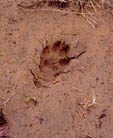
Bear-flipped rock

I found this flipped rock last year, so it won't qualify. Oh yeah, and the bear had already gone when I snapped the picture. But I'll be on the lookout.

To find out more about International Rock-flipping day click here. Or read Bev's post at Burning Silo, here.

Labels:

Monday, August 27, 2007

Giant Swallowtail in Thomasburg

I first saw this butterfly on a couple of occasions a couple of weeks ago--"what a big swallowtail that is," I thought to myself, "Not a tiger swallowtail either, and look at that strange yellow body..." Surely such a big swallowtail must be a Giant Swallowtail. But the Giant is a southern species, not known, I thought, in Canada, beyond the Carolinian region. I didn't get a photo then, but I checked the guides, and wrote to the Eastern Ontario Nature List. The Giant in the guides looked like my butterfly I thought, but I wanted to see it again to be sure. And the response I got from the List was that there were records for Prince Edward County (well, sure, that's pretty Carolinian in its way), and for Belleville (Belleville is a mere 25 km south of Thomasburg, and aside from being on the shores of Lake Ontario, not terribly different zone wise). Another post to the list this morning reported many sightings of Giant Swallowtails this past weekend on the south shore of Prince Edward County.
Finally, today, another giant swallowtail, again at mid-day, again on my mother's beautiful buddleia (beloved of butterflies). And this big butterfly was indeed the Giant Swallowtail (Papilio cresphontes)

Papilio cresphontes on Buddleia

Food plants for the larvae of this butterfly include Common Hoptree (Ptelea trifoliata) and Prickly Ash (Xanthoxylum americanum). We have a couple of specimen plantings of Common Hoptree (aka Wafer Ash), a species at risk in the small range of Ontario where it occurs naturally (here's a range map). We are growing it outside of its range here--but so far, so good. In more southern regions the Giant Swallowtail larva feeds on citrus, and is known as the Orange Dog, not well-loved by citrus growers. The leaves of the hoptree are said to have a citrusy smell when crushed. (I'll have to go check when I'm done here.) The Prickly Ash is very "citrusy" in a number of ways. They both come by it honestly, being members of the Rue family (Rutaceae) along with oranges and lemons etc.

Fruit of the Prickly Ash

Labels: , , , , , ,

Friday, August 24, 2007

Friday Hornworm

I found this on a baseball cap that was lying on the floor on the porch. On disturbance it started motoring along the concrete floor towards the wall of the house. That didn't seem good, so I encouraged it to climb onto a maple leaf also lying there and moved it into the garden. Then I went into the house to try to find out what it was--it was gone when I returned.

Hemaris diffinis
Pretty caterpillar, on a leaf not of its own choosing

I knew on sight that it was a hornworm, but what kind? I consulted BugGuide.net, of course, and scanned through the hornworms there. Turns out, it is most likely a Snowberry Clearwing (Hemaris diffinis) larva, not entirely of the brown form, nor of the regular green (see this page showing different colour phases of this caterpillar). It has the yellow at the base of the horn, and around the "neck," and the black dots that seem to define this species. Interesting because I've never been sure whether I've seen diffinis, or whether all the clearwings I've seen have been the very similar Hemaris thysbe. And now I have good reason to believe that the Snowberry does come around here.


Join us on the Friday Ark!

Labels: , , ,

Thursday, August 23, 2007

A Birder's Blog Meme

This week John (of New Jersey) of A DC Birding Blog tagged me with a birder's meme (originated by Cogresha of Earth House Hold, a new blog to me, and worth checking out). The form is simple, just seven easy birder questions:

1. What is the coolest bird you have seen from your home?

This is the question that grabbed me. Not so easy when I started to think about it. The coolest bird. When I'd been in Thomasburg for just a short while, before I'd gotten involved in the Ontario Breeding Bird Atlas Project, and got serious about the birds, I was sitting on the front porch when an Indigo Bunting flew in to perch briefly on a house plant on the porch with me, not much more than a metre away. I'd never seen such a stunning bird at such close range. The sun was hitting it just right--the blue of it was amazing. The coolest?

During the Great Gray Owl irruption of 2005 I got to see crows roust one of these magnificent birds out of a dead tree at the back of the yard. Not a great look at the bird (I did get a good look that winter, described here) but what a sight to see that impossibly tall owl lift off and fly away. Pretty darn cool.

But what about the Northern Shrike that came and landed in the snowball bush at the front of the house one winter afternoon--to the great consternation of the feeder birds? The Northern Harrier that perched in a dead tree at the back and let me walk up to within about 20 feet? The annual late-summer flyover of the Nighthawks?

Then there was the visit by a flock of Pine Grosbeaks, never before seen here by me, never before seen so far south by me. Very cool.

But no, the very coolest bird is none of these. It's the Red-eyed Vireo (Vireo olivaceus). Vireos of all kinds pass through here regularly in the spring, and the fall often brings one or two to the yard, but this year was different. I noticed in the spring that I was hearing a Red-eyed sing rather more than I was used to, day after day, on and on. And call too, that strange scree. (There were days that I thought I'd go mad.) Gradually I realized that there was a nesting pair here. And then I noticed that there was another pair--two nesting pairs where I'd never seen even one before. The Red-eyed vireo is a very common denizen of mixed and deciduous forests (in this range), but what was it doing here, in this yard?

I've been here ten years now, and in that time the trees in the yard, some mature when I came, some just babies, and the shrubs, have all grown, until finally this year I realized, with the help of the vireos, it is quite a different place. It's a forest now. Sure, there are a couple of fields around that are mowed, but the yard, and the hamlet itself is much more forest than not compared to what it was when I first saw it. And the far field? I'll have to start capitalizing that: Far Field, a place name, no longer a description of that place that used to be a field with a partial cover of a planting of young conifers. Now its a young forest, as willows and poplars (for the most part) have filled in between the conifers, and grown into real trees. This year I finally noticed that when I stand in the spot now where I stood six years ago at the north end of the far field and watched a bear bound into the cedar bush at the south end, all I see is green, a screen of trees, no distant vista at all.

So, gradually this place has been turning into a very different kind of place, and the Red-eyed Vireo made me see it. What could be cooler than that?

2. If you compose lists of bird species seen, what is your favorite list and why?

The only real listing I've done is data collection for the Breeding Atlas and Christmas Bird Counts. Of those the Breeding Atlas is my favourite, because it was an accumulation of breeding evidence over five years, a growing picture of the area. I do wish I kept a yard list though--I just can't seem to make myself really do it.

3. What sparked your interest in birds?

My first interest in the natural world, one of my earliest interests, was fostered by my mother and my paternal grandfather, laying the groundwork for a life-long study. The attention it's received has waxed and waned depending on where I was living, and what I else I was doing. Why birds? Birds are the vertebrates that are most accessible, which is why I enjoy them so much. Unlike mammals, most of them they live much of their lives in daylight, right out where you can watch. The Breeding Atlas experience gave me the structure I needed to take my knowledge of the birds to a whole new level.

4. If you could only bird in one place for the rest of your life where would it be and why?

It would be right here. There is so much more to learn. And now that I have a heightened sense of habitat change, thanks to the vireo, even more than I used to appreciate. I like birding places I know well. I like birding the breeding season, the season when one can return to a good spot and be reasonably assured that one will learn something more about birds already noted. I like birding successive seasons in the same spot, so I can ask myself questions such as, "Why no Kingbirds nesting here this year?" And come up with an answer: "Because it's not a field anymore."

5. Do you have a jinx bird? What is it and why is it jinxed?

The Snowy Owl jumps to mind, but really if I were willing to go to it (i.e., travel roughly 75 km to the known good spot some winter day), I'd probably have seen one by now. I want one to come to me. (See answer to question 4) If I'd been asked before this summer I might have said the Ovenbird, so often heard, and yet never seen, by me. But this season one popped up very kindly and let me have a good look. I guess I'll have to get a new one.

6. Who is your favorite birder? and why?

Not sure how to answer this. Like John I usually go out alone, but I have enjoyed the people I went out with on all the Christmas Bird Counts I've done. And I was helped a great deal by some very experienced birders I met through the Breeding Atlas, particularly John Blaney, with whom I spent a very productive morning in Vanderwater Conservation Area a few years ago. Then there's Terry Sprague; I haven't been out with him, but have gotten lots of help from him over the years in narrowing down identifications, etc.

7. Do you tell non-birders you are a birder? What do they say to you when they find out?

I don't know that I've said to anyone that I am a birder. But lots of people know, one way and another, at least that I watch the birds. When it comes up, they either say little or nothing, "Oh, yes?" Or they ask me about a bird they've seen.


Thanks, John (and Cogresha). Good questions--got me to try to articulate some of the things I've been thinking about lately. So now to tag: Crafty Gardener, Duncan, and Granny J. I really want to know what the coolest bird you've ever seen from home is, and why.

Earth House Hold is keeping a list of links to everyone who catches this meme.

But also, be sure to check out the 56th Edition of I and the Bird, over at Big Spring Birds for more birder talk, bird stories, and to get ready for summer's end.

I and the Bird

Labels: , , ,