Monday, July 04, 2005

And Changed Again

After a two-day reprieve we're are back into the heat, humidity and smog again in all of southern Ontario. They say the smog will lift tomorrow by mid-day, but I can feel a breeze from the south through my window as I write, and until that changes the smog will keep pouring in.

So between the weather conditions and the mosquitoes I know are out there, I'm taking the day off from the walk. But there's lots going on here in the yard today. And the house wrens are dominating the scene. House wrens, as the name suggests, like to nest in bird houses when they can get them (i.e., they are cavity nesters, and the houses we put up for bluebirds are a favourite of theirs). In the first round of nesting house wrens occupied the nest box on the elm tree by the road, and a family of chickadees took the house on the stump. Normally we have tree swallows and bluebirds in the boxes, but this year we got them up too late. The swallows and bluebirds scout nesting locations a few weeks (at least) before they're ready to nest, and when they scouted the yard there was nothing that suited them.
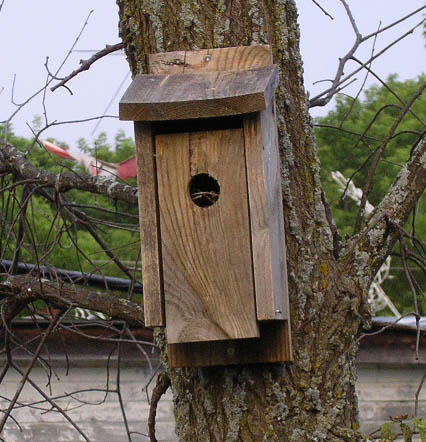

You can see twigs poking out of the box--the classic sign of the house wren.

The wrens come a little later, and the chickadees are here all the time and ready to move in. We've had chickadees use a bird house here before, but they are so quiet when they nest (and so noisy the rest of the time) that we scarcely noticed. The house on the stump though is pretty central.
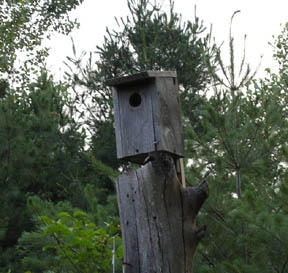

House on the stump.

The chickadees fledged a couple of weeks ago, made a great ruckus all around the yard, and then were off. The wrens fledged this past week from the box on the elm--and from another nest or two whose location I don't know. But there are many wrens in the yard right now--yelling at anything they don't like the look of, and in the last few days there have been two males singing lustily. It looks as if there will be wrens on their second nests in both boxes.

Other fledglings in the yard today: robins and purple finches. The young crows are still yelling their heads off across the street, but they're also moving around more--almost ready to fly with the big guys.

The catbird has started up singing again--it has a song like the thrasher, but each phrase is only used once in the sequence. (I realized that an earlier posting about the song of the thrasher was not entirely clear--what I meant to say is that the thrasher can be distinguished from the catbird because it sings each phrase of its song twice, not once.)

And the poppies are starting to bloom.
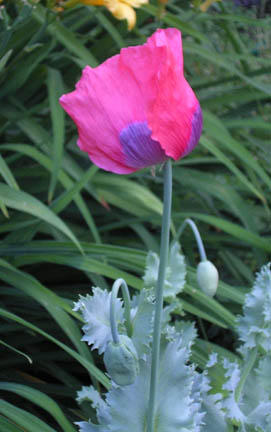

Papaver somniferum, the opium poppy, was made illegal in Canada just a few years ago. Strangely enough, this occurred in the context of some legislation to liberalize the laws with respect to marijuana. Somniferum is a self-seeding annual in many gardens in Canada, including this one. But our climate is unsuitable for the production of quality opium.

Saturday, July 02, 2005

A Change of Weather

The heat wave finally broke last night--temperature dropped to below 14C. This morning the sun is shining, the breeze is blowing and the walking is easy.


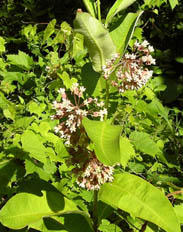
I've seen two monarch butterflies in the past few days, first of the season. Last year the number we saw here was way down, and according to my sources, all of eastern Ontario was the same. The milkweed is plentiful and just coming into bloom. Here's hoping that we see a few more butterflies this year.

I got out on my walk at about 7:30 this morning. Things were pretty quiet--mainly sparrows singing, and the wood thrush, no warblers. The brown thrasher spent some time follwing me, but I didn't see the fledglings this time. I did however see the Brewster's warbler lurking in the shrubbery, and taking careful note of me. I have yet to see a bird that might be a suitable mate for it--i.e., a female of either of the parent species or a female hybrid (the latter of which I'm not sure I'd recognize). But the lurking does make me suspect that he's nt just singing, but nesting too.

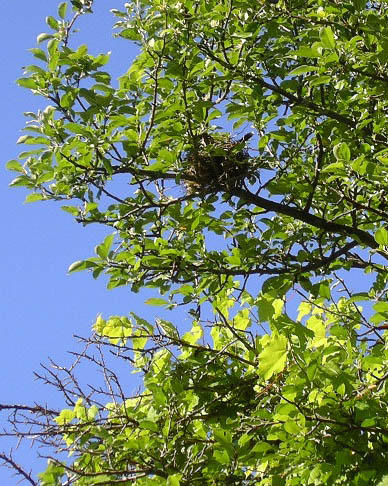
The pair of kingbirds on the other hand are definitely nesting in the old apple tree. The nest is still there, and one bird is firmly sitting on it--so still eggs, not nestlings. The other bird is hanging around--guarding vociferously against crows, but just watching me closely, without comment.


In the centre of the upper half of the image you can see the nest, and on the right hand side the white band on the end of the kingbird's tail.

Thursday, June 30, 2005

Fledgling Agitation

Out on the walk last night I met up with a brown thrasher near the far edge of the first field. I could hear the hard "chucks" of this bird long before I saw it, coming from the pine plantation (which is also filled with very noisy chipping sparrows right now). I was in there trying to find out more about the common yellowthroat that I am pretty sure is nesting just on the edge between the field and the swamp. I found the bird, confirming my suspicion, but was unable to really see anything in the mass of willow shrubs and high grasses growing there. Meantime I kept hearing the "chuck" of the thrasher.

The brown thrasher is a fairly large bird, with a long tail, and striking plumage, more rust than brown, whose song is a collection of borrowed sounds like that of the catbird and the northern mocking bird. The thrasher's song is recognizable because of its habit of repeating each phrase once. It sings loud and long in the spring, but goes pretty quiet when its nesting. And because it moves in the shrubbery of the fence lines, it is pretty inconspicuous most of the time, in spite of its size and colour.

The mosquitoes were incredible by the willow shrubs, I was wiping as many as twenty off my arm every few seconds, so after what seemed like a valiant effort to find out more about the common yellowthroat I moved on. As I got to the entrance to the far field that runs through another willow copse I notice that the thrasher was once again with me. Still chucking, but alternating the chucks with a soft short mew. I stood around for a while watching it as the mosquitoes built up on me once again, then started to move on. The bird continued to follow, continued to yell, all the way across the far field to the western edge. Finally I saw two other thrashers, confirming what I'd suspected, that there must be fledglings out. In fact many birds' fledglings are out now, all over, all over the field and the yard, and the din is terrific.

Wednesday, June 29, 2005

Little Brown Birds--Part 2

After I posted Little Brown Birds I had a tickling feeling that there was a bird I was forgetting. Then it came to me: the clay-colored sparrow (US spellings are the convention for bird species names). This is another bird that I should be able to find here--not as common as the field sparrow, chipping sparrow or song sparrow (or the savannah sparrow--also very common, but since we have no savannah I always forget to include it).

The clay-colored sparrow only showed up in nine percent of the squares in my region (Region 21--Kingston) in the last Ontario Breeding Bird Atlas, but this time, as of the end of last year's data collection, 37 percent of the squares found evidence of these birds breeding. In my first post on sparrows I make offhand reference to sparrows not mentioned as "a few rarities," and leave the matter there. But 37 percent is not rare beyond the realm of likely--and worse, another atlasser working in my square last year found a pair of clay-colored sparrows here. So it is up to me, in this final year of data collection, to upgrade the breeding evidence if I can--and that means being able to identify the bird.

The clay-colored sparrow's song is unlike that of the other sparrows in this group. It consists entirely of buzzes at a single pitch, repeated several times, rather slowly. I've heard this once or twice, only once knowing what it was, but I've never knowingly seen one of these guys. Click here to see a couple of good pictures of this bird. The page will open in a new window and loads slowly (for those of us on dial-up), but is worth the wait. Or go to the Wildspace page for a sample of the song and more information.

The picture at the Cornell site linked above make this look like a very distinctive bird--but unless the light is just right, this is the quintessential little brown bird. So here are the things I'll be trying to keep in mind. Clear breast (described as grey, but that won't actually help much, nor will the grey nape of the neck that shows so clearly in the photo), which distinguish it from the song, savannah and vesper sparrows. That leaves the chipping, field and grasshopper sparrows. Chipping sparrow is easy, in the breeding season it has a bright rusty cap and a well-defined eyebrow. The field sparrow is just so terribly plain, rusty cap and complete eye ring, but these are usually barely noticeable in the field. But then there's the grasshopper sparrow. The difference between these is mainly in the markings on the head, something I always find difficult to take in--i.e., median stripe (down the middle of the head), is it white, buff, grey? Is it very distinct?

Now that I know the bird's song, I'm hoping that they sing on into July, as many but not all birds do. And I'll keep my ears open.

So, to recap, the little brown birds in Thomasburg are the chipping sparrow, song sparrow, field sparrow, savannah sparrow, grasshopper sparrow, vesper sparrow, and the clay-colored sparrow. This excludes the swamp sparrow, also around here, but not a field and hamlet bird, and the Henslow's sparrow, an actual rare bird. Seven little brown birds--how hard could it be?

Tuesday, June 28, 2005

Back on the Walk

I'm back in Thomasburg now, and this morning I was back on the walk. It is a truly terrible day today, hot, humid and smoggy, but I was out early enough to still enjoy myself. Two weeks away and some rain has made a big difference. Grass, shrubs, weeds and grapevine have all grown spectacularly, greening the place right up, but also providing much denser cover for the birds. So I heard more than I saw.

The first thing I noticed being back home was how different it sounds here. I wrote in other postings about the birds around the place I was staying in the County, but I didn't mention that birds I was missing. In the yard here the house wren sings loudly and often. There is almost always a song sparrow singing, and a gold finch or two as well. I can also almost always here a common yellowthroat singing across the street. I heard all of these in the County, but just rarely. The bird I didn't here while I was there that nests just about every half acre around here is the field sparrow. As I noted in my recent post about sparrows, the field sparrow is a very plain little sparrow, but it has a very distinctive song. The field sparrows around here sing all morning and all late afternoon.

Out on the walk this morning I was pleased to see and hear many of the birds I've been following this season. The Brewster's warbler is still out there, beyond the edge of the far field, still singing. The chestnut-sided, common yellowthroat, black and white, and American redstart are all still singing too. The vesper sparrows who were nesting just by my warbler lookout rock seem to have finished up and moved on. But the kingbirds nesting in the old apple tree are still there, though nestlings if hatched aren't big enough to be heard from the ground yet. I took pictures of these locations and more, and even one of the Brewster's warbler (a shot that won't actually show anything--the bird was too far away for the equipment I use), but I seem to have left my USB cable behind, so no downloading images until I can retrieve it.

Of course I was also looking for the orchard orioles--I saw a female Baltimore oriole, and another that flew by too quickly to be identified. I learned a lot about orioles while I was in the County. There was a nesting pair of orchards orioles in the yard there, with noisy nestlings that they were working hard to feed. And there were Baltimore orioles nesting just below and down at the water. Orioles sing some after they start nesting, but otherwise they are very quiet nesters for the most part. They nest very high, and slid in and out of the foliage smoothly and quickly. I got lots of practice watching for them while I was away, which will help, but I'm not terribly hopeful that I will find the orchards again here, even if they are nesting at the edge of the field in the poplars (I have a picture of where I think there might be orioles nesting, of one kind or the other, but it will probably take a pretty long vigil to see them, if indeed they're there--which will have to wait until the weather improves).

Friday, June 24, 2005

A Pair of Loons


Every day since I've been in the County I've seen this pair of loons on the bay. No chicks in evidence and I don't know if there's a nest, but yesterday I did see a racoon with three young ones working the beach, so this may not be an ideal place to nest.


Not a great picture, I'm still learning the limitations of "digital zoom." And it's also a little hard to read because this raccoon has no tail, and her back end is facing the camera. Her three babies though are perfectly tailed--what you could see here, if the image were better, is the raccoon looking off in the direction in the shrubbery where the babies were playing when I took the shot.

Thursday, June 23, 2005

Cormorant Cull?

My second day here in the county I walked all the way down the lane to the beach to check things out. It was about 8:00 a.m., and the first thing I learned is that the turkey vulture is not an early riser. It was clear from the state of things turkey vultures had been roosting on the roof of the little pavilion by the water for quite some time. The ground around it was a litter of giant feathers, awash in guano, and dotted here and there with what looked like regurgitated this and that. There were two vultures on the roof as I arrived, and a third was in one of the dead trees, apparently having lifted off at the sound of my approach. The two left on the roof slowly, reluctantly, perhaps sleepily, took themselves off to another dead tree where they perched for quite a while, until my presence became too much of a bother.


After surveying the effects of their residence, described above, I walked to the water and along the beach for a bit. I came upon a stretch of about 3 or 4 metres littered with the, mostly skeletal, remains of at least five double-crested cormorants. Most of the bones were picked completely clean, although they didn’t look as if they’d been lying there all that long. There were a few wings, or pieces of wings that were relatively untouched, and one complete head. Now with the vultures in residence a few metres away it’s no mystery that there would be stripped bones like these, I guess. But why so many all in one spot on the beach. There was no sign of dead cormorant anywhere else in the vicinity.

I had no camera then, and the weather changed within a day or two of the discovery, causing almost all the evidence to be washed away into the lake. When I did get down with a camera I found one skeleton remaining–so at least there’s that. But one doesn’t a mystery make.


All that remains....

So the question is what preys on the cormorant, if anything? Or was there a little “die-off” in South Bay that no one’s talking about? Or a private cull? And in the latter two cases, who was collecting the bodies and bringing them to this one spot on the beach?

The double-crested cormorant is a controversial critter in these parts–it has made a spectacular invasion of parts of the Great Lakes and beyond, and because of some of its effects for the fish stocks and plant life around its breeding colonies it has been subjected to a number of “control” measures, from the oiling of eggs to prevent their hatching, to the use of sharpshooters to shoot
thousands in a day, always creating a lot of controversy.

The cormorant is a formidable bird–I’d just like to know if ospreys are whacking them too, or bald eagles, otters....?