This is a great time of year for listers and twitchers--the migration has begun in earnest and the birds you want to see are, briefly, passing through neighbourhoods all over the northern breeding grounds, heading further and futher south.
It's a tough time for neighbourhood birders such as myself--though a good time to see how much I managed to learn this season.
So far I have seen very few mystery birds--birds I'm not familiar with at all, i.e., have no search image for, but there are lots of birds out of place--and place is part of search image for me, so it's tricky enough.
Most interesting are the singers. What are they singing for? Weather stimulus (we're back in the hot humid stuff)? Practice? A week ago Saturday I was out on the walk with my friend Michael, visiting from Toronto. It was late morning, so I wasn't expecting a whole lot, but we did come upon an American redstart, all on his lonesome, singing every phrase this bird is known for, and that's a lot of phrases. He stayed visible and singing as we approached and for as long as we cared to stand there (several minutes). During this past week a Baltimore oriole has been singing from the tree tops across the street from the house on a number of occasions. Then this morning I found a singing red-eyed vireo in the cedar bush. I haven't heard a vireo since very early in the season. I heard the other two a little later, last time sometime in July. But I'm pretty sure these birds are not my birds--mine moved on a little while ago--I'm pretty sure these are travellers. And I should note that while the redstart and oriole were clearly alone, I saw a couple more vireos this morning not far from the singer.
The singers are good for my song identification chops in a number of ways. First because they are singing out of place and time, so I get the chance to see if I can identify them cold, without the other clues available in the breeding season proper. I did pretty well. I was glad I could make a visual confirmation in all three cases above, but in all three I at the very least had made a tentative correct guess before I saw the bird. I was particularly pleased about the red-eyed vireo because I don't have all that much experience with this bird, in spite of it being one of the most common birds of the woods around here (and elsewhere).
Also out and about this morning were a gang of flickers, three rose-breasted grosbeaks, the ubiquitous, raucous blue jay families, a few goldfinches, a couple of scolding wrens, a flock of about 15 cedar waxwings, a small flycatcher (I don't think it was a phoebe, but don't know what it was) and a singing cardinal. The constant singing of the cardinal stopped some days ago. Cardinals are year-round birds, so this may have been one of my resident cardinals just saying hello.
Sunday, August 28, 2005


Outside In
If you have been reading this blog you'll have gathered that I have an affectionate interest in the creatures around me: the spiders and snakes, the birds, skunks, rabbits, deer coyotes, foxes....everyone. But I am also a believer in setting boundaries. A simple rule: while many invertebrates are tolerated to some extent in the house (of necessity really--the cobweb spiders, for example, are here to stay no matter what I do), only three vertebrate species are allowed--Homo sapiens sapiens, Felis domestica, and Canis familiaris. And members of these three are allowed by invitation only! Of course, I can imagine special circumstances where a member of another vertebrate species might be allowed in the house briefly--but generally speaking that is the rule.
Yesterday morning the rule was broken.
It was very early--around 5:00 a.m. (I've been wakening much too early lately--and this time of the year it is still dark at 5:00 so it's kind of a drag.) I had taped The Osbournes the night before. In Canada this show runs on regular network television at 10:00 p.m., with nothing bleeped out, and an offensive language warning after every commercial break: "Even some adults may be offended by the language..." is my favourite phrase in the warning. And the warning makes it easy to fast forward through the commercials without running over into the show.
So there I was--up too early, sitting on my bed with my first cup of coffee, and my cat Sass (member of one of the permitted species), watching the slightly dull but watchable antics of Ozzy and the gang. Then a dark shape seems to dart across the bed and under the sleeping bag I use as a throw. I recall being told that shiftworkers and others of the sleep-disturbed class suffer from this kind of illusion in their peripheral vision. Then it comes back out from under the cover and looks at me, before darting off the bed, back the way it came. A mouse! And what did brave cat Sass do? Nothing--she didn't even notice. And my efforts to get her interested in the path the mouse took came to naught.
Common rodents around here are the vole, the Norway rat and the deer mouse. I believe this was a deer mouse (Peromyscus maniculatus). According to this Web page "The Deer Mouse is the only mouse native to North America that regularly enters sheds or houses..." For a picture of one that isn't quite as good looking as the one I saw, click here.
A Web search for this species also kicks up a lot of pages about Hanta virus, but we don't have much of the virus in Ontario. According to this site, "No cases have been confirmed east of Saskatchewan." But I am careful when I'm cleaning out a shed or other rodent-infested area. Hanta virus or no--the deer mouse is not on the list of allowed species for the house, and this one wasn't invited in any case!
Yesterday morning the rule was broken.
It was very early--around 5:00 a.m. (I've been wakening much too early lately--and this time of the year it is still dark at 5:00 so it's kind of a drag.) I had taped The Osbournes the night before. In Canada this show runs on regular network television at 10:00 p.m., with nothing bleeped out, and an offensive language warning after every commercial break: "Even some adults may be offended by the language..." is my favourite phrase in the warning. And the warning makes it easy to fast forward through the commercials without running over into the show.
So there I was--up too early, sitting on my bed with my first cup of coffee, and my cat Sass (member of one of the permitted species), watching the slightly dull but watchable antics of Ozzy and the gang. Then a dark shape seems to dart across the bed and under the sleeping bag I use as a throw. I recall being told that shiftworkers and others of the sleep-disturbed class suffer from this kind of illusion in their peripheral vision. Then it comes back out from under the cover and looks at me, before darting off the bed, back the way it came. A mouse! And what did brave cat Sass do? Nothing--she didn't even notice. And my efforts to get her interested in the path the mouse took came to naught.
Common rodents around here are the vole, the Norway rat and the deer mouse. I believe this was a deer mouse (Peromyscus maniculatus). According to this Web page "The Deer Mouse is the only mouse native to North America that regularly enters sheds or houses..." For a picture of one that isn't quite as good looking as the one I saw, click here.
A Web search for this species also kicks up a lot of pages about Hanta virus, but we don't have much of the virus in Ontario. According to this site, "No cases have been confirmed east of Saskatchewan." But I am careful when I'm cleaning out a shed or other rodent-infested area. Hanta virus or no--the deer mouse is not on the list of allowed species for the house, and this one wasn't invited in any case!
Saturday, August 27, 2005
The Controversy Continues
Much to tell--haven't posted in a while because life has become somewhat difficult, keeping me from getting out in the fields much, and from writing. Foolish to let that happen, because it is out there that I find peace and restoration. I'll get out this morning.
But first, there has been much distribution of A Single Banded Foot now, thanks to Terry Sprague, and I am hoping that soon an answer will come. Pheasant was in the lead for a while--pigeon has caught up and may be passing. I have begun to enquire of breeders of both who must at least know the feet of their own birds--haven't got a response yet from the he pheasant breeder. It's hard to phrase the question in a "cold" e-mail without sounding like very weird spam. And then my first attempt to e-mail a pigeon fancier failed--e-mail address on the 'net was no longer functional. Will try another.
But I have been informed that the bands on the foot are not those generally used on racing pigeons--so if it was someone's pigeon, it was probably a fancy (decorative?) breed, not a racer.
Here it is again:
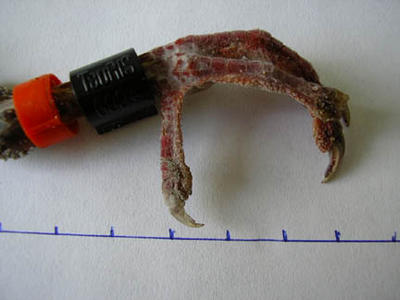
The rule is marked in centimetres and the middle toe, without the nail, is 3 centimetres long.
"Pigeon" came up in the comments to the original post, it was also suggested by Chris Grooms, formerly of the Loggerhead Shrike Project (it was Chris who confirmed the loggerhead shrike as a breeder in my atlassing square), and by some in communication with Terry. We don't have too many pigeons around Thomasburg--not enough barns in the immediate vicinity, and these birds, though very well-established exotics (domestics, whatever), don't like to stray too far from human habitation, which in the countryside they seem to associate with barns (and bridges), not houses or sheds. Toronto is full of pigeons, and very few barns...
I was in Belleville (small city on Lake Ontario, about 25 kilometres south of Thomasburg) the other day, eating lunch by the river and watching the Canada geese, ring-billed gulls, crows, grazing in the riverside park when I saw that there were a couple of pigeons in the mix. But I couldn't think of how to get a hold of one to measure its middle toe.
But first, there has been much distribution of A Single Banded Foot now, thanks to Terry Sprague, and I am hoping that soon an answer will come. Pheasant was in the lead for a while--pigeon has caught up and may be passing. I have begun to enquire of breeders of both who must at least know the feet of their own birds--haven't got a response yet from the he pheasant breeder. It's hard to phrase the question in a "cold" e-mail without sounding like very weird spam. And then my first attempt to e-mail a pigeon fancier failed--e-mail address on the 'net was no longer functional. Will try another.
But I have been informed that the bands on the foot are not those generally used on racing pigeons--so if it was someone's pigeon, it was probably a fancy (decorative?) breed, not a racer.
Here it is again:

The rule is marked in centimetres and the middle toe, without the nail, is 3 centimetres long.
"Pigeon" came up in the comments to the original post, it was also suggested by Chris Grooms, formerly of the Loggerhead Shrike Project (it was Chris who confirmed the loggerhead shrike as a breeder in my atlassing square), and by some in communication with Terry. We don't have too many pigeons around Thomasburg--not enough barns in the immediate vicinity, and these birds, though very well-established exotics (domestics, whatever), don't like to stray too far from human habitation, which in the countryside they seem to associate with barns (and bridges), not houses or sheds. Toronto is full of pigeons, and very few barns...
I was in Belleville (small city on Lake Ontario, about 25 kilometres south of Thomasburg) the other day, eating lunch by the river and watching the Canada geese, ring-billed gulls, crows, grazing in the riverside park when I saw that there were a couple of pigeons in the mix. But I couldn't think of how to get a hold of one to measure its middle toe.
Saturday, August 20, 2005
Canis Soup
Look at these two coyotes.
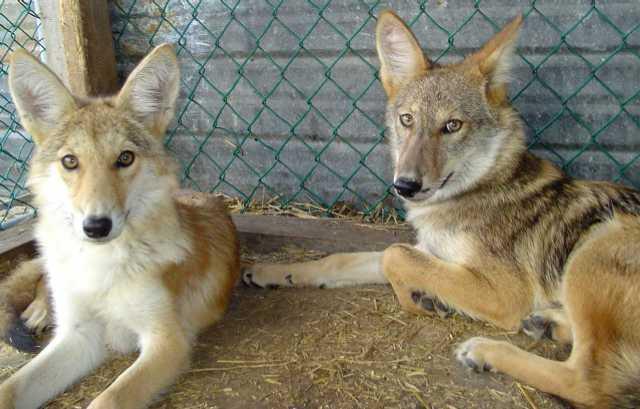
 Shelby and Brody
Photo courtesy of the Kerwood Wolf Education Centre
This photograph came to me included with an appeal for donations to help build them a home at the Kerwood Wolf Education Centre. The story is that two different families who knew each other each turned in a coyote to a wildlife rehabilitation centre north of Kerwood (in southwestern Ontario) within a few days of each other, claiming that these were young of the year, and otherwise being sketchy about their origins. These are not young of the year, but young of last year. And they not only know each other very well, but are also very comfortable with human beings, walk well on leash, etc. So it is thought that they are litter mates that were taken from the wild last year as very young pups and raised in two households until they were no longer manageable. Coyotes (and wolves, cougars, tigers, etc.) do not make good pets. These animals are no longer good coyotes either--not candidates for rehabilitation. Obviously a coyote that is prone to running up to folks looking for a snack is not going to live very long in the farmlands of southwestern Ontario. So the Kerwood Centre is giving them a permanent home in captivity.
When I received the e-mail and saw the picture I was immediately struck by how different these two look from each other, and how much Brody, the animal on the right, looks like an eastern wolf. Look at the broad red nose and large nose pad. On the other hand, what big ears they both have. I wrote to Vivian of Kerwood to ask about them, and to ask if I could use the picture here, and she assured me that although "Brody does slightly (in some ways) resemble eastern wolves or even eastern wolf/coyote hybrids but the resemblance is actually very minor. He is definitely a coyote." And of course since she has hands-on experience with wolves and coyotes, and this one in particular, I am happy to take her word for this.
Really it is Shelby, the animal on the left, that is most remarkable--significantly different than any coyote or coyote image I've seen before--but different in ways that I can propose no explanation for. That is, she doesn't look at all "wolfish" nor does she look like a dog....so what is it about her? The most striking thing is all that white.
I regret that the history of these animals will probably never really be known, since they were taken illegally from the wild and the takers are unlikely to start talking about exactly where and how that occurred. Before I started my "watching brief" on the eastern coyote, the eastern wolf, the red wolf, etc. a few years ago, I had a "field-guide" view of the world. A species is a species--check the field marks of any critter, slot it into the right category. Not so with the wild dogs around here. Every coyote I've seen around here--and this has been a bonanza year for them (see Signs of the Apocalypse and Another County Encounter for example) has been markedly different from every other one. And every one I've seen in Ontario or Quebec has been so different from the delicate, long-legged one I saw in Alberta that one might think they were different species. Some, ones I've seen around Thomasburg, but probably not the ones I've seen in Prince Edward County, may well be eastern wolf/coyote hybrids. Even their DNA doesn't sort these creatures out very well.
Update--January 28, 2007
I was alerted by a comment (see below) that there has been trouble at the Kerwood. Apparently animals were not being cared for properly, and a number, including a lion in very bad shape, were seized in November. I have no information about what has happened since, but the centre's website is mostly down.
Here are links to the stories in the London Free Press: Wildlife Facility Raided and Most animals thriving after rescue.
I am indebted to the commenter who alerted me to this. Very disturbing, and apparently something that developed after the centre attempted to expand its facilities to include exotic big cats. Sadly there are a lot of these animals in private hands in North America, and too many of them end up in very bad situations.
I really hope that nothing posted here ended up facilitating the ill-treatment of animals, native or exotic.
 Shelby and Brody
Photo courtesy of the Kerwood Wolf Education Centre
When I received the e-mail and saw the picture I was immediately struck by how different these two look from each other, and how much Brody, the animal on the right, looks like an eastern wolf. Look at the broad red nose and large nose pad. On the other hand, what big ears they both have. I wrote to Vivian of Kerwood to ask about them, and to ask if I could use the picture here, and she assured me that although "Brody does slightly (in some ways) resemble eastern wolves or even eastern wolf/coyote hybrids but the resemblance is actually very minor. He is definitely a coyote." And of course since she has hands-on experience with wolves and coyotes, and this one in particular, I am happy to take her word for this.
Really it is Shelby, the animal on the left, that is most remarkable--significantly different than any coyote or coyote image I've seen before--but different in ways that I can propose no explanation for. That is, she doesn't look at all "wolfish" nor does she look like a dog....so what is it about her? The most striking thing is all that white.
I regret that the history of these animals will probably never really be known, since they were taken illegally from the wild and the takers are unlikely to start talking about exactly where and how that occurred. Before I started my "watching brief" on the eastern coyote, the eastern wolf, the red wolf, etc. a few years ago, I had a "field-guide" view of the world. A species is a species--check the field marks of any critter, slot it into the right category. Not so with the wild dogs around here. Every coyote I've seen around here--and this has been a bonanza year for them (see Signs of the Apocalypse and Another County Encounter for example) has been markedly different from every other one. And every one I've seen in Ontario or Quebec has been so different from the delicate, long-legged one I saw in Alberta that one might think they were different species. Some, ones I've seen around Thomasburg, but probably not the ones I've seen in Prince Edward County, may well be eastern wolf/coyote hybrids. Even their DNA doesn't sort these creatures out very well.
Update--January 28, 2007
I was alerted by a comment (see below) that there has been trouble at the Kerwood. Apparently animals were not being cared for properly, and a number, including a lion in very bad shape, were seized in November. I have no information about what has happened since, but the centre's website is mostly down.
Here are links to the stories in the London Free Press: Wildlife Facility Raided and Most animals thriving after rescue.
I am indebted to the commenter who alerted me to this. Very disturbing, and apparently something that developed after the centre attempted to expand its facilities to include exotic big cats. Sadly there are a lot of these animals in private hands in North America, and too many of them end up in very bad situations.
I really hope that nothing posted here ended up facilitating the ill-treatment of animals, native or exotic.
Thursday, August 18, 2005
A Single Banded Foot--Update
Thanks to all who responded to my plea for help in A Single Banded Foot.
Unfortunately the identification problem posed is more difficult than I'd hoped. My local expert, the ever-helpful Terry Sprague, compares identification based on a foot to identification based on a single feather. My search for foot references has come up, well, sketchy. Best source so far has been Olaus J. Murie's A Field Guide to Animal Tracks.
But I have had a couple of positive suggestions. First a commenter on the blog has suggested that the bands look like the kind a breeder would put on domestic birds, followed by the suggestion that this foot might belong to a pheasant. The breeder band idea was seconded by another commenter. Murie's field guide lends some credence to the pheasant suggestion, but perhaps best of all, I showed the foot to my uncle, a former hunter of game birds, and his comment was, "Pheasant, isn't it?" He wasn't at all sure, but he has had (long ago) experience handling pheasants and that was what the foot brought to mind. (Ring-necked pheasants run wild in Ontario, as well as being raised domestically--they are native to Eurasia and introduced to North America--in some areas populations are maintained in the wild artificially.) I haven't often seen one in the wild, if ever really. The last time I remember seeing pheasants was the time I saw two ambling along across lawns in a well-to-do neighbourhood in Edmonton, Alberta.
It is still possible that more information will come my way--Terry Sprague and a member of the Eastern Ontario Nature List are passing on the mystery to others who may know something more about either the foot or the bands...I will post again if and when I know more.
Unfortunately the identification problem posed is more difficult than I'd hoped. My local expert, the ever-helpful Terry Sprague, compares identification based on a foot to identification based on a single feather. My search for foot references has come up, well, sketchy. Best source so far has been Olaus J. Murie's A Field Guide to Animal Tracks.
But I have had a couple of positive suggestions. First a commenter on the blog has suggested that the bands look like the kind a breeder would put on domestic birds, followed by the suggestion that this foot might belong to a pheasant. The breeder band idea was seconded by another commenter. Murie's field guide lends some credence to the pheasant suggestion, but perhaps best of all, I showed the foot to my uncle, a former hunter of game birds, and his comment was, "Pheasant, isn't it?" He wasn't at all sure, but he has had (long ago) experience handling pheasants and that was what the foot brought to mind. (Ring-necked pheasants run wild in Ontario, as well as being raised domestically--they are native to Eurasia and introduced to North America--in some areas populations are maintained in the wild artificially.) I haven't often seen one in the wild, if ever really. The last time I remember seeing pheasants was the time I saw two ambling along across lawns in a well-to-do neighbourhood in Edmonton, Alberta.
It is still possible that more information will come my way--Terry Sprague and a member of the Eastern Ontario Nature List are passing on the mystery to others who may know something more about either the foot or the bands...I will post again if and when I know more.
I and the Bird #4
 The fourth edition of I and the Bird is up at milkriverblog! A beautiful presentation and a great collection of bird and birding stories. Check it out.
Tuesday, August 16, 2005
A Single Banded Foot
Walking, tracking, birding and now blogging, I'm getting a reputation as a go-to girl for natural history mysteries. A case in point: A friend of mine found this on July 27, 2005, on his daily walk on County Road 13 in Prince Edward County, and saved it for me:

I was excited when I first saw it--a mystery foot (small raptor?), and banded. I should be able to track this down!
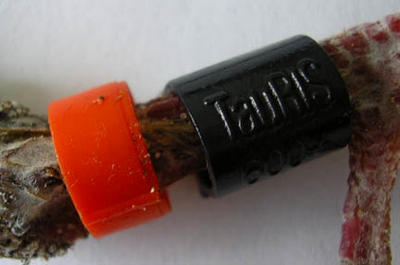
But after a little research I realized that what I needed was the standard aluminum band that every banded bird receives, the one with the information on it. The Ontario Field Ornithologists link page has a bunch of links to sites that deal with banding. The two biggies are the USGS page and Environment Canada's Bird Banding Office.
I think what we have here is a colour code of some kind, keyed to the species and research purpose for which this bird was banded. The standard band must have been on the other leg--now probably in the scat or other casting of a turkey vulture, coyote, fox....whoever.
Recognize this foot?
The rule in the photograph is marked in centimetres. I am hoping that if I can identify the species, I might be able to track the research purpose from that.
 Another view
The foot has four toes, three forward, one back. There is a claw on each (one has broken off).

The nail itself is about a centimetre long. The middle forward toe is 3 centimetres, the side toes, 2 centimetres and the backward facing toe, 1.5 centimetres (all measurements not including the nail).
 One last look
So that's it--a colour code and a foot, both out of context. Please leave a comment if either means anything to you--or if you have an idea about how I could track this further.

Ontario Breeding Atlas Square 18UP36 -- Region 20
Easting 335700, Northing 4866800, NAD 83
Easting 335700, Northing 4866800, NAD 83
I was excited when I first saw it--a mystery foot (small raptor?), and banded. I should be able to track this down!
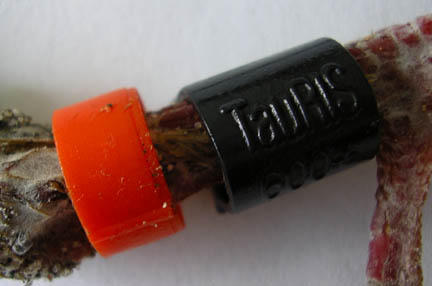
But after a little research I realized that what I needed was the standard aluminum band that every banded bird receives, the one with the information on it. The Ontario Field Ornithologists link page has a bunch of links to sites that deal with banding. The two biggies are the USGS page and Environment Canada's Bird Banding Office.
I think what we have here is a colour code of some kind, keyed to the species and research purpose for which this bird was banded. The standard band must have been on the other leg--now probably in the scat or other casting of a turkey vulture, coyote, fox....whoever.
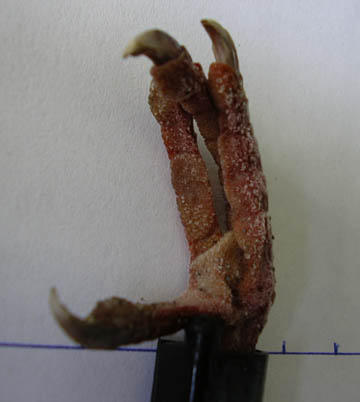
Recognize this foot?The rule in the photograph is marked in centimetres. I am hoping that if I can identify the species, I might be able to track the research purpose from that.
 Another view
The foot has four toes, three forward, one back. There is a claw on each (one has broken off).

The nail itself is about a centimetre long. The middle forward toe is 3 centimetres, the side toes, 2 centimetres and the backward facing toe, 1.5 centimetres (all measurements not including the nail).
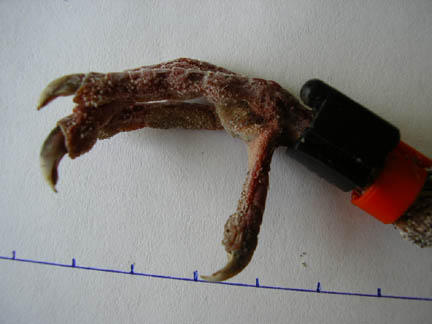 One last look
So that's it--a colour code and a foot, both out of context. Please leave a comment if either means anything to you--or if you have an idea about how I could track this further.
Subscribe to:
Posts (Atom)