Tuesday, June 07, 2005

Orioles--A Cautionary Tale

It's a beautiful morning this morning in the hamlet and yet here I am at the computer instead of out in the field. I was just about to go, but hearing the song of the Baltimore oriole I was reminded that I wanted to write this story, so I thought I would try to quickly get it down before I was distracted yet again.

One day last week I was out in the field, at the edge of the far field, at my best warbler spot, checking for the Brewster's as usual, but also hoping to see and hear a magnolia warbler. The magnolia warbler has a rather difficult to get hold of song--a little like the chestnut-sided, according to my sources, but not as strong, and not as distinct. And I've got a chestnut-sided that sings often and varies its song quite a bit. I know that there are magnolias out there (I've seen them a couple of times), so what I need is to see one singing so that I can match the song to the bird. I was having a good morning--there was a lot of activity, lots of song and lots of birds, all within the small area of bramble and shrub at the rock I've taken to standing on that gives me a good view of a couple of dead trees that the warblers and others will sometimes use as a perch from which to sing. From my notes: Brewster's singing and seen, black-and-white warbler singing, field sparrows singing and pair feeding, catbird duet singing, unidentified warblers and others singing, magnolia warbler (possibly pair) seen, yellow warbler seen.

All the while I was noticing out of the corner of my eye and with half an ear that there was an oriole in the poplars on the other side of the field. The Baltimore oriole is a confirmed breeder in my Breeding Atlas square, and has been for some time. There is almost always a pair nesting in the backyard, so this is a bird I know by sight and sound very well, and not one that I pay much attention too except for idle pleasure. So I wasn't paying much attention to this one, intent as I was on seeing and hearing magnolias and others. But I kept hearing a small voice in my head saying, "look at the oriole," and "there's something funny about that oriole." I'd glance over, but I never put the binoculars on it.

Finally burned out on hearing and seeing for the day I started back across the field headed home when a bird I'd never seen before gleaning in the willow shrubs growing under the poplars at the eastern edge of the field caught my attention. I stopped to study it for a while--had a very good look, had a field guide with me, but had no idea what it was or where to start looking for it. I guessed it might be some kind of vireo, but couldn't find one that fit, and it was really far to big. It wasn't until I was back home and remembered that "funny" oriole that I was able to find the unknown bird. It was a female orchard oriole (see second image on this page). And the singing oriole in the tops of the poplars was most likely a male orchard oriole, but because I never took a good look at it I'll never really know for sure.

The orchard oriole is not a rare bird, but it is a "regionally rare" bird. Until very recently it was unheard of this bird to breed this far north, but like several other species, due to who knows what combination of changes to weather patterns, habitat, land use patterns, etc., they are moving north. I've never seen one before, but it is almost certain that there was a pair out there in the field last week, and that the male was singing. And where there was a pair at the end of May, there will likely be a breeding pair somewhere around here, if not right here in 18UQ11.

How I missed getting a good look at both these birds is that it just never occurred to me that I might see them, and worse, and this is what I will call the not-quite-a-rookie-anymore mistake, I blindly assumed that any oriole I saw around here was a Baltimore oriole! Even though I've never forgotten the incredible story of the birders flocking to my friend's sister's backyard near High Park in Toronto to see the rare female summer tanager (as opposed to the more common female scarlet tanager). The moral of which is that the unexpected do turn up sometimes, and some of those times they look almost exactly like the commonplace.

But enough is enough--I must get out before the sun gets any higher, and take nothing for granted.

Sunday, June 05, 2005

A Family of Killdeers

It has been wonderful collecting data for the Ontario Bird Breeding Atlas the past few years--I've learned much more than I would have otherwise about breeding habits, bird song, and the species in the neighbourhood. But there has also been a down side. The data collection is cumulative over the five years, and the goal is to find the best breeding evidence possible for as many of the birds breeding in your square as you can over that time, and of course, in this part of the world, the breeding period is short and fast. The birds arrive almost all at once, get down to business, and go. The effect of this on a novice like myself is that it feels like there isn't time or attention to enjoy birds that are already "confirmed breeders" in the square.

In 2001, for example, when I scarcely knew a warbler from a vireo, I was walking back in the cedar bush when suddenly a little black and white bird was at my feet, weaving back and forth, wings spread, hissing. It was a black-and-white warbler (I guessed and later confirmed) displaying to distract me/frighten me away from either a nest or recently fledged young. A display such as this one counts as breeding evidence at the highest level--the black-and-white was now a confirmed breeder in the square, and I could forget about it and move on. So for the next few years that's what I did. I gradually learned more about new birds, but only very slowly and incidentally learned more about the birds that got the status of "confirmed breeder" early on. But then fortunately, or unfortunately, my progress in 2002 and 2003 wasn't all that it should've been, so in 2004 I had lots of help in the square. So now, in 2005, the final year for data collection, things are in good shape in 18UQ11, and I'm just looking to fill in some gaps, and to confirm more of my "probable" and "possible" breeders; but I am also trying to relax and enjoy more birds.

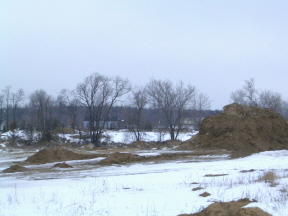
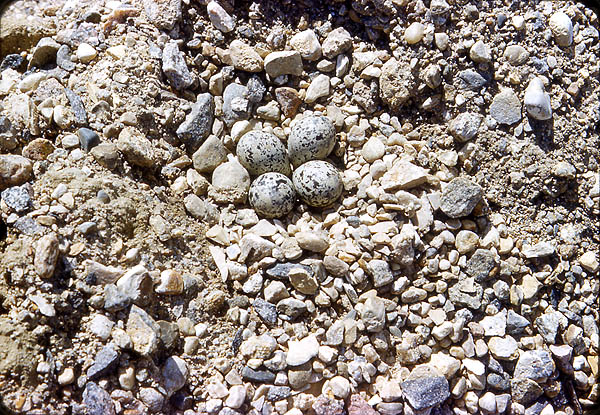
The killdeer is another bird that I confirmed as a breeder in the square some time ago. Killdeers nest in open areas, bare patches, gravelly places, etc. In other words, places just like what I call "the scrape," the area in the fields from which topsoil has been taken.


This is a picture of the scrape in winter, at the beginning of a temporary thaw, that I posted back on February 4, 2005. Just imagine this without the snow, and with sparse vegetation on the flat bits, thicker on the mounds of earth.

I confirmed this bird as a breeder in the square on the basis of a display I was treated to one year in the scrape--a bird led me all over the place. I never saw the nest, or any chicks. But this year, this week, there is a pair out there with three chicks, and I've spent a little time each of the last few days trying to balance my desire to see the chicks against the parents' distress at my being around. I don't go to close, I look for a short time, I walk away.

In spite of their habit of breeding in dry fields and gravel, killdeer are counted among the shore birds. The chicks are precocial, meaning that they come out of the egg just about ready to go. Their parents don't need to feed them, but they do brood them, and guard them for the few weeks that they spend earthbound. The chicks are covered with down when they hatch, but this doesn't last long, and when it's shed, as it has been in the case of the chicks out on the scrape today, they are almost identical to their parents, little round miniatures.

The other adventure of yesterday though was not bird-related at all. A few weeks ago I was listening to "chips" in the woods at the far side of the far field, near the old apple tree, when I heard something that sounded like puppies off in the brambly thickets. I listened for a while, but in the mixture of puppies and catbird calls and other birds, I decided that I wasn't hearing any mammal sounds at all, that it was all birds of one kind or another--just not all birds I knew....not unusual. Then yesterday, a little to the south of the same area, while I was engaged in much the same pursuit, I heard the cries again, this time just one voice, from the level of the ground, closer than before, but not close enough that there was any chance of seeing anything. And much too dense for me to get any closer to the sound without incurring severe damage and making a terrible ruckus, so I just listened. Now I am convinced that it was a mammal, and strongly suspect that it was a bear cub....

Wednesday, May 25, 2005

Warbler Agresssion

So I was back out at the edge of the far field, where I saw the Brewster's warbler, and many others besides, when I heard the song of the golden-winged warbler again. Then I heard the mixed song I'd heard the Brewster's singing. And of course, now that I've seen a Brewster's, I really want to see any bird singing this kind of song, not least because I can count the Brewster's as a "probable" breeder for purposes of the Breeding Atlas if I see it singing again in the same place a week or more after the first time. So, I listened and watched, climbed my viewing rock at the edge of the field, behind the willow copse (I have a line on a new camera--so I hope to be illustrating the action again soon), and watched and listened some more. I finally located the bird, but couldn't get a fix on it. I was looking through the binoculars, when all of a sudden, it flew by like a bullet within inches of my head.

Last fall I was in just this same spot, looking and listening, trying to identify the migrant warblers feeding in the shrubbery, and "pishing" to get one to show itself. A golden-winged flew at me in just this same way. I never did get a really good look at this current divebomber, but the glimpse I got after I found it again in the willows suggested golden-winged (I could see the a dark patch on the throat) not the Brewster's of earlier this month.

Any little bird might fly at your head once by accident, on its way somewhere perhaps, a moment of inattention, mistaking a person for some other large oblong shape. But twice? Same species? Same habitat? All I can say is, watch out for the pretty little golden-winged warbler.

Saturday, May 21, 2005

Breaking the silence

Over a month since the last post--the reason? Overwork? stress? Well, the main reason is that my digital camera gave up the ghost, and somehow the lack of images silenced me. But the bird breeding season is well underway, and there is much to report, so I fought hard to find my voice again.

Until I find another camera or a source for images, we'll have to make do with links. It's too bad--the fields and cedar bush go through amazing transitions in both colour and form through April and May. Right now the leaves are almost fully out, the grass is growing so fast you can see it, and the marsh marigolds are in bloom in the swamp.

But best of all, the warblers and others are singing.

Song sparrows are feeding young in the nest. Chickadees in the yard are fledged, I think. (Chickadees are fast and quiet breeders.) The king birds showed up in the field just days ago, and already have a nest built in the big old apple tree on the far side. This morning the wood thrush was singing, great crested flycatcher calling, chestnut-sided warbler singing, common yellow throat singing, cardinal, black and white warbler, song sparrows, field sparrows, white-throated sparrows (white-crowned sparrows have finally left for points north). The wood thrush is a common bird around here, and its song is heard from woodlots daily, early in the morning and late in the day well into July, yet its beautiful haunting quality never fails to grab my attention. This example is not the prettiest I've ever heard (individual songs vary enormously), but contains a good range of the sounds that might be included in any particular bird's song--good picture too.

I also heard the song (well, buzzes) of the golden wing warbler. The golden wing warbler hybridizes with the blue wing warbler, which also occurs in this region. I've seen a Brewster's warbler in the far field this season, a product of such a pairing. The one I saw was singing a mixed song, not a pure golden wing song, but even so, I like to see the bird at least once before I say which one it is, especially now that I know hybrids are around. (This is the first year I've seen a hybrid--last year there was a golden wing present all season in the far field.) There is some concern that the golden wing is threatened by hybridization--Cornell Lab of Ornithology is running a study to collect data on the species across its range to assess the impact of the phenomenon. Their web pages also provide lots of good information on habits and identification of the two birds and their offspring.

Check out my breeding atlas square to see the list of breeding birds found in the area. This is the last year that data is being collected for the new Atlas, so check back here often for updates on how it's going.

Sunday, April 10, 2005

Ducks in Trees

One morning last May I was out on a morning walk in the fields when I saw a sight I had never seen before: a pair of ducks sitting in a tree. The sun was rising behind them, so I couldn't make out any field marks, but it was clear they were ducks, and, I thought, everyone knows, ducks don't perch in trees!

Well, of course, it turns out that several species of duck do perch in trees, in particular the wood duck, which these turned out to be. Wood ducks nest in cavities in trees, sometimes far from water. And after the ducklings hatch (precocial, as all ducks are, meaning they come out of the shell ready to go), they jump from the tree and are lead by their mother overland to water, where they live (unless eaten) until they are able to fly.

I saw that particular pair of ducks several times over last spring, but did not discover if or where they nested.

This morning I set out for a walk, striding up the hill to the field, and startled a pair of wood ducks that were perched in a tree in the neighbour's backyard. I didn't get much of a look, but I caught up with them again in the swamp in the cedar bush. Perhaps they'll nest there this year.

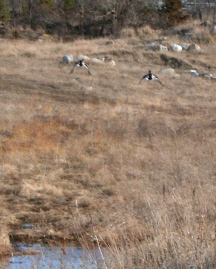
In the scrape there is a low spot that is a small pond for at least a month or two in the spring. The night before last, its banks were the dancing ground for a woodcock, but this morning, as it is many spring mornings, it was a resting and meeting place for mallards. The picture below shows (not terribly distinctly) two mallard drakes leaving the pond as I came up.


Brothers in Flight

Friday, April 01, 2005

The Yard Skunk

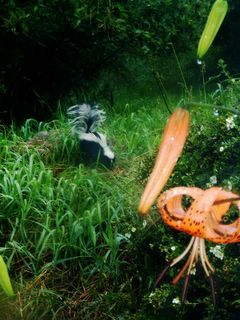
Late last summer a skunk started hanging around the yard. A small cute skunk that I saw regularly, usually at dusk or dawn, but occasionally, as in the photo below, taken last August, in broad daylight.


Through the lilies...

Today, late in the morning, I was walking up at the back, by the shed. I came around the corner, and there was a skunk, a small skunk, a cute skunk. The yard skunk returned? It saw me and skittered under the shed, through the entrance the yard rabbit used all winter. Then for the next few moments, it intermittently stuck its nose out to sniff to see if the danger had passed. But I was still there, so it eventually retreated out of sight. Maybe to wait me out, or maybe it's living there. A little later in the day, I saw my cat come bolting down the hill from the direction of the shed. I let her in the house, and gave her a good sniff, but all was well. I don't think she'd tangle with a skunk.....would she?

They're Here!

This morning I heard my first song sparrow singing of the season. Finally, the early birds are all in place. March 20, first red wing blackbird; March 26, first woodcock "peenting." The robins are singing in the yard too, and have been for several days, but robins overwinter so frequently around here (though I didn't see any this past winter), I am reluctant to count them as real migrants--they may have just flown up from Belleville.

We keep records of the first sightings or hearing of the early birds, and it is remarkable how consistent they are, regardless of weather conditions or whatever else might speed them up or slow them down. The date of arrival varies by less than a week to 10 days over the years.

The first woodcock heard this year was also the first woodcock I've ever seen. Woodcocks are small, funny looking birds that display and "peent" at dusk. They call from the ground, then take off in a whistling, tweeting flight, almost straight up, coming down again not too far from where they started to call again. The one I heard this week came down right past me, so I was able to track him to his landing, and was just able to make him out in the failing light. This bird is also rather cryptically coloured to blend well with the dead grass of the early spring field.

Other travellers reported in the hamlet (by my neighbour Nancy Newman), just passing through, a flock of 15 sandhill cranes flying overhead.

Activity on the walk goes on, but with the snow gone, I only see the barest clues. One print in a patch of mud here, a tuft or two of rabbit fur there, a clump of feathers. But soon the place will be filled with breeding birds. The next spring arrival should be the killdeer, with the bluebird not far behind, and not long after the air will be filled with the songs of the warblers and other late arrivals.

Spring in southern Ontario, sudden, brief, noisy, there's nothing like it.