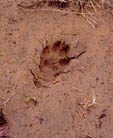
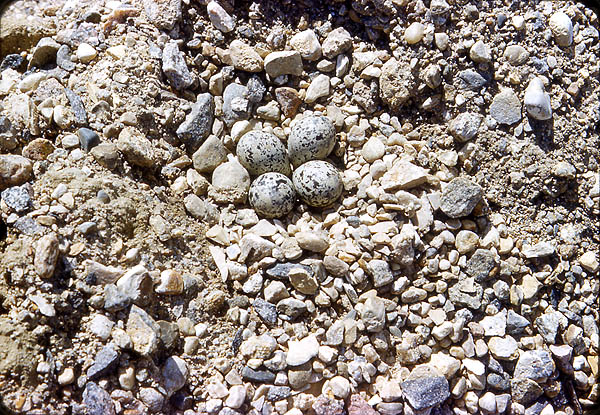
I’m in Prince Edward County this week, and on the first evening, the last night of the heat wave, I was wandering down the laneway from the house, dressed in heat-wave garb, not hiking gear,when I heard some movement in the leaf litter in the woods that the top of the lane runs through. I walked over to investigate, but my view was obscured by the flurry of young maples coming up in the edges of the understory. As I stood there, peering this way and that, listening for the sound again (I was thinking that it was probably a grey squirrel, very common in this wood), I heard a terrible laboured breathing, as if of a very large animal. Just a few breaths. Shocked, I froze,looked at the ground at my feet, saw I was heading into a patch of poison ivy and started to back away. I heard the breathing a couple more times, a little more movement, then nothing. Nothing emerged, nothing ran away....nothing that is except me....
Well, I didn’t really run, I was wearing sandals after all.....and I know never to run from a bear, or poison ivy. But I was a little shaken up. The next morning I posted the story on the Eastern Ontario Nature List to see if anyone thought that what I heard might have been a porcupine. I was hoping porcupine because I’ve had the experience before of encountering one of these guys and having it pay no attention to me, just go about its business. It was the fact of me being so close,and not being quiet, and the thing, whatever it was, not moving away that I found alarming. Others on the list posted stories of beavers, otters and porcupines all making breathing noises much louder than one would expect....so that was reassuring. But one contributor did post the suggestion that it might have been a sick animal, perhaps even rabid, and this also struck me as plausible.
The spot was just down from the house, and I was going to be here for days, and really I wasn’t going to have any fun at all if I was afraid to walk by there, so that day, a little after noon, I set out to check out the situation. I was walking down the lane looking for a good spot beyond the poison ivy patch to get into the wood when I noticed that just a little further down the lane, standing staring at me, was a whitetail doe accompanied by a very young fawn. We stared at each other for a while until she decided to go–fawn gamely trying to keep up. A pleasant interlude for me (I don’t think I’d seen a fawn that young before), but I had work to do. I went into the wood and searched for clues.
Of course there were no clues–nothing I could relate to what I’d heard anyway. I hadn’t really expected that there would be, but I needed to get back on the horse here so that I could walk up and down the lane without worrying that there was a heavy-breathing monster lurking in there.
Later that day I was telling someone the whole story, deer and fawn and all, and she said, “Maybe what you heard was the deer giving birth.”
Seemed too amazing somehow, but events kept unfolding, and I am now coming around to this point of view. I checked with the nature listers, and since then with some Web sites about the whitetail deer, and we are still in the time of birthing for deer.
Nothing happened for a couple of days.
Today, I got a late start, then walked down the lane to the water (shore of Lake Ontario) watching the warblers, sparrows, orioles, flycatchers, grackles, and on down to the pair of loons, and the gulls. The wind was high coming off the water and the waves crashing on the beach were deafening, so I didn’t hang around down there too long. On the way back I stopped at the point where the fields end and the little wood begins and watched two or more male indigo buntings chasing each other around, as well as a multitude of other field and woodland birds all in one place. The light was
perfect (a little overcast) for seeing the blue of the buntings and I could have stood there all day.
After about ten minutes I noticed a deer climb out of the tall grass (and over a fence) and walk into the wood. I had just been thinking about the deer and her fawn, and the tall grass along the laneway, and wondering if they were still around. Apparently so. There was no panic to her movements so I figured she hadn’t noticed me. I went back to admiring the buntings and watching all the other birds. Then I heard the deer bawling from the wood, further up, and on the other side of the lane from where I’d seen her go in.
Well this was too much. I know that deer don’t know this, but I do know that unarmed I’m no match for her. I stood there thinking about my options–make a home for myself right where I was; walk the long way around (two+ kilometres) to get to the house through the neighbour’s fields (or wade through chest-high wet grass and climb several fences to cut it short);or just walk on by. I even started back down to go around the long way until I realized the real reason I was so nervous about passing her was that I couldn’t see her. So I walked past and up to the house. I didn’t hear the deer again, and didn’t see her at all. But I did remember the screaming deer I met last year on my walk.
It was just about this same time–June–I met a deer in the fields (sometimes the first field, sometimes the far field) who didn’t run away, who screamed or called a very hoarse bawling call, something like what I heard today. She would move away from me, make this sound, stop, start, stop, until I either got too close, or had moved far
enough away from the area of concern. I met the screaming deer several times over a period of about a week or ten days. I figured at the time that she had a fawn hidden somewhere nearby, but it didn’t occur to me until today what she was doing. Check out the University of Michigan Web site on the whitetail, where they say that an injured deer will make a surprisingly loud sound.
Injured, my Aunt Fanny! And a killdeer will make a surprisingly loud call when it has a broken wing–right up until the moment it flies away laughing at you. This was a distraction display pure and simple. The deer today left her fawn in the tall grass, saw me, stayed cool (who knew a deer could do that?) made her way up into the wood and away from the fawn (other side of the lane) and pretended to be injured in the hope that I would follow her.
It just never occurred to me last year that what I was seeing was a distraction display–I thought the deer was honestly upset, not trying to fool me. I thought the deer was stupidly revealing to me that there was a fawn somewhere around, not cleverly trying to tempt me into chasing her so she could lead me away.
I haven’t found anything yet on the Internet about distraction displays and whitetails–it’s either too obvious to talk about, or the species is too common for this to have been studied. I’ll be here for a few more days–and if what I’ve read about the first few weeks of the life of a whitetail fawn is correct, so will the little family.
Saturday, June 18, 2005


Friday, June 10, 2005
Little Brown Birds
Sure, warblers are fun--the songs are hard to learn, there are lots of them, they're hard to see, and when you do get to see them, their plumage is often fantastic, and there's a whole page in the Peterson's guide called "Confusing Fall Warblers" to help distinguish them as they lose their very distinctive breeding plumage. But there is another group of birds that presents, in their own way, an even greater challenge to the birder climbing this steep learning curve--the little brown birds. These are, for the most part, the sparrows.
In Thomasburg we have the yard sparrows, the chipping sparrow, the song sparrow, and that pretender the English house sparrow (a finch, introduced to North America by some nut in the 19th century). These sparrows I know very well, and they look different from each other, and have very different songs and habits. The other small finches that hang around here, the goldfinch, the purple finch and the house finch, are also very familiar and fairly easily distinguished at a glance.
But just a few feet away, in the fields and the scrape, are the hard cases. The chipping sparrow and the song sparrow live out there too, and they're joined by the field sparrow, the savannah sparrow, the grasshopper sparrow, and the vesper sparrow, and a few rarities are also outside possibilities. All of these birds are about the same size: little; all of these birds are brown. And all of them are quick.
The field sparrow has a very distinctive song, and a very plain look. The chipping sparrow has a song that is something like the pine warbler and maybe one or two others, but it has a pretty distinctive look (once the tree sparrow has gone north--fortunately the tree sparrow has a mark on its breast that the chipping does not, is quite a bit bigger and usually leaves at around the time the chipping sparrow arrives in the spring). The grasshopper sparrow also has a relatively distinctive song, but it's hard to get a look at it and, in my experience (rather limited, but I have had a grasshopper sparrow around), it doesn't sing a whole lot the way the field sparrow, for example, does.
But then there's the devilish trio, the song sparrow, the savannah sparrow and the vesper sparrow. I tried to find web pages that had clear pictures of good exemplars of each of these birds, but these were the best I could come up with. The savannah sparrow picture is from BC, but it matches my field guide's description of this bird for Ontario, so gives an idea of what I'm up against. The real problem stems from the enormous variation in both the appearance and the song of the song sparrow. If it has a bit of yellow on its head and looks like these birds, then it's a savannah sparrow (unless it's a grasshopper sparrow of course)--but the breast markings, cheek markings, eye rings, sometimes obvious, sometimes almost non-existent. And while you may get to know the song of the song sparrow who nests in the juniper in your backyard--don't count on it being anything like the song of the song sparrow one field over--except maybe in some vague family-resemblance kind of way.
But this might help: the song sparrow has a rounded end to its tail while the other two have notched tails. So if you can just get them to pose in the right position. Also the savannah's pale areas underneath tend to be white, while the vesper's tends to be more to the beige, so if you can just get the light just right. Or look for that little bit of yellow.....
Here's where walking that same walk every day pays off. Over at the edge of the far field, just by my warbler listening post, there is a pair of sparrows nesting. I've been aware of them for a couple of weeks, and decided early on that they were probably vespers and probably nesting, but as the days passed I got to know them very well--sometimes I just said hello, and let them get on with whatever they were doing, others I took a little time to study them. This morning I spent a half an hour watching--and now I know for sure--they are vespers, and they've got chicks in the nest now, they were working furiously, catching caterpillars and carrying them back into the brush. I also know now that the vesper has two calls, a "chip" and a throatier "chirp" call that are used together, i.e. in sentences by a single bird, or called back and forth by the pair. Since I'm always there when I hear the calls what I suspect but don't know is that one of these is an alarm call to signal my presence.
So maybe now I know a vesper when I see or hear one.....but work on the little brown birds never ends. There are a large number of slightly larger brown birds that are the females of very colourful partners, the indigo bunting for example....and the list goes on.
In Thomasburg we have the yard sparrows, the chipping sparrow, the song sparrow, and that pretender the English house sparrow (a finch, introduced to North America by some nut in the 19th century). These sparrows I know very well, and they look different from each other, and have very different songs and habits. The other small finches that hang around here, the goldfinch, the purple finch and the house finch, are also very familiar and fairly easily distinguished at a glance.
But just a few feet away, in the fields and the scrape, are the hard cases. The chipping sparrow and the song sparrow live out there too, and they're joined by the field sparrow, the savannah sparrow, the grasshopper sparrow, and the vesper sparrow, and a few rarities are also outside possibilities. All of these birds are about the same size: little; all of these birds are brown. And all of them are quick.
The field sparrow has a very distinctive song, and a very plain look. The chipping sparrow has a song that is something like the pine warbler and maybe one or two others, but it has a pretty distinctive look (once the tree sparrow has gone north--fortunately the tree sparrow has a mark on its breast that the chipping does not, is quite a bit bigger and usually leaves at around the time the chipping sparrow arrives in the spring). The grasshopper sparrow also has a relatively distinctive song, but it's hard to get a look at it and, in my experience (rather limited, but I have had a grasshopper sparrow around), it doesn't sing a whole lot the way the field sparrow, for example, does.
But then there's the devilish trio, the song sparrow, the savannah sparrow and the vesper sparrow. I tried to find web pages that had clear pictures of good exemplars of each of these birds, but these were the best I could come up with. The savannah sparrow picture is from BC, but it matches my field guide's description of this bird for Ontario, so gives an idea of what I'm up against. The real problem stems from the enormous variation in both the appearance and the song of the song sparrow. If it has a bit of yellow on its head and looks like these birds, then it's a savannah sparrow (unless it's a grasshopper sparrow of course)--but the breast markings, cheek markings, eye rings, sometimes obvious, sometimes almost non-existent. And while you may get to know the song of the song sparrow who nests in the juniper in your backyard--don't count on it being anything like the song of the song sparrow one field over--except maybe in some vague family-resemblance kind of way.
But this might help: the song sparrow has a rounded end to its tail while the other two have notched tails. So if you can just get them to pose in the right position. Also the savannah's pale areas underneath tend to be white, while the vesper's tends to be more to the beige, so if you can just get the light just right. Or look for that little bit of yellow.....
Here's where walking that same walk every day pays off. Over at the edge of the far field, just by my warbler listening post, there is a pair of sparrows nesting. I've been aware of them for a couple of weeks, and decided early on that they were probably vespers and probably nesting, but as the days passed I got to know them very well--sometimes I just said hello, and let them get on with whatever they were doing, others I took a little time to study them. This morning I spent a half an hour watching--and now I know for sure--they are vespers, and they've got chicks in the nest now, they were working furiously, catching caterpillars and carrying them back into the brush. I also know now that the vesper has two calls, a "chip" and a throatier "chirp" call that are used together, i.e. in sentences by a single bird, or called back and forth by the pair. Since I'm always there when I hear the calls what I suspect but don't know is that one of these is an alarm call to signal my presence.
So maybe now I know a vesper when I see or hear one.....but work on the little brown birds never ends. There are a large number of slightly larger brown birds that are the females of very colourful partners, the indigo bunting for example....and the list goes on.
Wednesday, June 08, 2005
On the Female of the Species
This morning the warbler studies continued. I was out again at my favourite spot in the far field and I heard a new song, sounded to me like "who, who, who, Julio." It was coming from a particularly dense and brushy area, from about halfway up, so the bird was completely invisible. I watched for movement for a while but no luck, so I tried "pishing" to see if I could flush someone out. After a few pishes a bird emerged, a grey bird with gold markings high on the edges of a clear breast, small and warbler-like. Not a bird I knew. I pulled off my sunglasses, pulled on my reading glasses and got the field guide out--the bird was not there! I listened as the song resumed, watched hoping for another sighting....then a chestnut-sided warbler came into view and started to sing. Comparing the songs I was convinced the bird in question was indeed a warbler (not that there'd been much doubt, given its size, shape, behavious, etc.), the tone and range of its song was very similar to the chestnut-sided (as many are, according to my sources). So I pished again, and got another look at the grey bird with the gold markings.
The guide I had with me in the field was Sibley's which I really like because its new, it has maps on the same pages as the pictures and descriptions, etc. But it is always good to have more than one source to consult. So when I got back to the house I took a look at our old copy of Peterson's guide. Once again, the bird wasn't there, but I paused at a couple of possibilities--put off in each case by the descriptions of the songs. Luckily I also have a computer program from the Breeding Atlas Project with information about, pictures of and songs of all the birds I'm likely to see. I scrolled through the warblers.
One of the birds in Peterson's that had given me pause was the American redstart--not the male, and not the description of the song, but something about the picture of the female. Not that my bird looked like his exactly. But when I got to the redstart on the computer, because it is a common bird, there were a number of pictures of the female, including one that looked quite a bit like mine! And quite a few exemplars of the song, some of which sounded something like what I heard--so mystery solved.
There was a male American redstart singing in the brush accompanied by a female (perhaps on a nest, or preparing to nest). When I "pished" it was she who came out to see what was going on while he stayed on his hidden perch. So, a pair of redstarts and a redstart singing! And a reminder that I must learn what all those female warblers look like.....
The guide I had with me in the field was Sibley's which I really like because its new, it has maps on the same pages as the pictures and descriptions, etc. But it is always good to have more than one source to consult. So when I got back to the house I took a look at our old copy of Peterson's guide. Once again, the bird wasn't there, but I paused at a couple of possibilities--put off in each case by the descriptions of the songs. Luckily I also have a computer program from the Breeding Atlas Project with information about, pictures of and songs of all the birds I'm likely to see. I scrolled through the warblers.
One of the birds in Peterson's that had given me pause was the American redstart--not the male, and not the description of the song, but something about the picture of the female. Not that my bird looked like his exactly. But when I got to the redstart on the computer, because it is a common bird, there were a number of pictures of the female, including one that looked quite a bit like mine! And quite a few exemplars of the song, some of which sounded something like what I heard--so mystery solved.
There was a male American redstart singing in the brush accompanied by a female (perhaps on a nest, or preparing to nest). When I "pished" it was she who came out to see what was going on while he stayed on his hidden perch. So, a pair of redstarts and a redstart singing! And a reminder that I must learn what all those female warblers look like.....
Tuesday, June 07, 2005
Orioles--A Cautionary Tale
It's a beautiful morning this morning in the hamlet and yet here I am at the computer instead of out in the field. I was just about to go, but hearing the song of the Baltimore oriole I was reminded that I wanted to write this story, so I thought I would try to quickly get it down before I was distracted yet again.
One day last week I was out in the field, at the edge of the far field, at my best warbler spot, checking for the Brewster's as usual, but also hoping to see and hear a magnolia warbler. The magnolia warbler has a rather difficult to get hold of song--a little like the chestnut-sided, according to my sources, but not as strong, and not as distinct. And I've got a chestnut-sided that sings often and varies its song quite a bit. I know that there are magnolias out there (I've seen them a couple of times), so what I need is to see one singing so that I can match the song to the bird. I was having a good morning--there was a lot of activity, lots of song and lots of birds, all within the small area of bramble and shrub at the rock I've taken to standing on that gives me a good view of a couple of dead trees that the warblers and others will sometimes use as a perch from which to sing. From my notes: Brewster's singing and seen, black-and-white warbler singing, field sparrows singing and pair feeding, catbird duet singing, unidentified warblers and others singing, magnolia warbler (possibly pair) seen, yellow warbler seen.
All the while I was noticing out of the corner of my eye and with half an ear that there was an oriole in the poplars on the other side of the field. The Baltimore oriole is a confirmed breeder in my Breeding Atlas square, and has been for some time. There is almost always a pair nesting in the backyard, so this is a bird I know by sight and sound very well, and not one that I pay much attention too except for idle pleasure. So I wasn't paying much attention to this one, intent as I was on seeing and hearing magnolias and others. But I kept hearing a small voice in my head saying, "look at the oriole," and "there's something funny about that oriole." I'd glance over, but I never put the binoculars on it.
Finally burned out on hearing and seeing for the day I started back across the field headed home when a bird I'd never seen before gleaning in the willow shrubs growing under the poplars at the eastern edge of the field caught my attention. I stopped to study it for a while--had a very good look, had a field guide with me, but had no idea what it was or where to start looking for it. I guessed it might be some kind of vireo, but couldn't find one that fit, and it was really far to big. It wasn't until I was back home and remembered that "funny" oriole that I was able to find the unknown bird. It was a female orchard oriole (see second image on this page). And the singing oriole in the tops of the poplars was most likely a male orchard oriole, but because I never took a good look at it I'll never really know for sure.
The orchard oriole is not a rare bird, but it is a "regionally rare" bird. Until very recently it was unheard of this bird to breed this far north, but like several other species, due to who knows what combination of changes to weather patterns, habitat, land use patterns, etc., they are moving north. I've never seen one before, but it is almost certain that there was a pair out there in the field last week, and that the male was singing. And where there was a pair at the end of May, there will likely be a breeding pair somewhere around here, if not right here in 18UQ11.
How I missed getting a good look at both these birds is that it just never occurred to me that I might see them, and worse, and this is what I will call the not-quite-a-rookie-anymore mistake, I blindly assumed that any oriole I saw around here was a Baltimore oriole! Even though I've never forgotten the incredible story of the birders flocking to my friend's sister's backyard near High Park in Toronto to see the rare female summer tanager (as opposed to the more common female scarlet tanager). The moral of which is that the unexpected do turn up sometimes, and some of those times they look almost exactly like the commonplace.
But enough is enough--I must get out before the sun gets any higher, and take nothing for granted.
One day last week I was out in the field, at the edge of the far field, at my best warbler spot, checking for the Brewster's as usual, but also hoping to see and hear a magnolia warbler. The magnolia warbler has a rather difficult to get hold of song--a little like the chestnut-sided, according to my sources, but not as strong, and not as distinct. And I've got a chestnut-sided that sings often and varies its song quite a bit. I know that there are magnolias out there (I've seen them a couple of times), so what I need is to see one singing so that I can match the song to the bird. I was having a good morning--there was a lot of activity, lots of song and lots of birds, all within the small area of bramble and shrub at the rock I've taken to standing on that gives me a good view of a couple of dead trees that the warblers and others will sometimes use as a perch from which to sing. From my notes: Brewster's singing and seen, black-and-white warbler singing, field sparrows singing and pair feeding, catbird duet singing, unidentified warblers and others singing, magnolia warbler (possibly pair) seen, yellow warbler seen.
All the while I was noticing out of the corner of my eye and with half an ear that there was an oriole in the poplars on the other side of the field. The Baltimore oriole is a confirmed breeder in my Breeding Atlas square, and has been for some time. There is almost always a pair nesting in the backyard, so this is a bird I know by sight and sound very well, and not one that I pay much attention too except for idle pleasure. So I wasn't paying much attention to this one, intent as I was on seeing and hearing magnolias and others. But I kept hearing a small voice in my head saying, "look at the oriole," and "there's something funny about that oriole." I'd glance over, but I never put the binoculars on it.
Finally burned out on hearing and seeing for the day I started back across the field headed home when a bird I'd never seen before gleaning in the willow shrubs growing under the poplars at the eastern edge of the field caught my attention. I stopped to study it for a while--had a very good look, had a field guide with me, but had no idea what it was or where to start looking for it. I guessed it might be some kind of vireo, but couldn't find one that fit, and it was really far to big. It wasn't until I was back home and remembered that "funny" oriole that I was able to find the unknown bird. It was a female orchard oriole (see second image on this page). And the singing oriole in the tops of the poplars was most likely a male orchard oriole, but because I never took a good look at it I'll never really know for sure.
The orchard oriole is not a rare bird, but it is a "regionally rare" bird. Until very recently it was unheard of this bird to breed this far north, but like several other species, due to who knows what combination of changes to weather patterns, habitat, land use patterns, etc., they are moving north. I've never seen one before, but it is almost certain that there was a pair out there in the field last week, and that the male was singing. And where there was a pair at the end of May, there will likely be a breeding pair somewhere around here, if not right here in 18UQ11.
How I missed getting a good look at both these birds is that it just never occurred to me that I might see them, and worse, and this is what I will call the not-quite-a-rookie-anymore mistake, I blindly assumed that any oriole I saw around here was a Baltimore oriole! Even though I've never forgotten the incredible story of the birders flocking to my friend's sister's backyard near High Park in Toronto to see the rare female summer tanager (as opposed to the more common female scarlet tanager). The moral of which is that the unexpected do turn up sometimes, and some of those times they look almost exactly like the commonplace.
But enough is enough--I must get out before the sun gets any higher, and take nothing for granted.
Sunday, June 05, 2005
A Family of Killdeers
It has been wonderful collecting data for the Ontario Bird Breeding Atlas the past few years--I've learned much more than I would have otherwise about breeding habits, bird song, and the species in the neighbourhood. But there has also been a down side. The data collection is cumulative over the five years, and the goal is to find the best breeding evidence possible for as many of the birds breeding in your square as you can over that time, and of course, in this part of the world, the breeding period is short and fast. The birds arrive almost all at once, get down to business, and go. The effect of this on a novice like myself is that it feels like there isn't time or attention to enjoy birds that are already "confirmed breeders" in the square.
In 2001, for example, when I scarcely knew a warbler from a vireo, I was walking back in the cedar bush when suddenly a little black and white bird was at my feet, weaving back and forth, wings spread, hissing. It was a black-and-white warbler (I guessed and later confirmed) displaying to distract me/frighten me away from either a nest or recently fledged young. A display such as this one counts as breeding evidence at the highest level--the black-and-white was now a confirmed breeder in the square, and I could forget about it and move on. So for the next few years that's what I did. I gradually learned more about new birds, but only very slowly and incidentally learned more about the birds that got the status of "confirmed breeder" early on. But then fortunately, or unfortunately, my progress in 2002 and 2003 wasn't all that it should've been, so in 2004 I had lots of help in the square. So now, in 2005, the final year for data collection, things are in good shape in 18UQ11, and I'm just looking to fill in some gaps, and to confirm more of my "probable" and "possible" breeders; but I am also trying to relax and enjoy more birds.
The killdeer is another bird that I confirmed as a breeder in the square some time ago. Killdeers nest in open areas, bare patches, gravelly places, etc. In other words, places just like what I call "the scrape," the area in the fields from which topsoil has been taken.
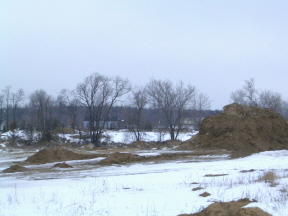
This is a picture of the scrape in winter, at the beginning of a temporary thaw, that I posted back on February 4, 2005. Just imagine this without the snow, and with sparse vegetation on the flat bits, thicker on the mounds of earth.
I confirmed this bird as a breeder in the square on the basis of a display I was treated to one year in the scrape--a bird led me all over the place. I never saw the nest, or any chicks. But this year, this week, there is a pair out there with three chicks, and I've spent a little time each of the last few days trying to balance my desire to see the chicks against the parents' distress at my being around. I don't go to close, I look for a short time, I walk away.
In spite of their habit of breeding in dry fields and gravel, killdeer are counted among the shore birds. The chicks are precocial, meaning that they come out of the egg just about ready to go. Their parents don't need to feed them, but they do brood them, and guard them for the few weeks that they spend earthbound. The chicks are covered with down when they hatch, but this doesn't last long, and when it's shed, as it has been in the case of the chicks out on the scrape today, they are almost identical to their parents, little round miniatures.
The other adventure of yesterday though was not bird-related at all. A few weeks ago I was listening to "chips" in the woods at the far side of the far field, near the old apple tree, when I heard something that sounded like puppies off in the brambly thickets. I listened for a while, but in the mixture of puppies and catbird calls and other birds, I decided that I wasn't hearing any mammal sounds at all, that it was all birds of one kind or another--just not all birds I knew....not unusual. Then yesterday, a little to the south of the same area, while I was engaged in much the same pursuit, I heard the cries again, this time just one voice, from the level of the ground, closer than before, but not close enough that there was any chance of seeing anything. And much too dense for me to get any closer to the sound without incurring severe damage and making a terrible ruckus, so I just listened. Now I am convinced that it was a mammal, and strongly suspect that it was a bear cub....
In 2001, for example, when I scarcely knew a warbler from a vireo, I was walking back in the cedar bush when suddenly a little black and white bird was at my feet, weaving back and forth, wings spread, hissing. It was a black-and-white warbler (I guessed and later confirmed) displaying to distract me/frighten me away from either a nest or recently fledged young. A display such as this one counts as breeding evidence at the highest level--the black-and-white was now a confirmed breeder in the square, and I could forget about it and move on. So for the next few years that's what I did. I gradually learned more about new birds, but only very slowly and incidentally learned more about the birds that got the status of "confirmed breeder" early on. But then fortunately, or unfortunately, my progress in 2002 and 2003 wasn't all that it should've been, so in 2004 I had lots of help in the square. So now, in 2005, the final year for data collection, things are in good shape in 18UQ11, and I'm just looking to fill in some gaps, and to confirm more of my "probable" and "possible" breeders; but I am also trying to relax and enjoy more birds.
The killdeer is another bird that I confirmed as a breeder in the square some time ago. Killdeers nest in open areas, bare patches, gravelly places, etc. In other words, places just like what I call "the scrape," the area in the fields from which topsoil has been taken.
I confirmed this bird as a breeder in the square on the basis of a display I was treated to one year in the scrape--a bird led me all over the place. I never saw the nest, or any chicks. But this year, this week, there is a pair out there with three chicks, and I've spent a little time each of the last few days trying to balance my desire to see the chicks against the parents' distress at my being around. I don't go to close, I look for a short time, I walk away.
In spite of their habit of breeding in dry fields and gravel, killdeer are counted among the shore birds. The chicks are precocial, meaning that they come out of the egg just about ready to go. Their parents don't need to feed them, but they do brood them, and guard them for the few weeks that they spend earthbound. The chicks are covered with down when they hatch, but this doesn't last long, and when it's shed, as it has been in the case of the chicks out on the scrape today, they are almost identical to their parents, little round miniatures.
The other adventure of yesterday though was not bird-related at all. A few weeks ago I was listening to "chips" in the woods at the far side of the far field, near the old apple tree, when I heard something that sounded like puppies off in the brambly thickets. I listened for a while, but in the mixture of puppies and catbird calls and other birds, I decided that I wasn't hearing any mammal sounds at all, that it was all birds of one kind or another--just not all birds I knew....not unusual. Then yesterday, a little to the south of the same area, while I was engaged in much the same pursuit, I heard the cries again, this time just one voice, from the level of the ground, closer than before, but not close enough that there was any chance of seeing anything. And much too dense for me to get any closer to the sound without incurring severe damage and making a terrible ruckus, so I just listened. Now I am convinced that it was a mammal, and strongly suspect that it was a bear cub....
Wednesday, May 25, 2005
Warbler Agresssion
So I was back out at the edge of the far field, where I saw the Brewster's warbler, and many others besides, when I heard the song of the golden-winged warbler again. Then I heard the mixed song I'd heard the Brewster's singing. And of course, now that I've seen a Brewster's, I really want to see any bird singing this kind of song, not least because I can count the Brewster's as a "probable" breeder for purposes of the Breeding Atlas if I see it singing again in the same place a week or more after the first time. So, I listened and watched, climbed my viewing rock at the edge of the field, behind the willow copse (I have a line on a new camera--so I hope to be illustrating the action again soon), and watched and listened some more. I finally located the bird, but couldn't get a fix on it. I was looking through the binoculars, when all of a sudden, it flew by like a bullet within inches of my head.
Last fall I was in just this same spot, looking and listening, trying to identify the migrant warblers feeding in the shrubbery, and "pishing" to get one to show itself. A golden-winged flew at me in just this same way. I never did get a really good look at this current divebomber, but the glimpse I got after I found it again in the willows suggested golden-winged (I could see the a dark patch on the throat) not the Brewster's of earlier this month.
Any little bird might fly at your head once by accident, on its way somewhere perhaps, a moment of inattention, mistaking a person for some other large oblong shape. But twice? Same species? Same habitat? All I can say is, watch out for the pretty little golden-winged warbler.
Last fall I was in just this same spot, looking and listening, trying to identify the migrant warblers feeding in the shrubbery, and "pishing" to get one to show itself. A golden-winged flew at me in just this same way. I never did get a really good look at this current divebomber, but the glimpse I got after I found it again in the willows suggested golden-winged (I could see the a dark patch on the throat) not the Brewster's of earlier this month.
Any little bird might fly at your head once by accident, on its way somewhere perhaps, a moment of inattention, mistaking a person for some other large oblong shape. But twice? Same species? Same habitat? All I can say is, watch out for the pretty little golden-winged warbler.
Saturday, May 21, 2005
Breaking the silence
Over a month since the last post--the reason? Overwork? stress? Well, the main reason is that my digital camera gave up the ghost, and somehow the lack of images silenced me. But the bird breeding season is well underway, and there is much to report, so I fought hard to find my voice again.
Until I find another camera or a source for images, we'll have to make do with links. It's too bad--the fields and cedar bush go through amazing transitions in both colour and form through April and May. Right now the leaves are almost fully out, the grass is growing so fast you can see it, and the marsh marigolds are in bloom in the swamp.
But best of all, the warblers and others are singing.
Song sparrows are feeding young in the nest. Chickadees in the yard are fledged, I think. (Chickadees are fast and quiet breeders.) The king birds showed up in the field just days ago, and already have a nest built in the big old apple tree on the far side. This morning the wood thrush was singing, great crested flycatcher calling, chestnut-sided warbler singing, common yellow throat singing, cardinal, black and white warbler, song sparrows, field sparrows, white-throated sparrows (white-crowned sparrows have finally left for points north). The wood thrush is a common bird around here, and its song is heard from woodlots daily, early in the morning and late in the day well into July, yet its beautiful haunting quality never fails to grab my attention. This example is not the prettiest I've ever heard (individual songs vary enormously), but contains a good range of the sounds that might be included in any particular bird's song--good picture too.
I also heard the song (well, buzzes) of the golden wing warbler. The golden wing warbler hybridizes with the blue wing warbler, which also occurs in this region. I've seen a Brewster's warbler in the far field this season, a product of such a pairing. The one I saw was singing a mixed song, not a pure golden wing song, but even so, I like to see the bird at least once before I say which one it is, especially now that I know hybrids are around. (This is the first year I've seen a hybrid--last year there was a golden wing present all season in the far field.) There is some concern that the golden wing is threatened by hybridization--Cornell Lab of Ornithology is running a study to collect data on the species across its range to assess the impact of the phenomenon. Their web pages also provide lots of good information on habits and identification of the two birds and their offspring.
Check out my breeding atlas square to see the list of breeding birds found in the area. This is the last year that data is being collected for the new Atlas, so check back here often for updates on how it's going.
Until I find another camera or a source for images, we'll have to make do with links. It's too bad--the fields and cedar bush go through amazing transitions in both colour and form through April and May. Right now the leaves are almost fully out, the grass is growing so fast you can see it, and the marsh marigolds are in bloom in the swamp.
But best of all, the warblers and others are singing.
Song sparrows are feeding young in the nest. Chickadees in the yard are fledged, I think. (Chickadees are fast and quiet breeders.) The king birds showed up in the field just days ago, and already have a nest built in the big old apple tree on the far side. This morning the wood thrush was singing, great crested flycatcher calling, chestnut-sided warbler singing, common yellow throat singing, cardinal, black and white warbler, song sparrows, field sparrows, white-throated sparrows (white-crowned sparrows have finally left for points north). The wood thrush is a common bird around here, and its song is heard from woodlots daily, early in the morning and late in the day well into July, yet its beautiful haunting quality never fails to grab my attention. This example is not the prettiest I've ever heard (individual songs vary enormously), but contains a good range of the sounds that might be included in any particular bird's song--good picture too.
I also heard the song (well, buzzes) of the golden wing warbler. The golden wing warbler hybridizes with the blue wing warbler, which also occurs in this region. I've seen a Brewster's warbler in the far field this season, a product of such a pairing. The one I saw was singing a mixed song, not a pure golden wing song, but even so, I like to see the bird at least once before I say which one it is, especially now that I know hybrids are around. (This is the first year I've seen a hybrid--last year there was a golden wing present all season in the far field.) There is some concern that the golden wing is threatened by hybridization--Cornell Lab of Ornithology is running a study to collect data on the species across its range to assess the impact of the phenomenon. Their web pages also provide lots of good information on habits and identification of the two birds and their offspring.
Check out my breeding atlas square to see the list of breeding birds found in the area. This is the last year that data is being collected for the new Atlas, so check back here often for updates on how it's going.
Subscribe to:
Posts (Atom)