Early last spring, one fine cool morning, I was walking up towards the back property line--a row of trees, some living, many dead, and a profusion of wild grape. I paused to see, not ten metres away, a raptor, sitting in clear view on the branch of a dead tree, probably less than 3 metres above the ground. The bird sat for a good long moment, so I could get a good long look, and I had no idea what it was. After the moment it flew away, giving me another nice clear view, and I went back to the house, determined to identify this bird.
My ability to identify raptors is still in infancy. I know a few, some because of lots of sightings, others because of great field marks. I, for example, can identify a mature bald eagle at great distance. I know this bird both by familiarity--I've spent time on BC's west coast where they are now extremely numerous--and of course field marks. We have a few around here, I see one about once a year (click here for my 2005 sighting). I am also pretty good at picking out a red-tailed hawk, a very common bird around here, year round; the American kestrel is also common during the breeding season, and I can usually identify it--good field marks too; merlin, not bad, there are lots of this bird in Edmonton, where I lived for four years, and a few around here; osprey, good field marks; northern harrier, good field marks and I am pretty familiar with this bird too--then there are all those other ones, accipters, buteos, falcons--I might be able to place a bird in its group, but unless I get an awfully good look, with a field guide in my hand, I'm not up to much more.
So, did I identify that bird last spring? Sadly, yes. It was on the list of raptors that I do know--it was a northern harrier. The problem was that it looked so much smaller than a harrier should look that I'd dismissed that as a possibility. Luckily the northern harrier has such good field marks; white bum, easily seen as it flies away; dihedral flight, facial disks, and this was a male with grey plumage, that through a process of elimination I was able to convince myself that I'd judged the size completely wrongly. Why did it look so small to me? No good frame of reference, an odd shape of land, and who knows why else.
I was thinking about this because this is the time of year that I might see many raptors. Thomasburg is not on a flight path where one might see hundreds, but we are close enough that through the early fall one can expect to see at least one migrant raptor everyday. Yesterday, I walked out of the house to see one sitting on a branch of the elm tree by the driveway that died this summer. A nice clear view of a clear white-breasted bird with a banded tail, well-defined bands. And that's all I got--from the sight of it sitting and it flying away. I had no binoculars, so the bands thing is just the impression at a distance.
Juvenile broad-winged hawk (15") fits pretty well--and this is a bird that is common around here. But it might also have been a Swainson's (19") I guess, though they aren't all that common. Then there's the ferruginous (23"), not common at all, in fact a species at risk...and the red-tailed (19") that I know so well actually comes in a wide variety of morphs, some of which have almost white breasts.
Now 15" seems about right for the bird I saw, i.e., bigger than a blue jay, but not all that big--I doubt this could have been a 23" tall bird (forgive the imperial measures--I'm taking it out of Sibley's, and anyway, I'm old enough that I was raised with imperial measures). But then I think of the harrier, 18" high, and how I was sure I was looking at about a 14" bird!
The Canadian Peregrine Foundation has a page here to help with raptor identification. I'll be checking it out--and maybe this coming year will be my "raptor" year--there are so few compared to the warblers, I should be able to get this thing beat.
But here's another predator puzzle--last winter a northern shrike flew into the snowball bush in front of the house and sent all the feeder birds into a tizzy. It took me moments longer than it took them to see that the bird was a shrike--they knew instantly, I thought it was a blue jay at first. I've wondered ever since how it is that these tiny birds (chickadees, goldfinches, house finches, etc.), with their tiny brains, have the ability to recognize the shrike as a predator, when it provides none of the raptor cues.
Sunday, September 11, 2005


Tuesday, September 06, 2005
Birding
Ever since I read Charlie's post about why he is a birder, on Charlie's Bird Blog, and browsed the "Reasons to Become a Bird Watcher " section in the archives on 10,000 Birds, I've thought about writing my own post about why I love to get out there and watch birds. This isn't really it.
But today I read a very satisfying essay in the New Yorker by Jonathan Franzen, "My Bird Problem," (August 8 & 15, 2005) that someone clipped out for me. The essay is about learning to love, dealing with death, what we do to the environment, the hell that is other people, and a love of birding. It did not go unnoticed among the nature bloggers--Rexroth's Daughter at Dharma Bums writes about it here.
Here is one passage from the essay that particularly struck me, where Franzen describes his "proper introduction" to birding, on a walk in the park with two "serious birders."
But today I read a very satisfying essay in the New Yorker by Jonathan Franzen, "My Bird Problem," (August 8 & 15, 2005) that someone clipped out for me. The essay is about learning to love, dealing with death, what we do to the environment, the hell that is other people, and a love of birding. It did not go unnoticed among the nature bloggers--Rexroth's Daughter at Dharma Bums writes about it here.
Here is one passage from the essay that particularly struck me, where Franzen describes his "proper introduction" to birding, on a walk in the park with two "serious birders."
We started at Belvedere Castle, and right there, on the mulchy ground behind the weather station, we saw a bird shaped like a robin but light-breasted and feathered in russet tones. A veery, the brother-in-law said.It's an eerie feeling, an epistemological miracle, when you see a bird for the first time the day after you learn it's prevalent in your region; it's a startling revelation to find that there are 40 different species observable in a morning in your yard in the spring, where you would have guessed 4 or 5 before making the count. Birding shows you something important about the complexity of the world, watching birds grounds you firmly on the earth, in the moment.
I'd never even heard of veeries. The only birds I'd noticed on my hundreds of walks in the Park were pigeons and sparrows and, from a distance, beyond a battery of telescopes, the nesting red-tailed hawks that had become such overexposed celebrities. It was weird to see a foreign, unfamous veery hopping around in plain sight, five feet away from a busy footpath, on a day when half of Manhattan was sunning in the park. I felt as if, all my life, I'd been mistaken about something important. [emphasis mine]
Sunday, September 04, 2005
Katrina
Family crisis kept my attention off the news for a few days during which an incredibly frightening situation developed in New Orleans in the aftermath of Hurricane Katrina. Difficult to understand why rescue efforts have been an added disaster--suggests to me a dangerously fractured society.
Here is a link to Truthout.org's page Mayday Mississippi Delta, a collection of news stories and others from the last few days.

See the links provided by Instapundit for other donation options.
Here is a link to Truthout.org's page Mayday Mississippi Delta, a collection of news stories and others from the last few days.
See the links provided by Instapundit for other donation options.
Friday, September 02, 2005
Welcome Clearwing!
Just as I was about to give up the clearwing moth for the season, a day or two ago I finally saw the first one this year. I wish I had paid more attention to the field marks of clearwing visitors to the garden in previous years. This one seems bigger than I remember (almost the size of a hummingbird--could that be right?), and a different colour.
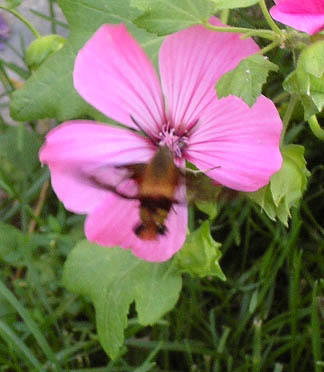
I think that this is a snowberry clearwing (Haemorrhagia axillaris*)--less pigment in the wings than some other hummingbird clearwings. What's that Bug? has a long page devoted to clearwing moths including a number of images of the various hummingbird moths, of which the snowberry is one.
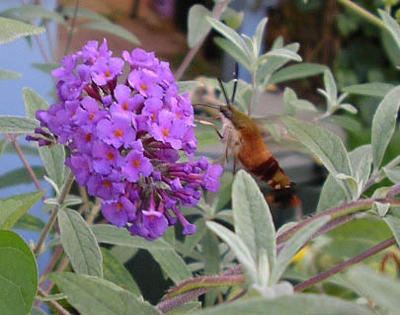
*Added later: "Haemorrhagia" may be some wierd variant spelling of Hemaris--I found a site that explained something about the difference between the pronounciation and spelling of this genus name, then lost it again in cyberspace. Additional research has lead me to think that this may actually be Hemaris diffinis--see comments.
Later still: Hemaris thysbe it was. See the post:Hemaris Thysbe

I think that this is a snowberry clearwing (Haemorrhagia axillaris*)--less pigment in the wings than some other hummingbird clearwings. What's that Bug? has a long page devoted to clearwing moths including a number of images of the various hummingbird moths, of which the snowberry is one.
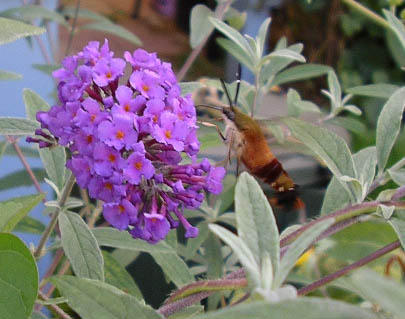
*Added later: "Haemorrhagia" may be some wierd variant spelling of Hemaris--I found a site that explained something about the difference between the pronounciation and spelling of this genus name, then lost it again in cyberspace. Additional research has lead me to think that this may actually be Hemaris diffinis--see comments.
Later still: Hemaris thysbe it was. See the post:Hemaris Thysbe
The Search is Over!!
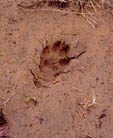
The Single Banded Foot is that of a rock pigeon, and a racer to boot!
Thanks to tony g, Nuthatch, Terry Sprague, members of the Eastern Ontario Nature Listserv, Chris Grooms, Mark Peck (ornithologist at the Royal Ontario Museum in Toronto), and finally Dorothy of the Canadian Racing Pigeon Union (CRPU)!
The origin of the bird will never be known--not without the other leg, as I expected. But it turns out, according to Dorothy at the CRPU, that the black band is informative. It is an electronic timing device, of the kind used on racing pigeons.
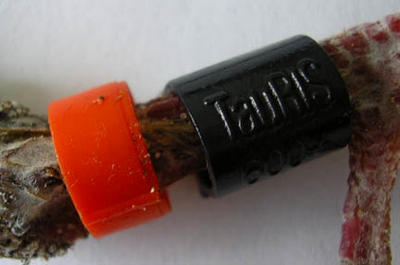
I learned a lot during this investigation. First, that I don't know much about birds' feet. I grew up in Toronto surrounded by rock pigeons (known until 2003 as "rock doves")and never looked at their feet. I was completely wrong about the kind of bird this was--the strength of the nails, and their curve suggested raptor to me--but the very first responses I got told me how wrong this was. I should have known better, perhaps, from the Gray Owl foot I had the opportunity to study earlier this year. (See Great Gray Tragedy.)
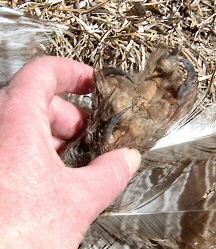
Also the bands I have now learned are bigger than bands that are put on wild birds--again, suggested by the first commenters, tony g and Nuthatch, based on their experiences banding birds. I am now determined to get out to Prince Edward Point in the County to help with the banding next spring.
But maybe the best thing about this whole chapter in my life as a growing birder was experiencing the generosity of the birding community in their willingness to help with this small, weird identification problem.
Thanks again!
Thanks to tony g, Nuthatch, Terry Sprague, members of the Eastern Ontario Nature Listserv, Chris Grooms, Mark Peck (ornithologist at the Royal Ontario Museum in Toronto), and finally Dorothy of the Canadian Racing Pigeon Union (CRPU)!
The origin of the bird will never be known--not without the other leg, as I expected. But it turns out, according to Dorothy at the CRPU, that the black band is informative. It is an electronic timing device, of the kind used on racing pigeons.
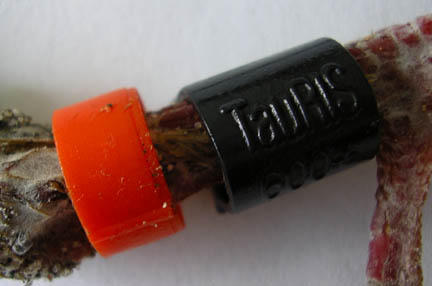
I learned a lot during this investigation. First, that I don't know much about birds' feet. I grew up in Toronto surrounded by rock pigeons (known until 2003 as "rock doves")and never looked at their feet. I was completely wrong about the kind of bird this was--the strength of the nails, and their curve suggested raptor to me--but the very first responses I got told me how wrong this was. I should have known better, perhaps, from the Gray Owl foot I had the opportunity to study earlier this year. (See Great Gray Tragedy.)
Also the bands I have now learned are bigger than bands that are put on wild birds--again, suggested by the first commenters, tony g and Nuthatch, based on their experiences banding birds. I am now determined to get out to Prince Edward Point in the County to help with the banding next spring.
But maybe the best thing about this whole chapter in my life as a growing birder was experiencing the generosity of the birding community in their willingness to help with this small, weird identification problem.
Thanks again!
Wednesday, August 31, 2005
A Feast of Carnivals

I just got word this morning that there is to be a new carnival, Circus of the Spineless, "A monthly celebration of Insects, Arachnids, Molluscs, Crustaceans, Worms and most anything else that wiggles," sponsored by milkriverblog, Bootstrap Analysis and Urban Dragon Hunters.
Deadline for submissions to the first edition, to be hosted by milkriverblog, is September 28.
Meantime, look for the 5th edition of I and the Bird (The blog carnival for bird lovers) tomorrow at A DC Birding Blog

Monday, August 29, 2005
A Monarch Year
Last year we saw almost no monarch butterflies at all--and we were not alone: numbers were down all over the region. This year, while not a spectacular year, the numbers are quite respectable. Sightings are reassuringly regular, and yesterday, finally a monarch caterpillar on a milkweed!
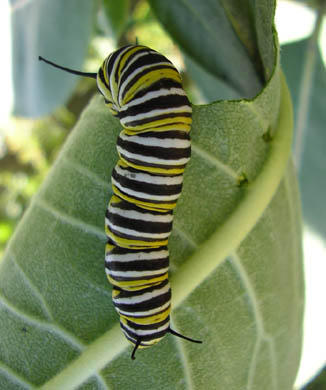
Once again, it was my neighbour Nancy who spotted this caterpillar and gave me a call (see Night Flyers for the cecropia caterpillar Nancy alerted me to).
Monarch butterflies are not the most co-operative subjects. After much time spent trying to get an open-winged shot, I settled for this one.
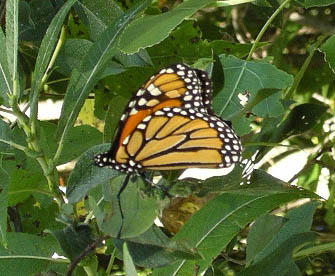
According to this site the main threat to the monarch butterfly is habitat loss in its winter range. But the least we could do in Ontario is take the milkweed off the "noxious weed" list!

Once again, it was my neighbour Nancy who spotted this caterpillar and gave me a call (see Night Flyers for the cecropia caterpillar Nancy alerted me to).
Monarch butterflies are not the most co-operative subjects. After much time spent trying to get an open-winged shot, I settled for this one.

According to this site the main threat to the monarch butterfly is habitat loss in its winter range. But the least we could do in Ontario is take the milkweed off the "noxious weed" list!
Subscribe to:
Posts (Atom)