This has been in many ways an extraordinary season. In the late fall, hearing reports of possible visits by a number of northern birds to my region I
wrote of my desire to see a crossbill. (Now that it's February, check out the Ontario Field Ornithologists'
winter finch forecast--see if it's panning out.) Crossbills were reported around Ottawa, a couple of hours to the northeast of Thomasburg, and sporadically elsewhere (and closer), but not here. Snowy owls have also been reported, and are still being reported in large numbers all around Ontario--no luck for me. (Though there is a place, Amherst Island, about an hour's drive away, where many have been seen--I could go down there, but what would be more interesting to me is if one came here.) I did get to see pine grosbeaks (see
Winter Birds); evening grosbeaks hung around for a while, but the warm weather seems to have put them on the move; and we've had some pine siskins; and regular visits by a small flock of common redpolls. Another northern bird I started to hear about in the fall was the
Bohemian waxwing. This made me nervous--too much like a bird I know, the
cedar waxwing. I was afraid that I would miss a Bohemian. So I studied up on the differences, read a number of interesting posts (see for example
this post at
10,000 Birds about the "wax" in waxwing, or
this post at
Words & Pictures about the winter return of the Bohemian, with a beautiful picture of same) about Bohemian waxwings, and then forgot all about it.
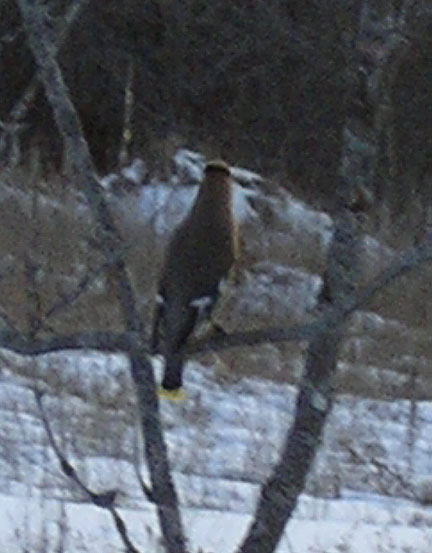
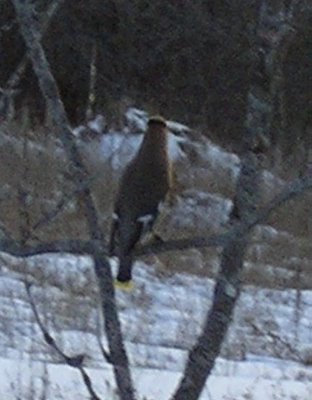 Not a great picture, but you can see the white on the wings,
the easiest to see field mark differentiating this bird from the cedar waxwing.
Late yesterday afternoon, when the light was starting to fade and I was making my way home from a walk across the fields, I saw a flock of birds fly overhead. The flight pattern was unusual, somewhat starling like. The flight calls were definitely not starling. They put me in mind of the cedar waxwing, but not much. The birds landed first on the top of a tree a field away--swirled to another, then out of sight. I stood and watched for a while--these were the first birds I'd seen on the walk aside from the ubiquitous chickadee, and I didn't want to go home without finding out what they were. A moment or two later they reappeared, flew over me and landed in a small red cedar (
Juniperus virginiana--a juniper that grows up, not across) in the scrape (the area of the fields where topsoil is harvested, and near where I stood. I could only see one of them (there were about 15), and I walked slowly up, sighting the bird with my pocket binoculars (not great, but better than nothing) as I walked. I saw the crested profile of a waxwing, so cedar waxwing? But this bird didn't look right, aside from the crest, the profile was wrong--too heavy, too tall. Then I noticed the white markings on the wings. That combined with the flight call suggested that these were Bohemians. I was able to move up enough to see them pretty well--and after the one that stayed visible flew off and landed on a nearby deciduous tree I took the picture above, in spite of the bad light.
When I got home I confirmed the identification, and noticed that the images in the field guides make the cedar and bohemian waxwings look much more alike than they look in life. I suppose if I'd been in a hurry I might have left it at the first sight of the crest and misidentified the bird. But once I got a good look I could see that the bohemian is quite a different bird.