Friday, September 08, 2006
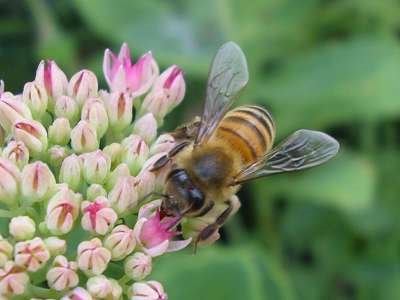
Friday Bee Blogging
Ever since the sedum first started to show the slightest bit of bloom they've been covered by these small bees.

Friday Ark #103


Tuesday, September 05, 2006
American Dagger Moth Caterpillar
At least that's what I think this is (aka Acronicta americana). Found this pretty, fuzzy yellow caterpillar on a leaf of a shrub in the garden (a purple-leaf sand cherry: Prunus cistena) back on August 24. It didn't seem to be dead, but neither did it seem very lively, not moving, not reacting much to a gentle prod.
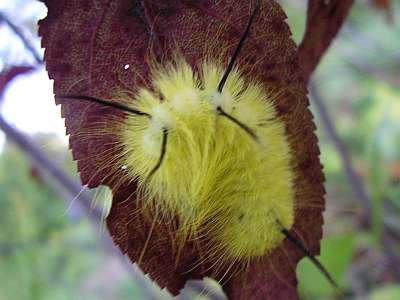
Next day, it was still there, in the same spot, apparently not having moved at all.
Day after that, August 26, this is what I found:
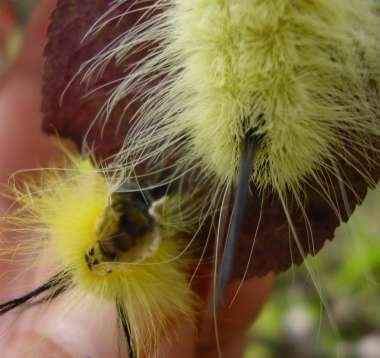
Off with the old!
What you see in the picture is the caterpillar above and its castoff exoskeleton rolled up below. I knew that caterpillars shed their skins a few times before they were ready to move on to the next stage, but somehow didn't picture fuzzy ones such as this shedding them whole, like peeling off a fur coat to reveal another underneath.
The day after the last shot the caterpillar was gone--then later I saw a quite lively dagger moth caterpillar motoring across the front porch and into the front garden, a cat with purpose! Cindy of Woodsong has a good picture of the moth this one will be turning into here.
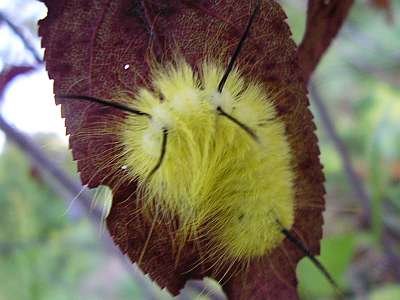
Next day, it was still there, in the same spot, apparently not having moved at all.
Day after that, August 26, this is what I found:

What you see in the picture is the caterpillar above and its castoff exoskeleton rolled up below. I knew that caterpillars shed their skins a few times before they were ready to move on to the next stage, but somehow didn't picture fuzzy ones such as this shedding them whole, like peeling off a fur coat to reveal another underneath.
The day after the last shot the caterpillar was gone--then later I saw a quite lively dagger moth caterpillar motoring across the front porch and into the front garden, a cat with purpose! Cindy of Woodsong has a good picture of the moth this one will be turning into here.
Friday, September 01, 2006
More Carnivalia
 What a week this is! A carnival, a circus, and now a festival: Festival of the Trees #3 is up at Bev's Burning Silo.
Festival of the Trees is a blog carnival of posts that celebrate trees in all their aspects. This month's edition is another great collection of posts from all over the world. Check it out!
And watch for Festival of the Trees #4, October 1, at Woodsong.
Thursday, August 31, 2006
Circus of Delights
Circus of the Spineless #12: yes, the first full year of the monthly carnival of the best of invertebrate blogging from around the blogosphere comes to a close. Where does the time go?
Ringmaster Steve of Sunbeams from Cucumbers (now there's an idea) has put together a great show. Check it out!

Ringmaster Steve of Sunbeams from Cucumbers (now there's an idea) has put together a great show. Check it out!
Watch for Circus of the Spineless #13, September 30, at Deep Sea News.

Sunday, August 27, 2006
Apple-Sumac Jelly
As I've mentioned before, this has been a spectacular year for fruit. After years of wanting to harvest wild grapes for jelly, for example, this year I've finally been able to do it, and leave behind many more than I took. The grapes are in the freezer right now waiting their turn in the jelly queue.
While picking grapes I discovered a little apple tree in front of the old apple tree in the far field that I'd never noticed before.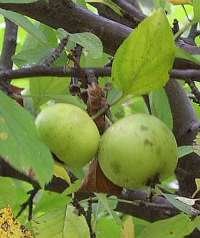 It had a few apples on it--I took some, left a couple, and cut the well-laden grapevine off it. I'll go back and clear the grapevine further back, and maybe next year this tree will produce a real crop. It's great to have all these wild grapes, but the vines kill trees, so I try to take them off of any trees that I want to protect. The grapevines are winning (maybe because there's too much edge and not enough woods) so I don't have any compunction about taking the side of the trees.
Last year was my first successful foray into jelly-making, using a few crab apples given to me by a neighbour and apples off the tree in the yard. This year I'm right into it: starting with strawberry, raspberry (best), blueberry and peach (not so good) freezer jams (all except the peaches fresh-picked in the neighbourhood), and moving on to chokecherry, apple, and most recently apple-sumac jelly.
The fruit of the staghorn sumac (Rhus typhina) is fuzzy, and quite unfruitlike. I've heard tell of a cold drink, reputed to be like lemonade, made with its juice. I've never tasted it, but doubt that's it's anything like lemonade. Nevertheless, here's a link to a recipe for it.
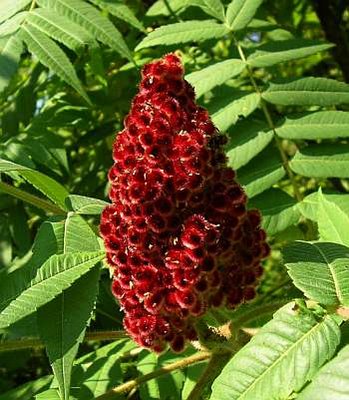
This is fruit as it was at the end of July. I gathered the fruit I used last week, by which time it had gotten quite dark. I was assured by people who knew that it was still suitable for jelly.
The juice I made for the jelly from the sumac fruit I collected looked and smelled like very strong tea.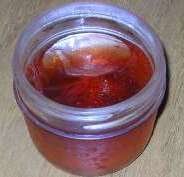 The jelly is delicious! Mine is a little soft, either because of the commercial juice I added or because it boiled over (use a large enough pot!!), so might not have boiled hard for the full minute. But I like it soft, so am content. Jelly depends partly on the pectin content of the fruit you start out with, something best determined by how the jelly turns out.
I was inspired to write about this by a post I read at Roundrock Journal about the winged sumac (Rhus copaliina). The fruit looks something like that of the staghorn, but isn't in tight clusters. I wonder if you can make jelly with it.
While picking grapes I discovered a little apple tree in front of the old apple tree in the far field that I'd never noticed before.
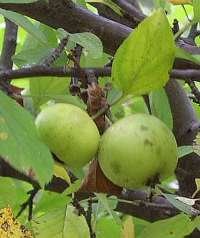 It had a few apples on it--I took some, left a couple, and cut the well-laden grapevine off it. I'll go back and clear the grapevine further back, and maybe next year this tree will produce a real crop. It's great to have all these wild grapes, but the vines kill trees, so I try to take them off of any trees that I want to protect. The grapevines are winning (maybe because there's too much edge and not enough woods) so I don't have any compunction about taking the side of the trees.
Last year was my first successful foray into jelly-making, using a few crab apples given to me by a neighbour and apples off the tree in the yard. This year I'm right into it: starting with strawberry, raspberry (best), blueberry and peach (not so good) freezer jams (all except the peaches fresh-picked in the neighbourhood), and moving on to chokecherry, apple, and most recently apple-sumac jelly.
The fruit of the staghorn sumac (Rhus typhina) is fuzzy, and quite unfruitlike. I've heard tell of a cold drink, reputed to be like lemonade, made with its juice. I've never tasted it, but doubt that's it's anything like lemonade. Nevertheless, here's a link to a recipe for it.
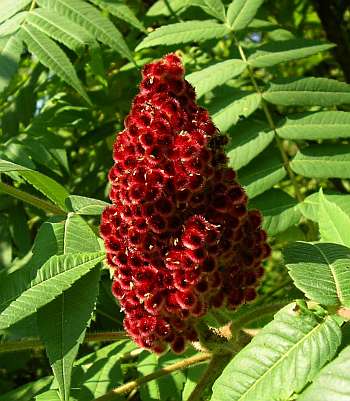
The juice I made for the jelly from the sumac fruit I collected looked and smelled like very strong tea.
To make the juice: rinse the fruit clusters, cover with water, bring to a boil, boil gently for about 10 minutes, crush through a sieve, strain though a jelly bag, or three or four layers of cheesecloth in a colander. (Get a jelly bag!) I cooked up the sumac with a few apples because I intended to use both in the jelly anyway, and to check the cooking time (until the apples are soft). I was nervous about both how it looked and how it smelled, but I went ahead. The juice will keep in the refrigerator for a few days.
Make your apple juice the same way--for small apples, cut off the blossom and stem end before cooking; larger ones, cut in quarters.
Apple-Sumac Jelly
7 cups juice:
3.5 cups sumac juice
2.5 cups apple juice
1 cup commercial apple-cranberry juice (which had been sitting in the fridge), added to make up the 7 cups.
The proportion of apple to sumac juice was arrived at by the amount of each I had ready. The commerical juice was a whim I had. Different proportions and different bits of whimsy would probably work out as well.
In a large pot, stir in one packet of pectin crystals, bring to a boil, add 8 cups sugar and boil hard for one minute. Take off heat, skim, bottle and seal, according to whatever system you use for this.
 The jelly is delicious! Mine is a little soft, either because of the commercial juice I added or because it boiled over (use a large enough pot!!), so might not have boiled hard for the full minute. But I like it soft, so am content. Jelly depends partly on the pectin content of the fruit you start out with, something best determined by how the jelly turns out.
I was inspired to write about this by a post I read at Roundrock Journal about the winged sumac (Rhus copaliina). The fruit looks something like that of the staghorn, but isn't in tight clusters. I wonder if you can make jelly with it.
Thursday, August 24, 2006
Teddy-bear Bee
Walking in the field a few days ago I was stopped by the sight of a small fuzzy something moving rather oddly across a leaf. A bee? A bee tangled in something? A strange bee!
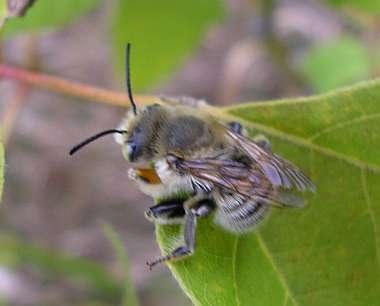
I knew, after I saw the photos, that I had something I hadn't seen before--but where to start to find out what? I went to BugGuide.net, joined up, and uploaded a couple of the photos (here).
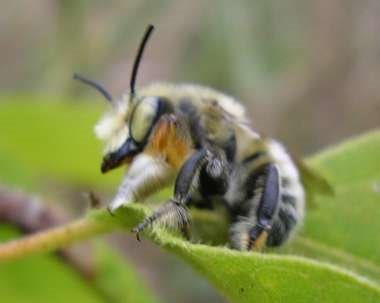
Fantastic feet!
In almost no time I had an answer: male leaf-cutting bee of the genus Megachile, identified by Eric Eaton
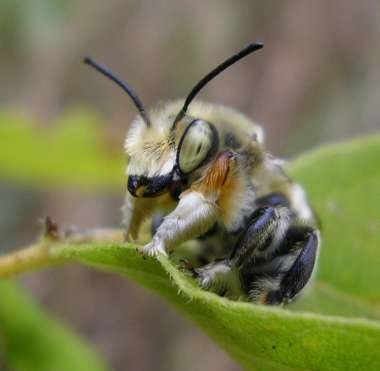
I've never seen a cuter bee!
I continue to be amazed that insect identification is possible. I'm still trying to let go of my vertebrate preconceptions. There are a number of advantages to keeping your skeleton on the inside--you can get a lot bigger, for example. But it does restrict the evolutionary pathways a species can follow. Looking at the world as a vertebrate I have a hard time getting used to the idea that relatively closely related species can vary enormously in what are to vertebrates very basic characteristics. Just one example: the mouth parts on this little cutie, compare them to those of the bee on scat I found in July.
Friday Ark #101 Who's on Board?

I knew, after I saw the photos, that I had something I hadn't seen before--but where to start to find out what? I went to BugGuide.net, joined up, and uploaded a couple of the photos (here).
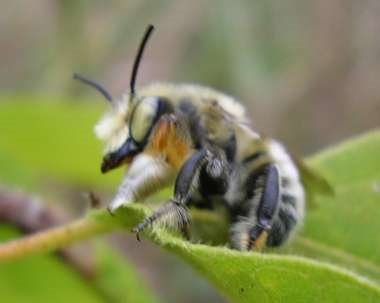
In almost no time I had an answer: male leaf-cutting bee of the genus Megachile, identified by Eric Eaton
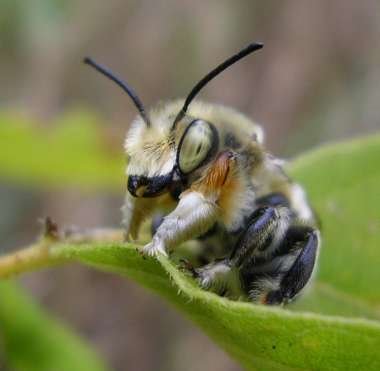
I continue to be amazed that insect identification is possible. I'm still trying to let go of my vertebrate preconceptions. There are a number of advantages to keeping your skeleton on the inside--you can get a lot bigger, for example. But it does restrict the evolutionary pathways a species can follow. Looking at the world as a vertebrate I have a hard time getting used to the idea that relatively closely related species can vary enormously in what are to vertebrates very basic characteristics. Just one example: the mouth parts on this little cutie, compare them to those of the bee on scat I found in July.
Subscribe to:
Posts (Atom)