Friday, September 29, 2006

A Hundred Common Yellowthroats

Walking at dusk tonight, down the lane to the lake (Lake Ontario) below the house where I sometimes stay in Prince Edward County, I ran into a flock of calling warblers. There was just enough light and co-operation to get a look at a Yellow-rumped Warbler, and then I knew the calls (which I've heard many times before). A little further on, light fading fast now, I ran into another flock, many more birds, different, louder call. The call of the Common Yellowthroat is one I know pretty well--but I don't know very many warbler calls, so don't know how many there are that are similar. I got a look at one bird, a pretty dim look, and I'm pretty sure Common Yellowthroat. But I've never seen/heard this bird in numbers like this. It was deafening.

Meantime robins were gathering and calling, blue jays were kicking up a fuss, and then three calling Great Blue Herons flew overhead. Finally a catbird joined in. There were at least two other species in the mix: something with a high thin call, and something else.

This place, Prince Edward County, is incredible for birds. I've written about it many times before, for example my stay down here during spring migration that I wrote about here, or my first red-bellied woodpecker, here.

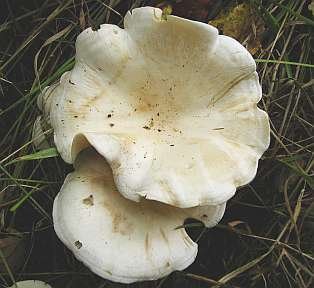
All those birds, and an interesting mushroom too.

Earlier today I watched thirteen Turkey Vultures (at least I stopped counting at thirteen) drift high overhead. Last night I stepped out to hear a Great Horned Owl softly hooting, then a coyote's single howl off in the distance, repeated a couple of times, until it was answered by another quite close by. For the last couple of days the trees around the house have been full of Eastern Phoebes and Yellow-bellied Sapsuckers. Yesterday I saw my first Winter Wren. Tomorrow, who knows?

Thursday, September 28, 2006

I and the Bird #33

Travel the world with Texas journalist, tax expert and birder Kay Bell of Don't Mess with Taxes, host of the 33rd edition of I and the Bird, the carnival of the best of recent bird and birder blogging. Head on over!


I and the Bird #34 will be hosted by Pam at Tortoise Trail, October 12. Click here to learn more about the carnival.

Tuesday, September 26, 2006

Fall Birding on a Windy Sunday Afternoon

After a rainy Saturday, Sunday came bright and windy. Windy, especially after the leaves start to fall is about the least favourable condition for checking out birds. It's hard to see them among all the other movement, and very hard to hear them, or locate sounds that you do hear.

Nevertheless, since I could feel the migrating birds all around me, I headed out to see what I could see. Across the street from the house there was a flicker, as there has been almost every day lately, at the top of a dead tree. Blue jays were calling, and crows were cawing in the hamlet. Interesting about the crows, once the breeding is over they seem to move off somewhere, then either they return, or another family-or-two-sized murder of crows moves in. Lately they've been scarce, until this past weekend.
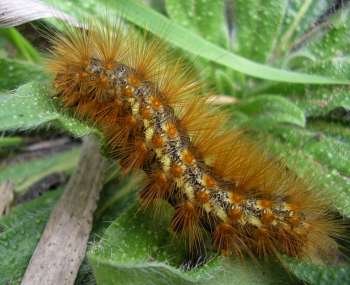
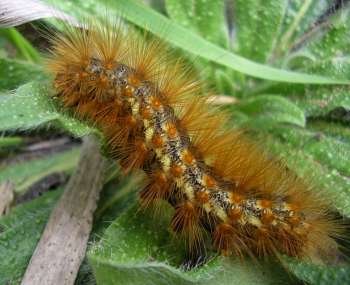
Virginia Tiger Moth Caterpillar, I believe.

Once I got out into the scrape I found this caterpillar. I've been seeing lots of these in the past few weeks. This one is on viper's bugloss, just like the one that was the subject of a post from this time last year, Tiger Moth Caterpillar?

The scrape was not scraped for topsoil this year (the activity for which I've named the area), nor was the pile created last year taken, and the crop of various colonizers is fantastic, providing lots of seeds for the taking. The main takers are sparrows and Mourning Doves. Mourning Doves flush so noisily and distinctively there's no problem knowing them. Not so with the sparrows. Over the past few weeks, when I can catch a glimpse, I've seen flocks of Chipping Sparrows, Vesper Sparrows, Song Sparrows, and on this occasion Field Sparrows. But often I can't identify them, as I walk they fly up from the weeds fast and fly quickly to a better spot down into the weeds again. There are a couple of small trees, but even when they take shelter (from me) in them I can't always get a fix on them.

Carrying on, without much hope of finding much more, I entered the far field and wandered up to the old apple tree. Surrounded by a thicket of prickly ash and other shrubbery, this is a good location for warblers, sparrows, and many others. Nobody was there, but I did find a couple of beautiful mushrooms.
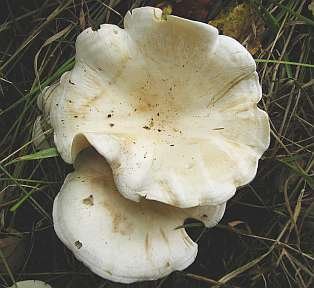

After a very dry end to summer, dry enough to curl the leaves of lots of trees and send them into an early fall, we've had a pretty wet few weeks. Everything not set too far back is green again, and there are mushrooms everywhere.

The wind was blowing pretty hard and I remembered all the living poplars I've seen snapped in two by wind (while long-dead elms stay standing) as I walked past stands of them. Once again nothing big came down while I was out there. A single Turkey Vulture flew overhead, going south, more or less. The flyway over Thomasburg in the fall for most flocks usually goes from the northeast to southwest, sometimes almost east to west. More flickers were calling around the edges of the far field. I headed south along the far edge and finally found the kind of commotion I was looking for. More Field Sparrows, some possible others, and an Eastern Towhee (Pipilo erythrophthalmus). It was the exact spot where I've seen a fall towhee in previous years. It's not where the breeding pair hang out, though not far away. The spot looks like the shrubby edge habitat the runs along the edge of the far field--but if you wanted to see a towhee in September that's where I'd send you. Must be something particularly lovely about it that I just can't see.

Making my way back, taking note of the leopard frog and the lovely giant dragonflies (none of which would settle for me to take a look--I was amazed that they could fly at all in that wind), I crossed the south end of the scrape again, and flushed something out of the weeds growing on a topsoil pile. Sparrow, I assumed, and raised the glasses to see if I could see which one.

Not a sparrow. Not a sparrow at all. I managed to get a few good looks as the bird balanced on a stalk, then flew into a nearby tree. A vireo! What the heck was a vireo doing out here, in the open, in the grasses and weeds? And which one was it? Some yellow underneath, no fancy eye ring. There was a pale eyebrow though, more distinct than the warbling vireo's. After I got back to the house I studied the vireos and decided that this was probably a Philadelphia Vireo ( Vireo philadelphicus).

Another bird, like the Scarlet Tanager of last week, completely out of its normal habitat. These are the strange pleasures of fall migration birding.

"You know when the moon’s blue it's a circus."

Circus of the Spineless, through the night, through the artists (Peter and Craig) and patrons of Spineless Tattoo, at Deep-Sea News. A little taste of the action:
Peter: Why the visit?
Tough Guy: Caterpillar
Peter: Caterpillar?
Tough Guy: Caterpillar tattoo
Peter: I got that much
Tough Guy: I was thinking something intimidating like a Hickory Horned Devil (courtesy of Fragments of Floyd) or Hornworm, maybe a black one (courtesy of Thomasburg Walks)
Peter: Tough Caterpillars?
Tough Guy: Dames like’m.
And this exchange:
Dame to Craig: Is that an earthworm your working on?
Craig: Yep
Dame: Why?
Craig: You can’t underestimate the impact of the earthworm (courtesy of Bootstrap Analysis)
And so much more--the best of recent invertebrate blogging. Check it out!

Saturday, September 23, 2006

Night falls fast

This time of year a walk at dusk has to be quick and timely. It takes me a while to get used to the change from the long evenings of summer, so tonight, as often happens, I was late getting out, and after a comparatively brisk walk around the fields (half an hour instead of the usual hour-and-a-half), came home in the dark.

The fields were full of birds I couldn't see, making calls that, for the most part, I couldn't identify. Yes, there were robins, and sparrows of some kind, but were those other "chuckers" cardinals, and what about those other, more mysterious calls? I let it go for the pleasure it is to be out there surrounded by sound in the misty gloom.

I flushed a cottontail as I walked--reminding me of just how little I can see at dusk. It was apparently sitting in the open when it made its dash. I was quite close and could see that white puff of tail bounding away, but if it had sat tight, I would never have seen it. I wouldn't be able to see a coyote in that light either, as I learned a few years ago. A neighbourhood dog whose home backs onto the fields used to be "at large" sometimes, and when it was it felt responsible for the whole area. If the dog was loose and I came out to walk it would follow me the whole time, at a distance, barking. I call the dog Berkeley, after the Bishop Berkeley (1685-1753), whose metaphysics is based on the precept, "esse est percipi," i.e., to be is to be perceived.

Berkeley is a German shepherd (or Alsatian) cross, so has the same basic colouring as the local coyotes. One fall evening Berkeley was out keeping pace with me, barking so that I could be certain of my existence, when he/she disappeared. There was still enough light that I could walk comfortably, and see my destination easily. But I could no longer see one loud brown dog against the earth and dead grasses just 15 metres or so away. Kinda spooky.

Tuesday, September 19, 2006

Season of the Unexpected

Even more than spring migration, fall migration is a real test of birding skill. I need more of it--skill that is, not fall migration.

Yesterday I stepped outside to see a flock of seven to ten birds (maybe more) flitting about in the lilac and Manitoba maple just off the corner of the house. Yellowish, dark wings, pale beaks, not too small. Orioles? They'd have to be Orchard Orioles, which would be interesting, since we are just beyond the normal range of the Orchard, though they're moving into our area. But not only are the beaks pale, but they're a bit too heavy for an oriole.

I took a few pictures, which didn't show much (got to get a better camera ...). I got the best looks I could, but they were moving fast in and out of the foliage. Gleaning? A little flycatching? I came in and consulted the books (mainly Sibley's). My guesses didn't seem to be quite right. I decided to sleep on it.

This morning I went back to the sometimes-successful method of flipping through the book. Identification is so much easier when you already know generally what kind of bird you are looking at: finch, oriole, vireo, even warbler, narrows the question down nicely. It doesn't always lead to an answer, think flycatcher, sparrow, for example, but it gives you a basis for inquiry. Without that, you're left with the flip method. It sometimes fails--gives one an odd feeling when it does: when one looks at every bird in the guide and doesn't see the bird that just passed through the yard. But it happens a lot.

In spring birds arrive in their breeding plumage, and are often singing territorial songs long before they get to their breeding grounds. It's always tough to identify birds out of context, but the plumage and songs make it much easier. In the fall, most birds are in winter plumage and singing is sporadic and often off key (though I did hear a pretty vireo song this morning).

So, there I was flipping. Considering perusing the finches (though it wasn't any finch I knew), when I stumbled into the tanagers. And there it was: Scarlet Tanager (Piranga olivacea). scarlet tanagerThe male in breeding plumage is unmistakable in his brilliant scarletness. But this is a bird I've only seen a few times (for example, May 2006, Prince Edward County--at right).

The Scarlet Tanager lives in mature deciduous forest, a kind of habitat I visit sometimes, but not one I enjoy every day. In other words, this is not a bird I know the giss of, and certainly not a bird I expect to find feeding in the yard.

A little later on I was back out in the yard. The tanagers were gone, and among the chickadees now feeding in the same Manitoba maple there was a Yellow-rumped Warbler. Now that's a fall migrant I expect to see!

Monday, September 18, 2006

A Hornworm of Another Colour

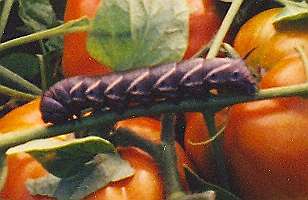
In August of 2003 I discovered this critter and some friends on garden tomato plants. I grabbed this photo but was unable to find out what this was until this past weekend. I posted the photo on BugGuide.net and within the hour I had the answer. It looks so much like a tomato hornworm because it is.

A later blog search turned up a post at Pharyngula from last February that mentions this phenomenon: Evolution of a Polyphenism. Apparently the colour variation is a result of temperature during the early stages of development--not sure if it's during the egg stage or what. Anyway, cooler temperatures result in this black form; warmer, green. I checked the weather records for the summer of 2003 and found that while it was a fairly moderate summer (as compared with, say, 2005), and there were some cool nights in July (10C), nothing jumped out as a protracted chilly spell.

Tomato Hornworm (Manduca quinquemaculata), dark morph.