Wednesday, July 20, 2005

A Busy Morning in the Yard

The weather has turned--still hot, but the humidity is much decreased. The yard was one busy place this morning. A family of great crested flycatchers is hanging around. Adults calling, fledglings begging, everyone flying from tree to shrub to tree.

The honeysuckles are full of robins, adults and young, and we have some eccentric singers among them. Our local naturalist, Terry Sprague, has written about the problem of dialect differences among birds, i.e., the problem it poses for birders, but he is comfortable distinguishing birds by "tone of voice." I am only really familiar with a few birds' tones, but I am finding at this point on the learning curve I hear much more and am confident of less. So I am out in the yard frequently through the day to see if that really is a robin I hear. What I don't know is if all the funny songs I am hearing are being sung by adults. Maybe the young try out their songs in their first summer?

There is a family of rose-breasted grosbeaks in the mix, and while I usually know this bird's song, it (and a host of others I am just learning) have enough similarity to the robin that again I must check, check, check. The begging call of the grosbeaks is also quite similar to that of the great crested flycatchers--different tone, similar pitch and duration--at least that's how it seems to me.

Even the wrens are creating an epistemological problem for me today. Perhaps because there are wrens in both birdhouses, which I haven't experienced before, either one of them is singing its song almost upside down, or there's a mystery bird out there too--always a live possibility. Right now, through the window, I can hear the mew of a flicker, I think, but it may also be a yellow-bellied sapsucker. Both hang around here--and sometimes by this time of year I'm in birdsong overload, and really need to check everything I hear.

With all this action in the yard, not even mentioning the sparrows, goldfinches, catbirds, common yellowthroats and chickadees (and whoever else I'm leaving out), and the first pleasant morning we've had in long time, I was anxious to get out on the walk.

To my surprise there was very little going on in the fields. I saw one kingbird, some unidentified sparrows, a mourning dove, and of course heard the ubiquitous wrens. Also singing, a field sparrow, and just as I was heading back the common yellowthroat in the cedar bush started up. Maybe if I'd lingered I'd have heard and seen more--I really want to see that Brewster's warbler carrying food (which would confirm it as a breeder for the Breeding Atlas). But I kinda rushed through because of the one species that was very active and very numerous today. From the time I hit the scrape, all through the far field and most of the way back home I was being buzzed by 10 or 15 deer flies. This is more than I've ever seen before at one time here. I wasn't bitten--perhaps like blackflies these were species-specific biters but omnivorous buzzers--but they made it very difficult for me to relax and stand in one spot for any length of time. The mosquitoes, on the other hand, were much less numerous than they have been recently, even in the cedar bush.
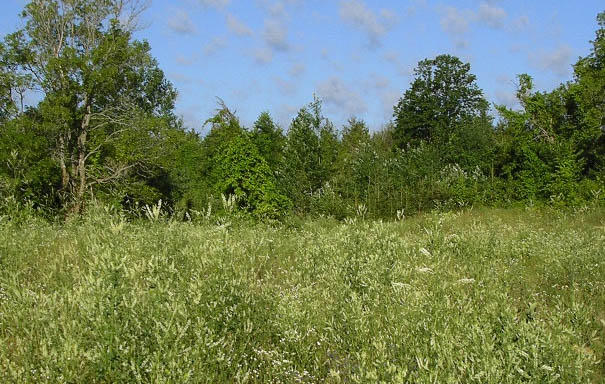
The fields turning white

As striking as the number of deer flies in the fields was the change of colour. Where purple dominated just a little while ago (clovers, bugloss, and above all curly vetch) now white has taken over. The sweet clover, a tall clover with clusters of small white flowers and the Queen Anne's lace are just coming in to their own.
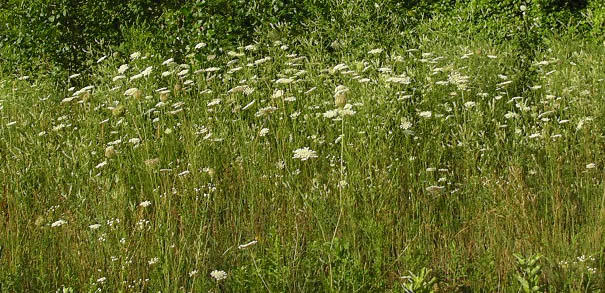
Queen Anne's lace

Saturday, July 16, 2005

The Scrape

In spite of the heat and humidity (less smog though) I have finally managed to get out into the fields a couple of times over the last 48 hours. Fledgling activity is high. I saw a family of brown thrashers wandering up the lane at the north end of the scrape. I listened for many minutes to a plaintive cry until I was finally able to identify it as that of a fledgling rose-breasted grosbeak. The oriole family at the near edge of the field was out and feeding and the wrens were scolding everywhere. I've never seen so many wrens here before!

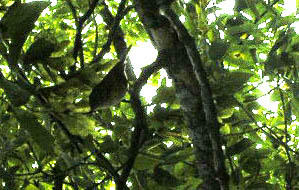
Here is one of the many wrens who scolded me just for being alive this morning.

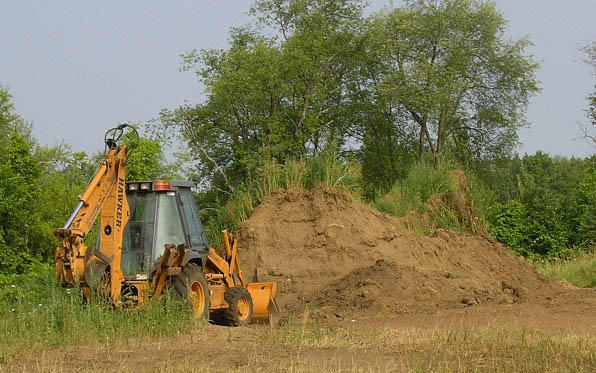
The other notable observation I made was that the scrapers are back scraping the scrape again this year. Every year they take some topsoil out, and pile up more to sift and remove the next year. All they've done so far is move a pile or two and start a couple of new ones.

The scrapers' scraper, sitting in the fields just north of the original scrape.


The topsoil harvest makes this part of the walk more interesting in a number of ways. The two most obvious are the opportunity it creates for the observation of colonizing plant species, i.e, answering the question (differently every year) of which plants will turn up first to cover the newly bared (and rather impoverished) landscape, and the surface it leaves for tracks.

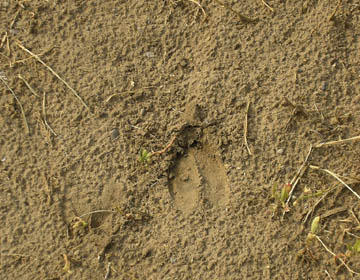
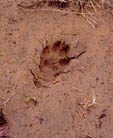
Deer track

We had rain two days ago--fierce downpour, but not enough to make a real difference. The fields were as dry as dust this morning, but there must have been enough dampness when this deer came through to make this nice clear track.

Tuesday, July 12, 2005

Where the snakes are.....

Some years are snake years--some years are not. This summer has all the makings of a snake year, hot, still, hazy (we're back in the smog again), but I haven't seen many snakes. The season started with great promise. On May 28 I was sitting on the front porch, glanced across the street and saw a suspicious long thin object sprawled out on the road. I quickly ducked in the house for my shoes, and when I stepped out again I could see that the object had moved--my first instinct had been right, a snake and alive. I started walking over, hoping I would get to it before a car came by.

It was a milk snake, Lampropeltis triangulum, about a metre long but very slim. As I approached it reared up, coiled back and started to vibrate its tail. I managed to chase it off the road in spite of its recurrently diplayed willingness to stand and fight.

In the literature milk snakes are sometimes described as docile, sometimes as feisty, and I have seen both. A couple of years ago I saw my neighbour across the street chasing something on her stoup with a hoe. After a moment or two I realized to my horror that she was chasing a snake. Calling out that I would help I rushed over. That too was a milk snake, but very calm, especially considering the circumstances. It was uninjured (my neighbour told me that she didn't want to hurt the snake, but she couldn't bear for it to be so close to the house), and allowed me to pick it up with no difficulty at all. I carried it back across the street and let it loose in the tall grass at the edge of the yard.

Milk snakes are a species of concern. It is not thought that they are endangered, but because of the habits described above there is believed to be a lot of pressure on their population. The habit of coiling back as if to strike and vibrating the tail puts people in mind of the rattlesnake, as it is intended to do, of course. But people react to the thought of a rattlesnake by killing. The habit of lying on the road leads to death by automobile. So, like so many other species, the primary threat to the milk snake is us.

Because of its status as a species of concern, the Natural Heritage Information Centre (Ontario) collects reports of sightings of this species at their Web site.

Identifying a milk snake is not as easy as I once thought. We see them here every year, some years more than others, and for a while I was convinced that some of the snakes I saw were the much rarer fox snake. The fox snake is provincially rare, and non-existent in eastern Ontario, yet I was not the only one to believe that we had them here in Thomasburg.

The fox snake also vibrates its tail when threatened (and is found in an area where there actually are some rattlesnakes, southwestern Ontario), and is to my eyes quite similar in its markings to the milk snake. Here's a link to a site that has images and descriptions of all the lizards and snakes in Ontario. If you look at the images on the site given you'll see two snakes that look quite different. The milk snake there has much greater contrast between the marks and background on its back, and looks more red than beige. I've seen snakes around here that look like that one, and more, that are very red, with very sharp contrast, and a very clear black-and-white checkered pattern on their bellies (fox snakes also have this belly feature, but with a yellow rather than white background to the markings). These snakes also tend to be very small. It turns out though that as they grow milk snakes tend to become much more brown or beige, and lose that sharp contrast between foreground and background markings. Older milk snakes also tend to be quite large and heavy, generally much heavier than the snake I chased off the road this spring.

So, two years ago I spent some months and many e-mails to various experts trying to establish that there were fox snakes here--sure that the big heavy beige and brown snakes I'd seen had to be these. Finally I found another way to distinguish the species. The fox snake has a divided anal plate, the milk snake does not (there are other species with divided anal plates that might have been part of this story, but as it turned out they were moot). The anal plate is just what is sounds like, a plate on the underside of the snake at the anus.

The controversy ended with the death by car of a snake here in the hamlet. It was one of the mystery snakes, and the accident left the anal plate intact. If you get a good look at the underside of a snake this is a very easy field mark to recognize. The snake had a single anal plate, hence milk snake.

But now there's the black rat snake--a new controversy in the making. The black rat snake is found in eastern Ontario, but only in a few places, primarily Frontenac Provincial Park (east of Thomasburg, due north of Kingston). It is a big snake, and, of course, black. Neighbours in the hamlet report that they have seen this snake, and this year I almost believe (ever hopeful of a sighting of the rare) that I almost saw one a few weks ago. Standing in the driveway, saying goodbye to guests, my arms full of a tomato plant I was carrying down to the car for them I saw just a bit of a very large, very dark snake in the grass. It slithered away before I could get organized to go over for a better look. I've been keeping my eyes peeled ever since.....

Friday, July 08, 2005

Year of the Vetch

This year perennial gardeners in this part of Ontario lost all kinds of plants to a particularly nasty winter: little snow cover, a significant February thaw, and a spring that ran both hot and cold. But a season that's bad for some things is best for others. Few roses made it through, the bloom on the lilacs was pitiful, but the honeysuckles were delightful.

In the fields, due to conditions, amount and timing of rain and frosts among others, and the normal succession of plants (from ragweed to hardwood forest), the dominant wild flowers (or flowers run wild) also change every year. This year is the year of the curly vetch.


Curly vetch close-up


Every year there is some curly vetch in the yard (where the mower doesn't run) and in the fields, but this year, and right now just at its peak, everything else is dominated by it.


Curly vetch covering the far field.

The close-up of the vetch was taken today, a rather gloomy day, which is why the colour is so different (well that and because I'm still learning to control the new camera). I swear it's the same flower.

Also in bloom now are the viper's bugloss, various clovers, fleabane, bladder campion, some mustards, and a number of other wildflowers.


Viper's bugloss

Wednesday, July 06, 2005

Speak of the Devil...

Monday I wrote about the house wrens in the yard, and the bluebirds that scouted early in the spring and went on their way because the accomadations weren't ready. Well, yesterday morning a pair of bluebirds turned up to scout for the second nesting! I don't think there's much chance that they could take a house from the wrens at this point, but it was nice to see them.

Meantime the wrens continue to sing, and now one of them has started to renovate the house on the stump.


Wren renovation

Male house wrens entice females by finding suitable nesting cavities and filling them with twigs. When a female accepts the spot, she rebuilds the nest to her liking, but the final product is a pretty stick-filled affair. In the picture you can see that a twig is sticking out of the house today where there was none on Monday. Males will also take on two females (two nests) if they can, but it's pretty clear that there are at least two males in the yard right now.

I also got out on the walk yesterday, in spite of the smog, heat, humidity, mosquitoes and deer flies, but I couldn't linger as long as I like to, so didn't see a whole lot. The chestnut-sided warbler is singing, along with the American redstart, the common yellow throat, and the multitude of sparrows. I did see a king bird, but there was no activity at the nest in the old apple tree. I'll have to keep an eye on it, but I am concerned that the nest may have failed, as many nests located where they can easily be seen seem to.

Walking back I was struck by the growth in the area I call "the scrape," because topsoil is taken off regularly, and earth is piled for the taking the next year. There is usually a scruff of weeds across the scraped earth by this time of the year, but this year the growth seems very lush.


Last year this was a bare, scraped patch of earth and a mound of piled up topsoil--just look at it now!

Monday, July 04, 2005

And Changed Again

After a two-day reprieve we're are back into the heat, humidity and smog again in all of southern Ontario. They say the smog will lift tomorrow by mid-day, but I can feel a breeze from the south through my window as I write, and until that changes the smog will keep pouring in.

So between the weather conditions and the mosquitoes I know are out there, I'm taking the day off from the walk. But there's lots going on here in the yard today. And the house wrens are dominating the scene. House wrens, as the name suggests, like to nest in bird houses when they can get them (i.e., they are cavity nesters, and the houses we put up for bluebirds are a favourite of theirs). In the first round of nesting house wrens occupied the nest box on the elm tree by the road, and a family of chickadees took the house on the stump. Normally we have tree swallows and bluebirds in the boxes, but this year we got them up too late. The swallows and bluebirds scout nesting locations a few weeks (at least) before they're ready to nest, and when they scouted the yard there was nothing that suited them.


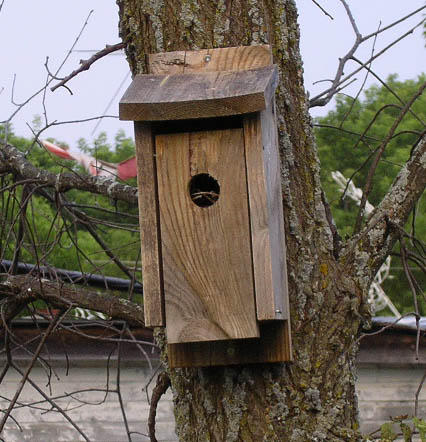
You can see twigs poking out of the box--the classic sign of the house wren.

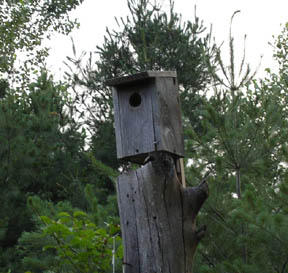
The wrens come a little later, and the chickadees are here all the time and ready to move in. We've had chickadees use a bird house here before, but they are so quiet when they nest (and so noisy the rest of the time) that we scarcely noticed. The house on the stump though is pretty central.


House on the stump.

The chickadees fledged a couple of weeks ago, made a great ruckus all around the yard, and then were off. The wrens fledged this past week from the box on the elm--and from another nest or two whose location I don't know. But there are many wrens in the yard right now--yelling at anything they don't like the look of, and in the last few days there have been two males singing lustily. It looks as if there will be wrens on their second nests in both boxes.

Other fledglings in the yard today: robins and purple finches. The young crows are still yelling their heads off across the street, but they're also moving around more--almost ready to fly with the big guys.

The catbird has started up singing again--it has a song like the thrasher, but each phrase is only used once in the sequence. (I realized that an earlier posting about the song of the thrasher was not entirely clear--what I meant to say is that the thrasher can be distinguished from the catbird because it sings each phrase of its song twice, not once.)

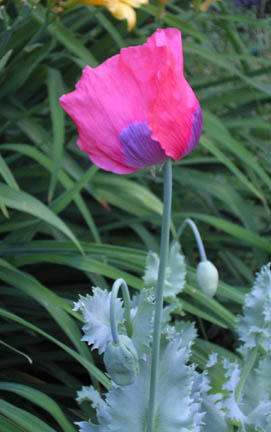
And the poppies are starting to bloom.


Papaver somniferum, the opium poppy, was made illegal in Canada just a few years ago. Strangely enough, this occurred in the context of some legislation to liberalize the laws with respect to marijuana. Somniferum is a self-seeding annual in many gardens in Canada, including this one. But our climate is unsuitable for the production of quality opium.

Saturday, July 02, 2005

A Change of Weather

The heat wave finally broke last night--temperature dropped to below 14C. This morning the sun is shining, the breeze is blowing and the walking is easy.


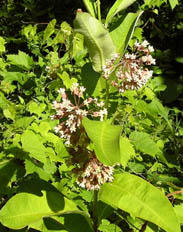
I've seen two monarch butterflies in the past few days, first of the season. Last year the number we saw here was way down, and according to my sources, all of eastern Ontario was the same. The milkweed is plentiful and just coming into bloom. Here's hoping that we see a few more butterflies this year.

I got out on my walk at about 7:30 this morning. Things were pretty quiet--mainly sparrows singing, and the wood thrush, no warblers. The brown thrasher spent some time follwing me, but I didn't see the fledglings this time. I did however see the Brewster's warbler lurking in the shrubbery, and taking careful note of me. I have yet to see a bird that might be a suitable mate for it--i.e., a female of either of the parent species or a female hybrid (the latter of which I'm not sure I'd recognize). But the lurking does make me suspect that he's nt just singing, but nesting too.

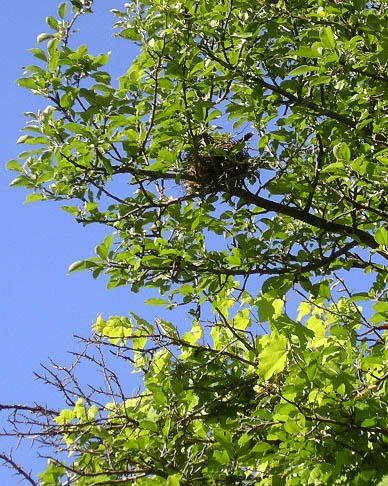
The pair of kingbirds on the other hand are definitely nesting in the old apple tree. The nest is still there, and one bird is firmly sitting on it--so still eggs, not nestlings. The other bird is hanging around--guarding vociferously against crows, but just watching me closely, without comment.


In the centre of the upper half of the image you can see the nest, and on the right hand side the white band on the end of the kingbird's tail.