Thursday, August 04, 2005

Nature Stories

Cruising around the blogosphere over the last couple of weeks looking for science and nature blogs (I found lots--see the blogroll for a selection of interesting sites!) I was struck by the energy being expended, mostly on American blogs, on the issue of Intelligent Design (ID) vs. Darwinian Evolution. I knew that this was an issue in the United States, that there are movements afoot to add ID to high school science curriculums, but I had no idea that the controversy was as heated and active as it seems to be. President Bush's remarks a couple of days ago (see for example these articles at Truthout), to the effect that he favoured the inclusion of ID in curricula, created a spike in blog activity on the topic.

This is pretty disturbing on a number of levels. The most immediate is not only that ID "theory" is not science, but that it seeks to end biological science as I know and love it. In my post, Midsummer, for example, I talk about different strategies for the raising of young among warblers. Darwinian evolution creates the context for this conversation. It is the framework for speculation and investigation into why this species is doing well and that one isn't in this slice of time, so small in the history of the two species as to be less than the blink of an eye. It is what makes diversity and change in the natural world interesting and meaningful. Taking it away sucks all the fun out of what I love to do--watching and learning, thinking about the life around me. I would hate to see the opportunity to experience nature in all its real complexity taken away from anyone.

I won't get into the arguments that are being put forward for and against ID--check out Pharyngula (much discussion, but current major post here and Panda's Thumb for lots of discussion and a list of sites addressing this issue this week. I read a number of the recent posts with interest, and I stumbled on a five-parter at Panda's Thumb about an evolutionist's experiences attending a creation conference that was both funny and sad by turns, and gave a good deal of insight into what's going on in the "creation" world (here is the link to Part One).

But in the end I just find it sad that energy is being expended by biologists and philosophers of biology defending evolutionary theory against this stuff.

Sunday, July 31, 2005

Midsummer

The weather has been perfect for birding the last couple of days--light breeze and cool mornings. And although this is a quieter time than the spring, it is also a time when there are both birds nesting, birds courting, birds molting, and birds back on the move.

Friday morning I saw and/or heard these birds as I stood in the yard: savannah sparrow, chipping sparrow, cardinal, wrens, chickadees, crow, blue jay, phoebe, chimney swift, cedar waxwings, goldfinches, flicker, rose-breasted grosbeak, and an unidentified singer. Out in the fields there was a goldfinch calling incessantly, a contact call I suspect, but one I didn't know. Five great blue herons flew overhead together, another followed a few minutes later--family group? A pair of towhees calling a singing. A field sparrow carrying food. And the female common yellowthroat was keeping watch at the willows by the cedar bush.

This morning was even more business than travel. Because it was so cool, and because the swamp is all mud, no water now, I was able to get right into the cedar bush for the first time in a long time.

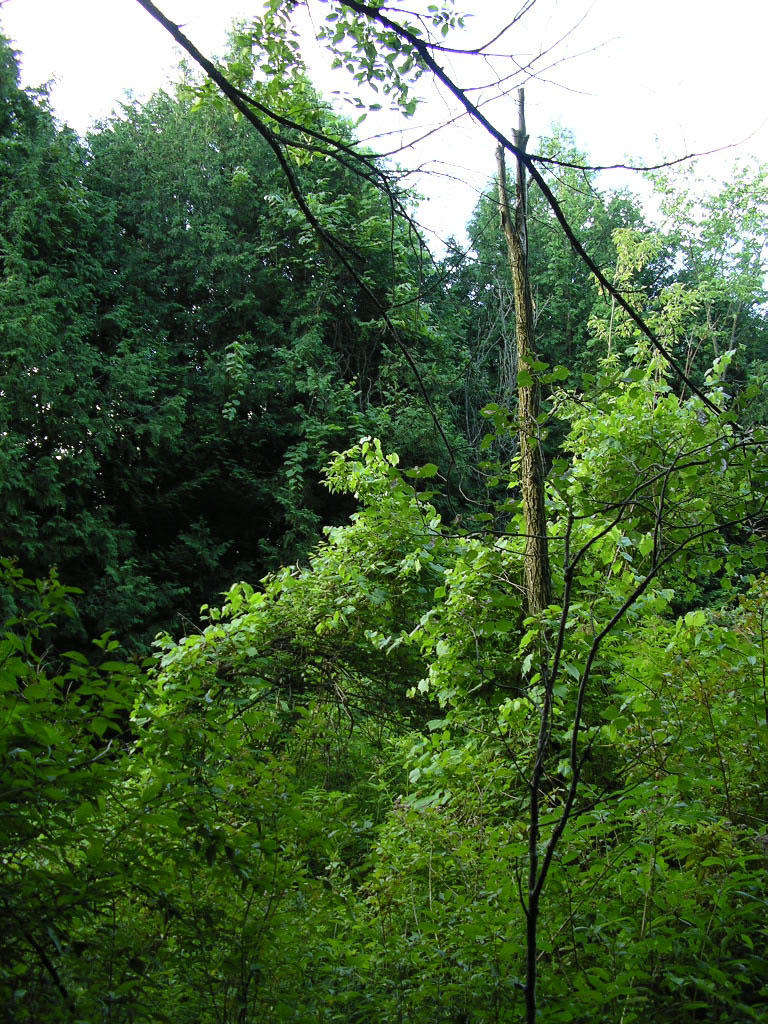
This is a view across one of the swampy clearings in the bush.

And I finally caught the common yellowthroats carrying food. The first, by the willows on the outside of the bush, because I came along and caught her at it. The second, in a swampy clearing in the bush, because he didn't see me.

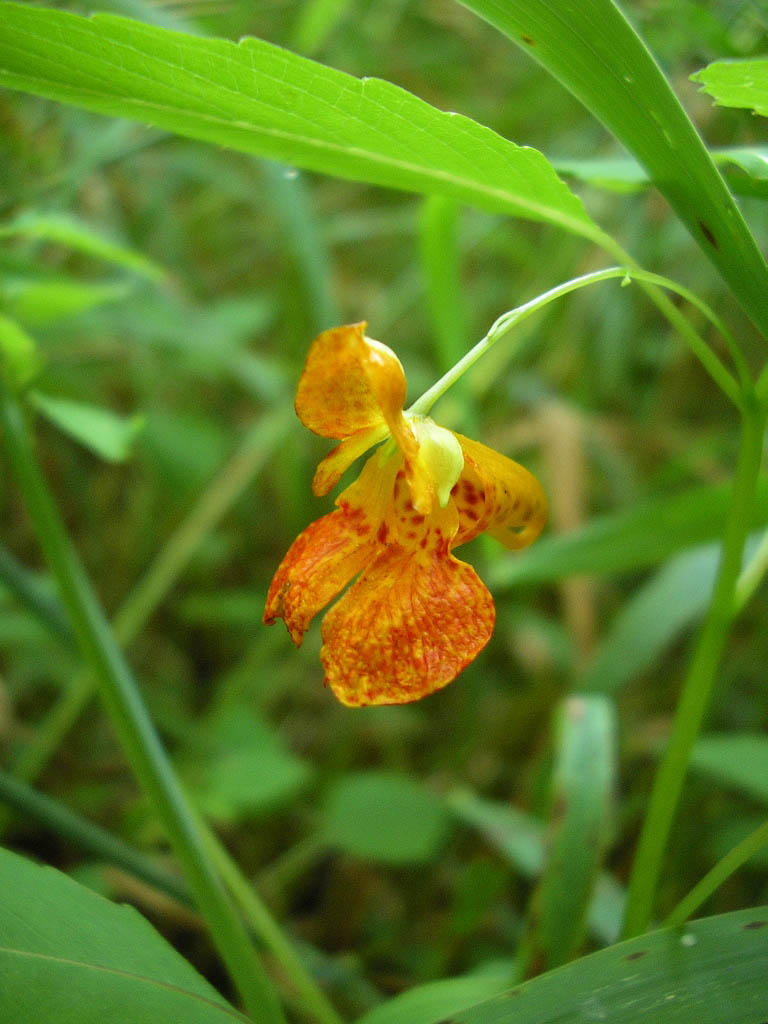
Joe Pye weed over my head.

I was hidden by the Joe Pye weed. This plant did pretty well last year for the first time since I've been walking here, but this year it is dominating the clearings in the cedar bush, and standing about 2 metres high, compared to just over a metre last year. Other years Virgin's bower clematis has dominated in here.

At the beginning of the breeding bird season this year when I looked over my data for the previous 4 years I was surprised to see that no one, not me, not the more expert birders who worked in my square last year, had been able to confirm the common yellowthroat as a breeder. To confirm a bird, you need to see it entering or leaving a nesting site or carrying food or a fecal sac, or you need to see new fledglings, a nest with eggs, or hear or see a nest with nestlings. The common yellowthroat was down as a "probable" breeder, on the basis that it had been observed to be on territory, i.e., had been heard singing in the same place over a period of time (two occasions a week apart is enough). The bird is so common here I was determined to upgrade its status. In a recent post I wonder why this bird is so successful compared to other warblers with similar habitat and food requirements. After spending the last little while concentrating on getting the breeding evidence I need I am beginning to develop some speculations about this.

The day that I saw the Brewster's and blue-winged warblers carrying food, and heard their young, the common yellowthroats were there too, but they spent the whole time that I was there watching me, chucking, etc. I knew that there was a nest or young in the area from their behaviour, but I didn't know where. I did know where the Brewster's young were, and had I had a taste for young warblers I could have swooped in and found them by following the parents and the noise of young being fed. Today, when I spied the male common yellowthroat from my hiding place in the Joe Pye weeds, I wondered why he wasn't "chucking." Then after a while, and after he'd captured a nice fat caterpillar and was carrying it away, suddenly he started to call. He'd seen me. Hypervigilance has its price. In a busy environment, and this is certainly that, I can count 7 nest predators just off the top of my head, the young of the hypervigilant get fed less often than those of the more casual parent. As I watched the day the Brewster's and friend were in the willows, I must have seen them carrying at least five caterpillars each to the brood, while the common yellowthroats got nothing. Feed them faster, they grow faster, and are less vulnerable sooner. On the other hand more vigilance, lose fewer nestings, more chance that the young that are raised make it to adulthood.

According to the Wildspaces life history pages on the common yellowthroat and the golden-winged warbler there are two interesting differences between these two that may be affecting their relative success. First, the common yellowthroat nest twice, while the golden-winged only nests once, though the clutch sizes are almost the same. And second, golden-winged nests are parasitized by brown-headed cowbirds at twice the rate of common yellowthroat nests. (Here's a link to the Wildspaces page on the blue-winged warbler--parasitism rate is somewhere in between.) Both birds are small, both nest low or on the ground. What accounts for the difference? Perhaps it is just that much more difficult to find a common yellowthroat nest.

I tried to find a control for the comparison, in case the parasitism rate is affected by the number of nestings. I wondered if this was important because I've noticed that the brown-headed cowbirds seem to finish up their breeding business by mid July. That is, the males stop singing and chasing females by then, and they seem to take off somewhere, perhaps to join the flocks of starlings and grackles that are forming around this time. But I couldn't find anything obvious quickly. American redstarts only nest once, have the same number of offspring per nesting as common yellowthroats, nest deeper in the woods and higher up, and have a similar parasitism rate to them (20% compared to 19%). The redstart also approaches the common yellowthroat as a vigilant parent. I don't have a reference for a rate of nestings lost to other causes (predation, insect infestation, weather, etc.) for any of these birds--but I'd be very surprised if the nest-hiding vigilance of the common yellowthroat did not keep its rate of nest predation down compared to other species.
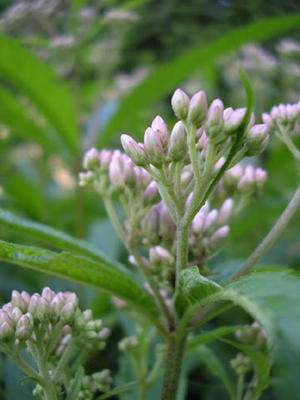
Budding Joe Pye--This place will be spectacular when the blooms are at their peak.

When I'd had enough of this good father, I let him get back to feeding his young and made my way out of the cedar bush, flushing a grouse as I went.
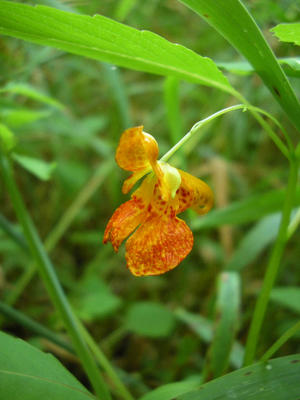
Jewel weed--just past its prime.

A catbird was also relieved that I finally took myself off. As made my way to the western edge of the bush I heard a great crashing in another of the swampy clearings--the clearings are so choked with vegetation now that I couldn't see anything. Sounded like a deer's step--I haven't seen any bear sign this year, not since the cub's cries I heard from the edge of the far field earlier in the season. But the raspberries are ripening...

On the far side of the far field the agitation continued. An eastern towhee seemed not glad to see me, as was the case with the female American redstart and the female cardinal. I didn't see the Brewster's or the blue-winged warbler, nor any sign of the chestnut-sided warbler that sang so loudly and so often earlier in the season.

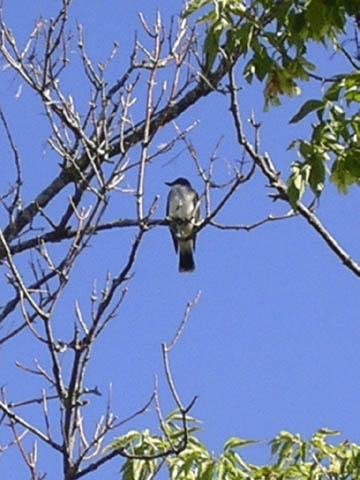
Heading back to the first field I noticed a kingbird on the old dead tree between the first and second fields. A second kingbird flew in, but I didn't see where it landed.
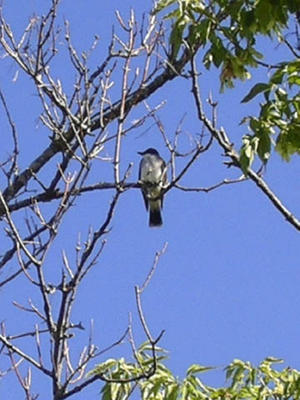
Keeping watch.


I suspect that they're nesting in this fencerow somewhere. After the two failures in the old apple tree in the far field (the second one almost certainly had eggs in it, as I observed a bird sitting on it for long periods on a couple of occasions before the nest disappeared), I'm glad that I can't see this nest--maybe the crows, or whoever took the other two, won't be able to see it either.


Wednesday, July 27, 2005

Night Flyers

Many an evening I've sat out on the porch and watched some really big flyers in the light of the street light up the road (yes, there are street lights in the hamlet, and even a short length of sidewalk). Today I believe I met one of the offspring of the really big ones.


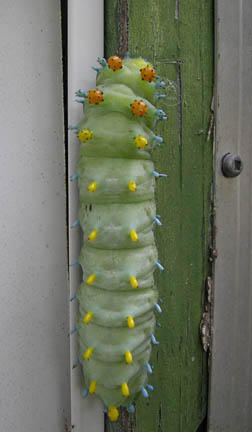
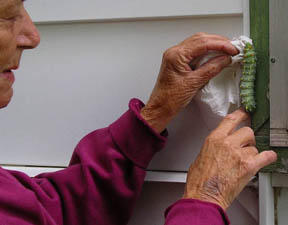
This critter was clinging to the door frame of my neighbour Nancy's house. She brought it in, identified it as a cecropia caterpillar (Hyalophora cecropia) and gave me a call.


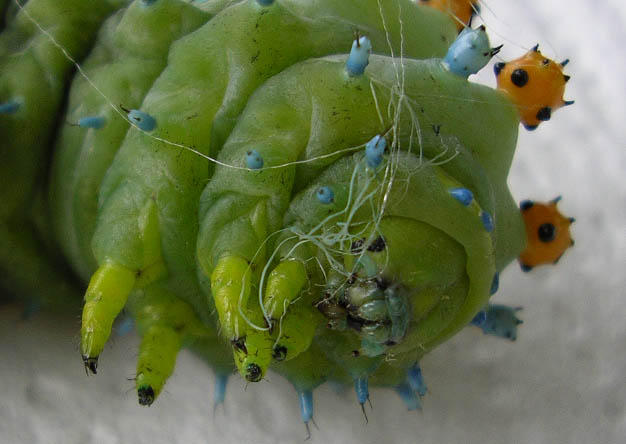
In the picture above you can see the mouth of the caterpillar and strands of silk. Cocoon spinning was just begun when the caterpillar was spotted--the door frame was not a good spot--so after I got a good look and took a few photos, Nancy released the critter onto a window frame. Same substrate, quieter location, in the hopes that it will settle there or somewhere even more suitable. What's That Bug recommends this site for an overview of the cecropia moth life cycle, and, I might add, a good photo of the adult moth.

This photo, Nancy releasing the caterpillar, shows just how big this baby is!

Tuesday, July 26, 2005

I Know Why the Common Yellowthroat Sings

The other day in the willow scrub where I was observing the Brewster's warbler and his friend the blue-winged, there was also a pair of common yellowthroats. The Brewster's et al. were foraging and carrying food, the common yellowthroats were chucking. I never saw them pick up anything. I went back the next day to see if the Brewster's and friend were still there (they were not--it must have been fledglings not a nest that I was hearing being fed that first day), and met up once again with the c. yellowthroats. Once again the birds were chucking, and while the female centred herself around the willow clump, the male would follow me for 30 or more metres in all directions, never letting me out of his sight, and never shutting up.

Then, as we travelled south, he had to pause in his scolding of me to chase another male common yellowthroat. A few moments later, as we moved back towards the centre (where there must be a nest or a clutch of fledglings), the other bird began to sing.

This morning I ran into a common yellowthroat on the far side of the far field (a female), and shortly afterward heard a male singing there. Meantime, as I headed back towards the area held by the first pair, I was met by the male, again, some distance from the presumed nesting site, and was thoroughly "chucked" out, the female only joining in as I approached the willows.

I used to think that male birds sang until mated, then got to down to the business of nesting, feeding young, etc. with their partners (at least I thought this about the species where the male is an active partner in raising the family). And that does seem to be true of many--my Brewster's has not sung for some time now, for example. The black and white warblers have just started to sing again in the last few days after a long silence, the chestnut-sided also stopped singing quite a while ago, and the list goes on. On the other hand, the robins and wrens never shut up.

The common yellowthroat really is a common bird. Its not as often seen as the house wren or the robin. It rarely nests in people's yards, though the one from the marshy wood across the street occasionally drops by the front yard. But it does seem that there is a pair of common yellowthroats occupying every suitable half hectare available--and the singing is required to keep the neighbours from encroaching, just as in the case of the robins and house wrens. The robins and wrens live here so openly it is obvious that their nesting territories were cheek by jowl--and those boundaries must be maintained, just, as it turns out, as in the case of the common yellowthroat.

The question then is why is this bird so common, when other warblers with apparently pretty similar lifestyles in terms of habitat and food requirements are in trouble.

Monday, July 25, 2005

Urban Wildlife

This little critter (well, little like a house cat) spent the day clinging to the top of the fence in my brother's backyard in Toronto back in June.

Playing possum (Photo: Jeremy Martin)


So far as I know we don't have the Virginia opossum (Didelphis virginiana) in this part of Ontario yet, but it is now well established in Toronto, and all points to the southwest.

From a 2002 article in Now Magazine on-line:
Opossums One of the clearest indications that global warming has taken hold in southern Ontario is the rapid increase in the opossum population, particularly in the western part of the GTA.
My brother had never seen one alive in the city before (though he had seen road-killed specimens). After this visit he discovered in conversation with friends and neighbours that sightings and visitations of this strange looking creature (North America's only marsupial) are becoming commonplace in the urban scene.

From ASSESSMENT OF SPECIES DIVERSITY IN THE MIXEDWOOD PLAINS ECOZONE:
Didelphis virginiana southern distribution
The Virginia Opossum is a southern species with a range that has recently expanded into the Mixedwood Plains Ecozone of Canada. The clearing of forests and maintenance of agricultural land in southwestern Ontario has benefited this species. Before the widespread destruction of the forests of this ecozone the Virginia Opossum did not occur in eastern Canada.


There are a couple of things I find very interesting about this. First, I have a general interest in the phenomenon of the southern species moving north, as I have alluded to in a couple of posts about bird species turning up around here. Opossums sometimes turn up in very out-of-the-way places, and it is suspected (or sometimes even established) that they accomplish this by stowing away on trucks coming north. The greater the number of trucks, the greater the number of opossums. But now it is understood that there is a more natural movement explaining the gradual build-up of the opossum population across southwestern Ontario, and now into the GTA.

But the other thing is the nature of urban wildlife. As a former city girl (born and bred in Toronto) turned rural nature watcher I often reflect on the differences between the experience of wildlife in the two habitats. This is best illustrated, I think, by experiences with raccoons. Toronto has a huge raccoon population--there is nothing unusual about seeing one there, in fact, there is nothing unusual about seeing one in your kitchen, eating your cat's food out of the bowl, and only leaving slowly and reluctantly after much shouting and stamping of feet on the part of the householder. When I lived in Toronto I often saw them, had to chase them out of attics, had them burst out from under my feet as I walked out the back door, etc. Now that I live in Thomasburg I see them rarely (although I know there are lots here too), and it's almost always a treat, not just another nuisance of life.

There is a wonderful book, Wild Nights by Anne Matthews, about the wildlife in New York City. Cities, the living is tough, but the food is plentiful!!

Saturday, July 23, 2005

In the Yard


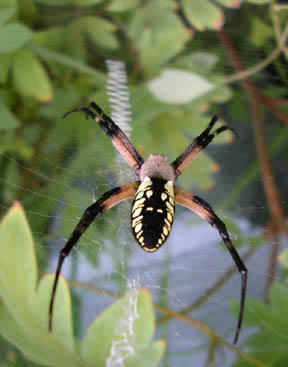
According to Bev Wigney's spider gallery of beautiful photographs this lovely specimen found in the garden today is an Agriope Argiope aurantia. (See also What's That Bug.) Note the seam-like structure (called a stabilimentum according to What's That Bug) running down the middle of the web.


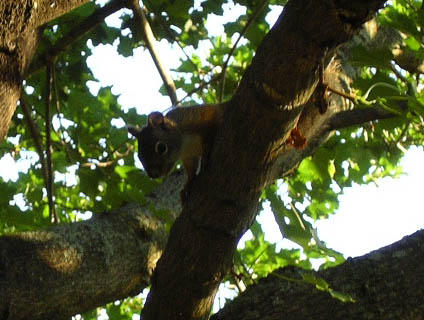
The red squirrel is an occasional, usually cross visitor to the Norway maple beside the house.

Brewster's Update

Yesterday I was going to write quite a different story than the one I have today--but I never got around to it. Yesterday I saw the Brewster's in the old apple tree on the far side of the far field, and it seemed to be with another warbler, but damn these slow birder eyes, I only got a glimpse of the other bird and couldn't take in enough of its field marks (it was a warbler in the yellow-greeny group, I think) to make any claims that it might have been with the Brewster's--i.e., partner, young, whatever.

Where the bird was.

Out again early this morning, near the cedar bush where I have been on the lookout for the common yellowthroat that I am pretty sure is nesting near the willow shrubs on the east side of the cedars, there was a warbler "chuck" cacophony. The mosquitoes weren't too bad (cool morning, the first in ages!) so I was able to take up a position and spend some time watching the warblers flit in and out of the foliage. The common yellowthroat was there, and gradually I saw three others as well, including a Brewster's! Same one as the one I've been hearing and seeing on the other side of the far field? The distance between the closest singing perch from earlier in the season and this point is probably not much more than 100 metres, but the habitat changes three (or four) times, making it seem like another world. Because the Brewster's is rare, assume that this was the same bird. Because the Brewster's may well be the offspring of the golden-wing that spent last season here, assume that there are three others for whom this is also home. I may need to find a partner to work the Walk from the other direction for a few mornings to see if we can see Brewster's warblers in two different places at the same time.......

Anyway, the great thing this morning, whoever this bird was, was that it was carrying food, and entering a nest site with noisy nestlings. And one of the other warblers at the scene was a blue-winged, also carrying food, also going into the noisy nest. In one fell swoop, this observation, if accepted, confirms both the Brewster's and the blue-winged warbler as breeders in my breeding atlas square (18UQ11)!! In fact this is the first record of a blue-winged for the square.

The Brewster's warbler is the common form that a hybrid produced by a mating of golden-winged and blue-winged takes. In a way it is more a phenomenon than a bird--and a rather worrying one. The fact of the hybridization and other changes affecting the golden-winged warbler is thought to be putting the species at risk. Cornell Ornithology is running a study right now to monitor golden-winged populations. From their site:

The Golden-winged Warbler is declining precipitously in the northeastern U.S. (7.6% per year in USFWS Region 5), while increasing in the northern and northwestern portions of its range where farmland abandonment and clear cutting is common. The decline may be due, in part, to a loss of shrubland habitat. In addition, this decline correlates with the range expansion of the Blue-winged Warbler into the range of the Golden-winged Warbler. The northward expansion and resultant zone of overlap has led not only to increased competition, but also to widespread interbreeding between the Golden-winged and Blue-winged warblers. Because of this wide-spread hybridization, populations of pure Golden-winged Warblers may soon disappear after the arrival of the Blue-wings.

I was very excited when I first found the Brewster's warbler back in May, and a little apprehensive because I knew this meant I would have to fill out a rare bird report for the breeding atlas. I did the report right away, then as the weeks passed and I saw the bird with great regularity I knew that there had been no mistake about it. And I was hoping that I would get to see it with a mate. I was curious as to what species it would end up with--blue-winged or golden-winged, or another Brewster's. But I am also concerned that the presence of this bird in the field where there was a golden-winged last year is an ominous sign. I just got to know the golden-winged last year, and am fond of it in part because it has a song that I was able to learn fairly easily (certainly much easier than sorting out chestnut-sided from redstarts from magnolia warblers). Now, with the Brewster's mating with a blue-winged, the golden-winged has been edged out here.

In his very interesting book, Out of Eden, Alan Burdick writes about the ambivalence with which some scientists investigating invasive species view their subjects. On the one hand many invaders are very destructive of the ecosystems they invade (the book opens with the brown tree snake, the havoc it has wreaked in Guam and the work being done to prevent it from getting a "foothold" in Hawaii), on the other hand the invasion itself is quite interesting, and there is something attractive about the resourcefulness and tenacity of the winners of the Darwinian struggle.


The blue-winged warbler is not an exotic like the species Burdick discusses, but it is a species whose range is probably expanding because of changes we have made to the habitat in North America over the last hundred years.

The history of life on earth has always been a history of both incremental and sudden, drastic change. Right now we are seeing the ranges of many bird species shifting because of changes in barriers to movement, changes in habitat, changes in weather. A great number of species are shifting north, such as the orchard oriole I recorded in the square. Others are losing habitat because of the reduction in the amount of land used for agriculture over the last hundred years, just as many lost habitat when the forests were cleared in the previous century. The history of the golden-winged warbler, probably largely unknown, would be very interesting to see correlated with logging and the clearing of land for agriculture. The kind of shrubby habitat it prefers, that exists at the edge of the cedar bush and the far field, is there because the forests were cut, the land was farmed and now it is reverting to forest again, both because of the effort of human beings (some years ago a lot of the land in this area that is no longer being farmed was planted with evergreens--this practice is falling out of favour now because it destroys the habitat of the grassland birds) and the natural succession of plant growth--as trees get going, they eventually shade out the shrubbery. Any change of this kind, from grassland to shrub to forest, benefits some species to the detriment of others. Burdick layers his accounts of invasive species in various parts of the world and various habitats with more philosophical musings about what is natural, what our role in ecological change is, and how we perceive the difference.

Personally, in this case, I regret the possibility that the golden-winged warbler, my new friend, is fading away into the blue-winged warbler population, but simultaneously welcome the opportunity to witness the event.