Friday, August 12, 2005

So Quiet

There are still a lot of birds around--this morning from the front porch I could hear hummingbirds squabbling, blue jays contact calls, a catbird calling, a crow, a phoebe saying I don't know what, a little wren calling, a flock of blackbirds (grackles and cowbirds I think) flying overhead, a lone cedar waxwing contact calling...but singing? No. The last real singer in the neighbourhood, strangely enough, was the cardinal. I heard it yesterday, just a bar or two, but up until then cardinals were singing all day every day.

From the OntBirds, the mailing list of the Ontario Field Ornithologists, this excerpt from a report from Long Point:
Yellow Warbler migration has been pretty thick this past week at Long Point with mostly moulting adult females and juveniles moving. There have been respectable numbers of Least and Traill's Flycatchers and Yellow-bellied Flycatchers have been observed daily since the 5th. There have also been small movements of Northern Waterthrush and Ovenbirds.
The exodus has begun.

From my notes of the last few days:

August 6-7: Cardinal singing, blue/goldenwing singing (probably the Brewsters, more than probably, but following Ontario Breeding Atlas protocol, if I don't see it, this is how I identify it), American redstart singing, black and white warbler singing.

But when I say "singing" now what I mean is a phrase or two, from all but the cardinal. No one else was really belting it out.

There are still fledglings and possibly nestlings out there, but I can feel the drop in the level of activity--it's just very still compared to a few short weeks ago. I walked last night without attracting the chucks of the common yellowthroat or the thrasher or even many wrens. And I believe I saw a fox sparrow in the far field--didn't get a very good look, but my impression was first of a large bird, then when I saw it better, a bright sparrow. Seems early for this guy to be passing through here again. (Last seen on April 14--here is a link to a range map for this bird.)

Looking back at last year, the fields were much more active until much later. I see from my notes that I heard and saw a golden-winged warbler on August 24(suspected father of my Brewsters--or perhaps never mated, he sang all season, unlike the Brewsters this year). And also on that day last year, a veery calling. I haven't heard a veery for weeks. On the other hand it was August 24 when I first started to notice the raptor migrants--last year was great for raptors on the walk. And this was also the time when I was seeing the flicker families.

Last year we had almost no hot weather--this year almost nothing but. So perhaps it was this that speeded this season up for the small migrants? Sad really, because it was the hot weather that kept me indoors way more than I wanted to be.

Tuesday, August 09, 2005

A Really Big Foot

I was just over at A Whippoorwill this morning, a blog from, I believe, due northeast of Thomasburg, and I found a wonderful story about a father and daughter and some expert tracking, Nimbaabaa. Included is a photo of a track that puts my little canid track of a day or two ago to shame.

Thomasburg is near the southern edge of the "canis soup" region of Ontario, where the coyotes are big and the wolves are small, and the crossover (hybridization) between them may be extensive. The wolves that hybridize with coyotes (as opposed to killing them, as for example the reintroduced wolves in Yellowstone do) are thought to be a separate and older species, known as either the red wolf (Canis rufus) or the eastern wolf (Canis lycaon). The wolves of Algonquin Park are representatives of the species--the identification of them as separate from Canis lupus is recent and still controversial. Canis lupus (grey wolf, timber wolf) ranges to the north and west, and is thought to hybridize with Canis lycaon at the southern boundaries of its range. Too far from Thomasburg for me to be likely to ever see a track like the one Whippoorwill found. But I do sometimes hear the lower, rounder notes of a wolf howl in the coyote choruses in the night.

Recommended reading:

John and Mary Theberge spent many years studying the wolves of Algonquin Park, and wrote a book, Wolf Country, about the experience, both in its personal and professional/scientific aspects.

Mike Runtz's Howls of August is an account (in words and photographs) of his experiences with the wolves in the park over 25 years.

Sunday, August 07, 2005

Hummingbird Lore

There is much to say about the birds I saw yesterday morning and this morning--lots of families out, lots of noise, strange late season songs and singers...but that will have to wait for another day.

Just one quick hummingbird note: Near the old apple tree, amidst the din of the agitated cardinal, I watched a hummingbird chase a wren out of a juniper with great vigour and persistence. It took three diving attacks until the wren was finally far enough away to suit the hummer. I know what it's like to have one of these little things buzz by--it has happened to me often enough when I've stood too close to the hummingbird feeder on the porch--but to have one come after you, intentionally, repeatedly and ferociously....The wren didn't have a chance.

Later in the day, on the 'net, I stopped by Pharyngula and found this post, containing a link to amazing photos of a hummingbird meeting its end at the hands of a praying mantis.

Earth-moving Change

Friday the humidity lifted again--over the weekend it's been hot days (30C) but cool nights, so cool and bug-free mornings.

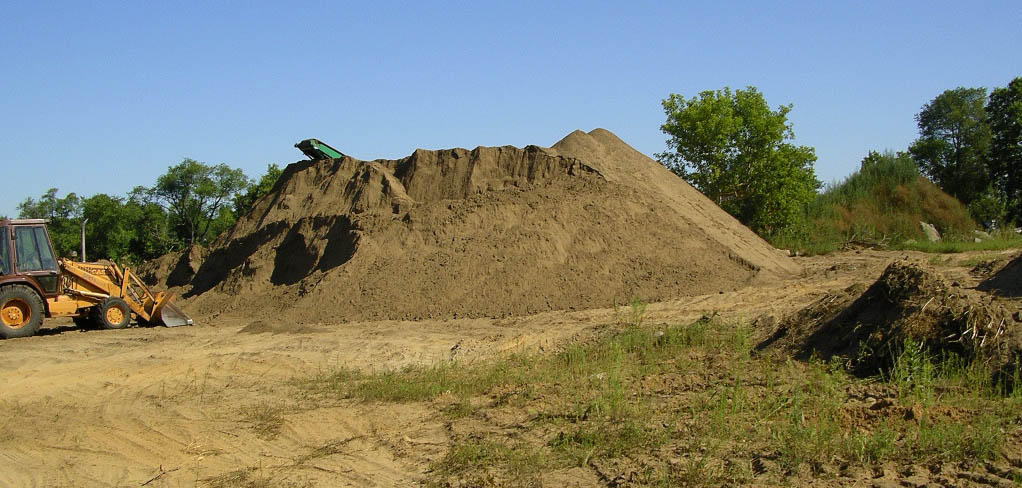
I got out Friday evening to look at what's happened with the topsoil harvest. As always the changes are quite disorienting--it's dificult to remember just how where that berm was, or that heap, now that everything has been moved around, including some long-standing features of the landscape.


This is an image I posted back on July 6


The tree on the right side of the image is the same
as the tree on the right in the first photo.

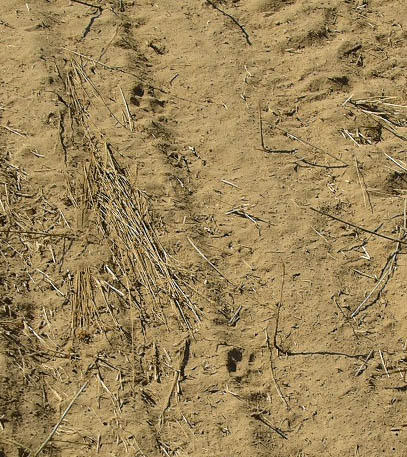
I took the photograph of the work this morning. The equipment driving in, and the scraping has produced and fine dusty surface that takes prints well.


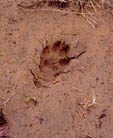
I would like to say what left this print, but I don't know. I think it's a fox print (it had that vibe...), but it could be a coyote. Both frequent the area, and the differences between their feet are pretty subtle. The stride looks longer relative to the size of the foot in the photo than it seemed to me in the field (I had no tape measure with me.) The print itself measured about five centimetres long (without the nails). Fox and coyote feet are very close to the same size. Could it have been a dog? Sure...but the trail is in a straight line like a cat's trail and the track is "open," i.e., lots of space in the middle, between the toe pads, both suggesting "not a dog." There are sometimes dogs "at large" around here--but they are usually bigger than this track suggests.


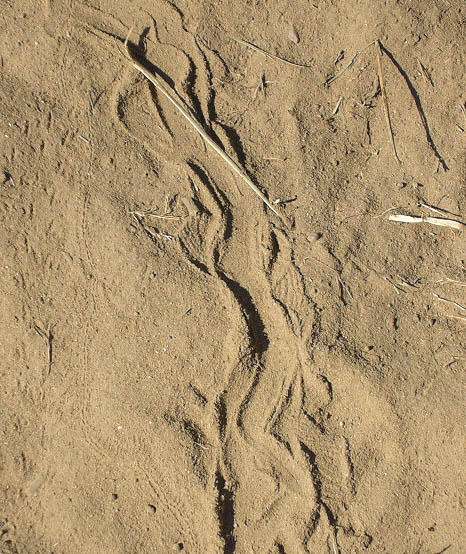
I was very pleased to see this track--for a hot summer, I have seen very few snakes, and to me, a track is almost as good as a sighting.

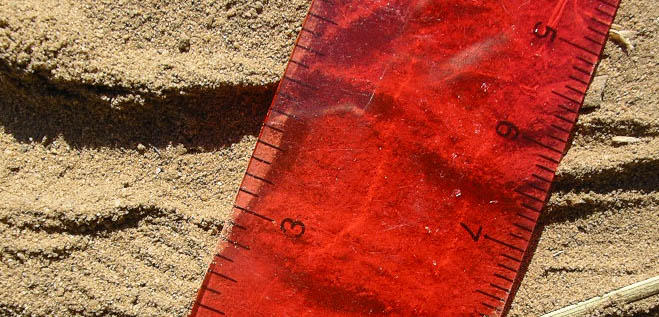
Not a very big snake--track was only half an inch wide (1.25 cm), but not tiny either.

Friday, August 05, 2005

Fields in Transition

After a few days respite the heat and smog descended again, so I haven't gotten out much, but I can hear the big news from the fields from my front porch. The topsoil harvest is on--the machines have been out every day this week, scraping, digging and sifting. The landscape will be much changed by now--pictures soon.

But the undisturbed areas are in transition now as well. The white is fading away--the sweet clover is almost finished blooming, and the Queen Anne's lace will soon follow. Next up, yellow and gold.

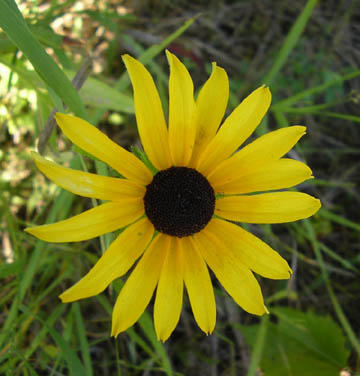
Brown-eyed Susan


The brown-eyed Susans have been in bloom in small patches emerging from the grasses for some time now. More recently the evening primrose has also been in bloom, growing mostly in the barest patches of the scrape, where there is no competition.

Evening Primrose


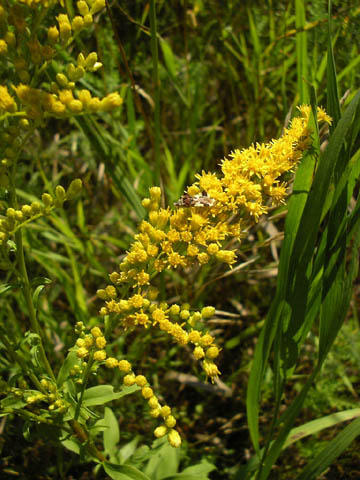
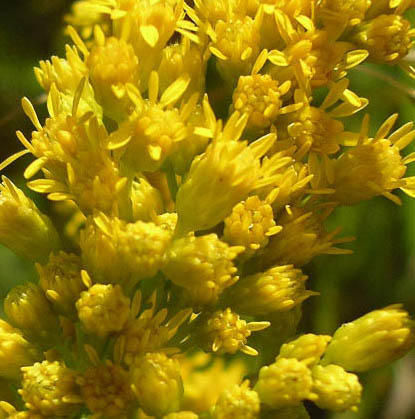
But the next big flower story of the year will be the goldenrod--early signs indicate that it is set for a spectacular show.

Goldenrod just coming into bloom


Goldenrod detail


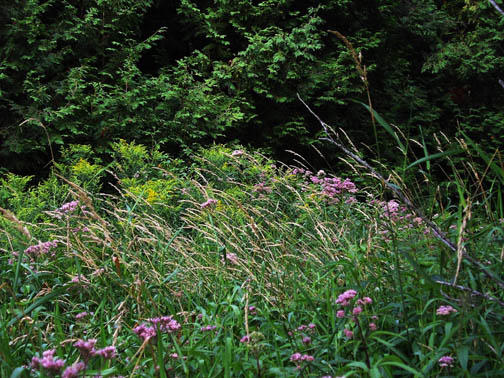
Even in the swamp clearing where the Joe Pye weed is doing so well, you can see the edge starting to turn as the goldenrod comes into force.


Last time I did get out, a couple of mornings ago, I met up with the female common yellowthroat still keeping watch at the edge of the bush by the willow copse. I haven't seen the male on either of my last two visits. This is the first time since spring that he hasn't been there either singing or defending and I'm concerned that he has come to some bad end.

On this visit she deigned to pose!

Thursday, August 04, 2005

I and the Bird

The third instalment of the birders' blog carnival, I and the Bird, 'I and the Bird' #3: The Backyard and Beyond is up today--hosted by B and B. It's a great, international, diverse selection of birding stories, from the scientific to the personal, from stories about birds to stories about birding and birders.

Check out I and the Bird #2, hosted by Charlie's Bird Blog (including my own Little Brown Birds--Part 2).

And you can find #1 at 10,000 Birds.

I and the Bird has a permanent home at 10,000 Birds--information about upcoming editions and their hosts is available there.

Nature Stories

Cruising around the blogosphere over the last couple of weeks looking for science and nature blogs (I found lots--see the blogroll for a selection of interesting sites!) I was struck by the energy being expended, mostly on American blogs, on the issue of Intelligent Design (ID) vs. Darwinian Evolution. I knew that this was an issue in the United States, that there are movements afoot to add ID to high school science curriculums, but I had no idea that the controversy was as heated and active as it seems to be. President Bush's remarks a couple of days ago (see for example these articles at Truthout), to the effect that he favoured the inclusion of ID in curricula, created a spike in blog activity on the topic.

This is pretty disturbing on a number of levels. The most immediate is not only that ID "theory" is not science, but that it seeks to end biological science as I know and love it. In my post, Midsummer, for example, I talk about different strategies for the raising of young among warblers. Darwinian evolution creates the context for this conversation. It is the framework for speculation and investigation into why this species is doing well and that one isn't in this slice of time, so small in the history of the two species as to be less than the blink of an eye. It is what makes diversity and change in the natural world interesting and meaningful. Taking it away sucks all the fun out of what I love to do--watching and learning, thinking about the life around me. I would hate to see the opportunity to experience nature in all its real complexity taken away from anyone.

I won't get into the arguments that are being put forward for and against ID--check out Pharyngula (much discussion, but current major post here and Panda's Thumb for lots of discussion and a list of sites addressing this issue this week. I read a number of the recent posts with interest, and I stumbled on a five-parter at Panda's Thumb about an evolutionist's experiences attending a creation conference that was both funny and sad by turns, and gave a good deal of insight into what's going on in the "creation" world (here is the link to Part One).

But in the end I just find it sad that energy is being expended by biologists and philosophers of biology defending evolutionary theory against this stuff.