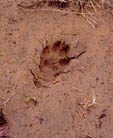
Out on the walk last night I met up with a brown thrasher near the far edge of the first field. I could hear the hard "chucks" of this bird long before I saw it, coming from the pine plantation (which is also filled with very noisy chipping sparrows right now). I was in there trying to find out more about the common yellowthroat that I am pretty sure is nesting just on the edge between the field and the swamp. I found the bird, confirming my suspicion, but was unable to really see anything in the mass of willow shrubs and high grasses growing there. Meantime I kept hearing the "chuck" of the thrasher.
The brown thrasher is a fairly large bird, with a long tail, and striking plumage, more rust than brown, whose song is a collection of borrowed sounds like that of the catbird and the northern mocking bird. The thrasher's song is recognizable because of its habit of repeating each phrase once. It sings loud and long in the spring, but goes pretty quiet when its nesting. And because it moves in the shrubbery of the fence lines, it is pretty inconspicuous most of the time, in spite of its size and colour.
The mosquitoes were incredible by the willow shrubs, I was wiping as many as twenty off my arm every few seconds, so after what seemed like a valiant effort to find out more about the common yellowthroat I moved on. As I got to the entrance to the far field that runs through another willow copse I notice that the thrasher was once again with me. Still chucking, but alternating the chucks with a soft short mew. I stood around for a while watching it as the mosquitoes built up on me once again, then started to move on. The bird continued to follow, continued to yell, all the way across the far field to the western edge. Finally I saw two other thrashers, confirming what I'd suspected, that there must be fledglings out. In fact many birds' fledglings are out now, all over, all over the field and the yard, and the din is terrific.
Thursday, June 30, 2005


Wednesday, June 29, 2005
Little Brown Birds--Part 2
After I posted Little Brown Birds I had a tickling feeling that there was a bird I was forgetting. Then it came to me: the clay-colored sparrow (US spellings are the convention for bird species names). This is another bird that I should be able to find here--not as common as the field sparrow, chipping sparrow or song sparrow (or the savannah sparrow--also very common, but since we have no savannah I always forget to include it).
The clay-colored sparrow only showed up in nine percent of the squares in my region (Region 21--Kingston) in the last Ontario Breeding Bird Atlas, but this time, as of the end of last year's data collection, 37 percent of the squares found evidence of these birds breeding. In my first post on sparrows I make offhand reference to sparrows not mentioned as "a few rarities," and leave the matter there. But 37 percent is not rare beyond the realm of likely--and worse, another atlasser working in my square last year found a pair of clay-colored sparrows here. So it is up to me, in this final year of data collection, to upgrade the breeding evidence if I can--and that means being able to identify the bird.
The clay-colored sparrow's song is unlike that of the other sparrows in this group. It consists entirely of buzzes at a single pitch, repeated several times, rather slowly. I've heard this once or twice, only once knowing what it was, but I've never knowingly seen one of these guys. Click here to see a couple of good pictures of this bird. The page will open in a new window and loads slowly (for those of us on dial-up), but is worth the wait. Or go to the Wildspace page for a sample of the song and more information.
The picture at the Cornell site linked above make this look like a very distinctive bird--but unless the light is just right, this is the quintessential little brown bird. So here are the things I'll be trying to keep in mind. Clear breast (described as grey, but that won't actually help much, nor will the grey nape of the neck that shows so clearly in the photo), which distinguish it from the song, savannah and vesper sparrows. That leaves the chipping, field and grasshopper sparrows. Chipping sparrow is easy, in the breeding season it has a bright rusty cap and a well-defined eyebrow. The field sparrow is just so terribly plain, rusty cap and complete eye ring, but these are usually barely noticeable in the field. But then there's the grasshopper sparrow. The difference between these is mainly in the markings on the head, something I always find difficult to take in--i.e., median stripe (down the middle of the head), is it white, buff, grey? Is it very distinct?
Now that I know the bird's song, I'm hoping that they sing on into July, as many but not all birds do. And I'll keep my ears open.
So, to recap, the little brown birds in Thomasburg are the chipping sparrow, song sparrow, field sparrow, savannah sparrow, grasshopper sparrow, vesper sparrow, and the clay-colored sparrow. This excludes the swamp sparrow, also around here, but not a field and hamlet bird, and the Henslow's sparrow, an actual rare bird. Seven little brown birds--how hard could it be?
The clay-colored sparrow only showed up in nine percent of the squares in my region (Region 21--Kingston) in the last Ontario Breeding Bird Atlas, but this time, as of the end of last year's data collection, 37 percent of the squares found evidence of these birds breeding. In my first post on sparrows I make offhand reference to sparrows not mentioned as "a few rarities," and leave the matter there. But 37 percent is not rare beyond the realm of likely--and worse, another atlasser working in my square last year found a pair of clay-colored sparrows here. So it is up to me, in this final year of data collection, to upgrade the breeding evidence if I can--and that means being able to identify the bird.
The clay-colored sparrow's song is unlike that of the other sparrows in this group. It consists entirely of buzzes at a single pitch, repeated several times, rather slowly. I've heard this once or twice, only once knowing what it was, but I've never knowingly seen one of these guys. Click here to see a couple of good pictures of this bird. The page will open in a new window and loads slowly (for those of us on dial-up), but is worth the wait. Or go to the Wildspace page for a sample of the song and more information.
The picture at the Cornell site linked above make this look like a very distinctive bird--but unless the light is just right, this is the quintessential little brown bird. So here are the things I'll be trying to keep in mind. Clear breast (described as grey, but that won't actually help much, nor will the grey nape of the neck that shows so clearly in the photo), which distinguish it from the song, savannah and vesper sparrows. That leaves the chipping, field and grasshopper sparrows. Chipping sparrow is easy, in the breeding season it has a bright rusty cap and a well-defined eyebrow. The field sparrow is just so terribly plain, rusty cap and complete eye ring, but these are usually barely noticeable in the field. But then there's the grasshopper sparrow. The difference between these is mainly in the markings on the head, something I always find difficult to take in--i.e., median stripe (down the middle of the head), is it white, buff, grey? Is it very distinct?
Now that I know the bird's song, I'm hoping that they sing on into July, as many but not all birds do. And I'll keep my ears open.
So, to recap, the little brown birds in Thomasburg are the chipping sparrow, song sparrow, field sparrow, savannah sparrow, grasshopper sparrow, vesper sparrow, and the clay-colored sparrow. This excludes the swamp sparrow, also around here, but not a field and hamlet bird, and the Henslow's sparrow, an actual rare bird. Seven little brown birds--how hard could it be?
Tuesday, June 28, 2005
Back on the Walk
I'm back in Thomasburg now, and this morning I was back on the walk. It is a truly terrible day today, hot, humid and smoggy, but I was out early enough to still enjoy myself. Two weeks away and some rain has made a big difference. Grass, shrubs, weeds and grapevine have all grown spectacularly, greening the place right up, but also providing much denser cover for the birds. So I heard more than I saw.
The first thing I noticed being back home was how different it sounds here. I wrote in other postings about the birds around the place I was staying in the County, but I didn't mention that birds I was missing. In the yard here the house wren sings loudly and often. There is almost always a song sparrow singing, and a gold finch or two as well. I can also almost always here a common yellowthroat singing across the street. I heard all of these in the County, but just rarely. The bird I didn't here while I was there that nests just about every half acre around here is the field sparrow. As I noted in my recent post about sparrows, the field sparrow is a very plain little sparrow, but it has a very distinctive song. The field sparrows around here sing all morning and all late afternoon.
Out on the walk this morning I was pleased to see and hear many of the birds I've been following this season. The Brewster's warbler is still out there, beyond the edge of the far field, still singing. The chestnut-sided, common yellowthroat, black and white, and American redstart are all still singing too. The vesper sparrows who were nesting just by my warbler lookout rock seem to have finished up and moved on. But the kingbirds nesting in the old apple tree are still there, though nestlings if hatched aren't big enough to be heard from the ground yet. I took pictures of these locations and more, and even one of the Brewster's warbler (a shot that won't actually show anything--the bird was too far away for the equipment I use), but I seem to have left my USB cable behind, so no downloading images until I can retrieve it.
Of course I was also looking for the orchard orioles--I saw a female Baltimore oriole, and another that flew by too quickly to be identified. I learned a lot about orioles while I was in the County. There was a nesting pair of orchards orioles in the yard there, with noisy nestlings that they were working hard to feed. And there were Baltimore orioles nesting just below and down at the water. Orioles sing some after they start nesting, but otherwise they are very quiet nesters for the most part. They nest very high, and slid in and out of the foliage smoothly and quickly. I got lots of practice watching for them while I was away, which will help, but I'm not terribly hopeful that I will find the orchards again here, even if they are nesting at the edge of the field in the poplars (I have a picture of where I think there might be orioles nesting, of one kind or the other, but it will probably take a pretty long vigil to see them, if indeed they're there--which will have to wait until the weather improves).
The first thing I noticed being back home was how different it sounds here. I wrote in other postings about the birds around the place I was staying in the County, but I didn't mention that birds I was missing. In the yard here the house wren sings loudly and often. There is almost always a song sparrow singing, and a gold finch or two as well. I can also almost always here a common yellowthroat singing across the street. I heard all of these in the County, but just rarely. The bird I didn't here while I was there that nests just about every half acre around here is the field sparrow. As I noted in my recent post about sparrows, the field sparrow is a very plain little sparrow, but it has a very distinctive song. The field sparrows around here sing all morning and all late afternoon.
Out on the walk this morning I was pleased to see and hear many of the birds I've been following this season. The Brewster's warbler is still out there, beyond the edge of the far field, still singing. The chestnut-sided, common yellowthroat, black and white, and American redstart are all still singing too. The vesper sparrows who were nesting just by my warbler lookout rock seem to have finished up and moved on. But the kingbirds nesting in the old apple tree are still there, though nestlings if hatched aren't big enough to be heard from the ground yet. I took pictures of these locations and more, and even one of the Brewster's warbler (a shot that won't actually show anything--the bird was too far away for the equipment I use), but I seem to have left my USB cable behind, so no downloading images until I can retrieve it.
Of course I was also looking for the orchard orioles--I saw a female Baltimore oriole, and another that flew by too quickly to be identified. I learned a lot about orioles while I was in the County. There was a nesting pair of orchards orioles in the yard there, with noisy nestlings that they were working hard to feed. And there were Baltimore orioles nesting just below and down at the water. Orioles sing some after they start nesting, but otherwise they are very quiet nesters for the most part. They nest very high, and slid in and out of the foliage smoothly and quickly. I got lots of practice watching for them while I was away, which will help, but I'm not terribly hopeful that I will find the orchards again here, even if they are nesting at the edge of the field in the poplars (I have a picture of where I think there might be orioles nesting, of one kind or the other, but it will probably take a pretty long vigil to see them, if indeed they're there--which will have to wait until the weather improves).
Friday, June 24, 2005
A Pair of Loons

Every day since I've been in the County I've seen this pair of loons on the bay. No chicks in evidence and I don't know if there's a nest, but yesterday I did see a racoon with three young ones working the beach, so this may not be an ideal place to nest.

Not a great picture, I'm still learning the limitations of "digital zoom." And it's also a little hard to read because this raccoon has no tail, and her back end is facing the camera. Her three babies though are perfectly tailed--what you could see here, if the image were better, is the raccoon looking off in the direction in the shrubbery where the babies were playing when I took the shot.
Thursday, June 23, 2005
Cormorant Cull?
My second day here in the county I walked all the way down the lane to the beach to check things out. It was about 8:00 a.m., and the first thing I learned is that the turkey vulture is not an early riser. It was clear from the state of things turkey vultures had been roosting on the roof of the little pavilion by the water for quite some time. The ground around it was a litter of giant feathers, awash in guano, and dotted here and there with what looked like regurgitated this and that. There were two vultures on the roof as I arrived, and a third was in one of the dead trees, apparently having lifted off at the sound of my approach. The two left on the roof slowly, reluctantly, perhaps sleepily, took themselves off to another dead tree where they perched for quite a while, until my presence became too much of a bother.

After surveying the effects of their residence, described above, I walked to the water and along the beach for a bit. I came upon a stretch of about 3 or 4 metres littered with the, mostly skeletal, remains of at least five double-crested cormorants. Most of the bones were picked completely clean, although they didn’t look as if they’d been lying there all that long. There were a few wings, or pieces of wings that were relatively untouched, and one complete head. Now with the vultures in residence a few metres away it’s no mystery that there would be stripped bones like these, I guess. But why so many all in one spot on the beach. There was no sign of dead cormorant anywhere else in the vicinity.
I had no camera then, and the weather changed within a day or two of the discovery, causing almost all the evidence to be washed away into the lake. When I did get down with a camera I found one skeleton remaining–so at least there’s that. But one doesn’t a mystery make.

All that remains....
So the question is what preys on the cormorant, if anything? Or was there a little “die-off” in South Bay that no one’s talking about? Or a private cull? And in the latter two cases, who was collecting the bodies and bringing them to this one spot on the beach?
The double-crested cormorant is a controversial critter in these parts–it has made a spectacular invasion of parts of the Great Lakes and beyond, and because of some of its effects for the fish stocks and plant life around its breeding colonies it has been subjected to a number of “control” measures, from the oiling of eggs to prevent their hatching, to the use of sharpshooters to shoot
thousands in a day, always creating a lot of controversy.
The cormorant is a formidable bird–I’d just like to know if ospreys are whacking them too, or bald eagles, otters....?

After surveying the effects of their residence, described above, I walked to the water and along the beach for a bit. I came upon a stretch of about 3 or 4 metres littered with the, mostly skeletal, remains of at least five double-crested cormorants. Most of the bones were picked completely clean, although they didn’t look as if they’d been lying there all that long. There were a few wings, or pieces of wings that were relatively untouched, and one complete head. Now with the vultures in residence a few metres away it’s no mystery that there would be stripped bones like these, I guess. But why so many all in one spot on the beach. There was no sign of dead cormorant anywhere else in the vicinity.
I had no camera then, and the weather changed within a day or two of the discovery, causing almost all the evidence to be washed away into the lake. When I did get down with a camera I found one skeleton remaining–so at least there’s that. But one doesn’t a mystery make.

All that remains....
So the question is what preys on the cormorant, if anything? Or was there a little “die-off” in South Bay that no one’s talking about? Or a private cull? And in the latter two cases, who was collecting the bodies and bringing them to this one spot on the beach?
The double-crested cormorant is a controversial critter in these parts–it has made a spectacular invasion of parts of the Great Lakes and beyond, and because of some of its effects for the fish stocks and plant life around its breeding colonies it has been subjected to a number of “control” measures, from the oiling of eggs to prevent their hatching, to the use of sharpshooters to shoot
thousands in a day, always creating a lot of controversy.
The cormorant is a formidable bird–I’d just like to know if ospreys are whacking them too, or bald eagles, otters....?
Wednesday, June 22, 2005
Deer Family Update
After I saw the coyote on the lane Sunday evening, and of course I've been hearing coyotes every night since I've been here, I hoped that I would see the doe and fawn again. Yes, coyotes have to eat, but I've picked sides this time.
This afternoon I was walking down the lane from the house and just past the point where I heard the strange noises the first night I was here I noticed something a shadowy shape in the wood to my left.
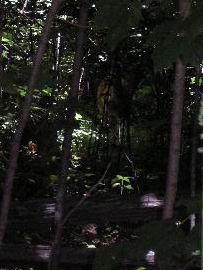
If you look closely, you can just see her in the trees. The fawn is to her right.
The doe and I stood and stared for a while I took a few pictures and then I saw that the fawn was with her. So, good, the fawn has survived in spite of the crowds of coyotes.
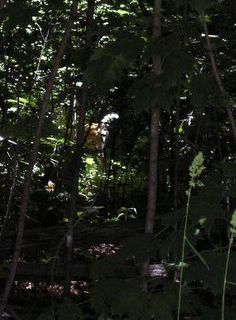
As they left the doe flipped her tail, as you can see, but otherwise they seemed calm.
Since the family is still here I guess the fawn is not yet up to the running life of the deer, but I expect that it won't be too much longer before they're off.
This afternoon I was walking down the lane from the house and just past the point where I heard the strange noises the first night I was here I noticed something a shadowy shape in the wood to my left.
If you look closely, you can just see her in the trees. The fawn is to her right.
The doe and I stood and stared for a while I took a few pictures and then I saw that the fawn was with her. So, good, the fawn has survived in spite of the crowds of coyotes.
As they left the doe flipped her tail, as you can see, but otherwise they seemed calm.
Since the family is still here I guess the fawn is not yet up to the running life of the deer, but I expect that it won't be too much longer before they're off.
Tuesday, June 21, 2005
Another County Encounter
I haven't seen the mother deer or fawn again, but Sunday night I met someone else. It was just after 8:00 p.m., and I wandered down the lane to the bottom of the hill to take one last look at the woods and the field before calling it a day. I stood for a while, listening to the robins, yellow warblers, warbling vireo, chipping sparrows, and more. I'd hope to see the indigo bunting again, but no luck. I turned and looked down the lane towards the lake (invisible from this point) for a bit, just dawdling really, reluctant to go in.
Then I heard the swish of something moving in the grass just down a little way and to my left. A coyote stepped out on to the lane, couldn't have been more than 10 metres from where I stood. It started to turn to go down towards the lake, paused, looked at me, then turned around and went back the way it came.
The coyote was brown, and had the bluntest features I've seen on one of these guys yet, put me more in mind of a dingo than of the coyote I met in the far field in Thomasburg last August. But it was clearly mothing but a coyote--the third I've seen the past 12 months in the County, and the sixth I've seen this year overall. It's been some year, six is twice as many as I'd seen in my previous 47 years of looking. Of course seeing two in one night this past winter helped the numbers quite a bit!
But this coyote had more import, of course, since by happenstance I had an attachment to a fawn that I had good reason to believe was somewhere within a 100 metres of where we met. I know that if I'd met the coyote first, I would have thought of its family, and been glad that there were lots of deer around for it. Also glad that the abundance of deer would keep it out of harm's way by keeping it away from the sheep. And glad that the coyotes are here helping keep the deer in check so that we don't end up crashing into even more of them on the roads.
As it was though, I couldn't help hoping that the fawn was still tucked away on the right-hand side of the lane, and that my "encouraging" the coyote to turn back will contribute to it living to grow a little older.
Then I heard the swish of something moving in the grass just down a little way and to my left. A coyote stepped out on to the lane, couldn't have been more than 10 metres from where I stood. It started to turn to go down towards the lake, paused, looked at me, then turned around and went back the way it came.
The coyote was brown, and had the bluntest features I've seen on one of these guys yet, put me more in mind of a dingo than of the coyote I met in the far field in Thomasburg last August. But it was clearly mothing but a coyote--the third I've seen the past 12 months in the County, and the sixth I've seen this year overall. It's been some year, six is twice as many as I'd seen in my previous 47 years of looking. Of course seeing two in one night this past winter helped the numbers quite a bit!
But this coyote had more import, of course, since by happenstance I had an attachment to a fawn that I had good reason to believe was somewhere within a 100 metres of where we met. I know that if I'd met the coyote first, I would have thought of its family, and been glad that there were lots of deer around for it. Also glad that the abundance of deer would keep it out of harm's way by keeping it away from the sheep. And glad that the coyotes are here helping keep the deer in check so that we don't end up crashing into even more of them on the roads.
As it was though, I couldn't help hoping that the fawn was still tucked away on the right-hand side of the lane, and that my "encouraging" the coyote to turn back will contribute to it living to grow a little older.
Subscribe to:
Posts (Atom)