Monday, July 31, 2006

Come to the Circus!

It's time once again to celebrate invertebrates at the Circus of the Spineless, the blog carnival for invertebrate blogging. The 11th Edition is up at Words and Pictures, hosted by Ringmaster Roger, and it's a beauty. From molluscs to spiders, ants to butterflies, to the creatures of the Cambrian Explosion, and more, even my own mystery bee--lots to read, lots to see. Check it out!

And watch for next month's edition at Sunbeams From Cucumbers. For more information about the carnival click here.

Question Mark!

After I posted about the Question Mark and Comma butterflies, with orange and dark spots on my mind, I found this specimen, collected, I think, by one of the porch spiders living on the patio.


Spiders are not the best collectors for purposes of identification. But these punctuation butterflies do have this very weird field mark, the punctuation mark.

Question Mark

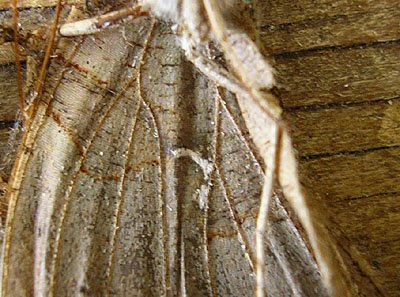
After I pulled the spider-bundle apart, and teased open the wings, there it was, clear as day, a question mark. This is, then, a specimen of Polygonia interrogationis, the Question Mark butterfly. (See Bev of Burning Silo's photo of an Eastern Comma, showing the comma, here.)

I'm sure that this is not the butterfly I'd photographed earlier. Its hindwing, top side, was not nearly as dark, and its colours not so rich. And the webbing it was wrapped in was pretty grubby, as if it had been hanging around for a while. So all that this find establishes is that there are Question Mark butterflies around here.

Saturday's live punctuation butterfly--turned headside up

But John of A DC Birding Blog left a comment on the earlier post to say that the markings on that living butterfly indicated Question Mark, not Eastern Comma. I quote:
According to Kaufman's butterfly guide, Question Marks have a black dash near the tip of the forewing on the top side, but Commas lack this dash. Both Commas and Question Marks have a series of three black dots together in the middle of the forewing. The Question Mark's black dash is just to the outside of this trio. Your butterfly has it, so I would say Question Mark.

Now I must go out and look for an Eastern Comma...

Saturday, July 29, 2006

Question Mark or Comma?

Not a question that comes up a lot--usually it's pretty clear when a question mark is required, even if I slip up on the blog sometimes. Found a butterfly this morning clinging onto an iron lamp in the garden. Grabbed the best picture I could (sometimes a subject just won't stay still), but didn't get the picture I need as it turns out. I have a couple of baby guides to butterflies and moths. One didn't have this butterfly at all. The other (Peterson First Guides: Butterflies and Moths) led me to identify it as a Question Mark (Polygonia interrogationis), so called because of a mark on the underside of its hindwing.
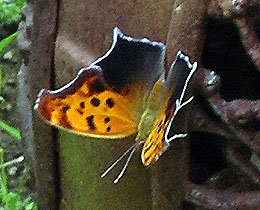

With my success in identifying the Milbert's tortoiseshell, and now this, I felt like I was on a roll. Then Googling around on the internet I discovered that there are two very similar butterflies, Question Mark and Eastern Comma (Polygonia comma). The best distinguishing feature between them is that little mark on the underside of the hind wing. (See here for Bev of Burning Silo's excellent photo showing the underside of an Eastern Comma's wing.) Oh sure, the Question Mark is bigger, and the markings on the top side of the wings are subtly different. But I only know this butterfly was an impressive size not whether it falls to one side or the other of the given ranges: 45-68 mm for the Question Mark, 37-56 for the Eastern Comma. The other distinguishing feature is "the long, violet-edged hindwing tails" of the Question Mark. That sounds more helpful, but my butterfly seems to have a bit more tail than the Comma at Butterflies of Canada, and less than the Question Mark there. Their Comma is missing the pale edging of the Question Mark, and mine has it--but the text warns that this may be seen in a Comma.

Also according to the species page for the Question Mark at Butterflies of Canada: "The summer generation (form "umbrosa") is darker; the hindwing upperside is almost black, and the underside is more heavily marked than in the overwintering generation." Which is certainly true of this specimen. And of course, it's also true of the Comma.

So this is definitely a summer generation Polygonia, possible comma, possible interrogationis. I think it's probably Polygonia comma....

Just like learning to identify birds, once you start to look at the butterflies, there's so much to see. And there's so much to learn--I learn something more every time I grapple with an identification. I'll know this butterfly (i.e., these butterflies) if I see it again, and know I've got to get a look at the underside of the hind wings!

Friday, July 28, 2006

Flower Danger

A few days ago I read a very interesting post at Burning Silo about little critters called Ambush Bugs, or phymata (meet the phymata, and see also more on the phymata). Bev has some fantastic photos of these things--they look like dinosaurs, but so tiny. They hide in flowers and ambush prey many times their size. In the post and comments Bev suggests checking yarrow, Queen Anne's Lace, and some other flowers for them, and that the easy way is to scan for larger insects in odd postures. So I went out to look.

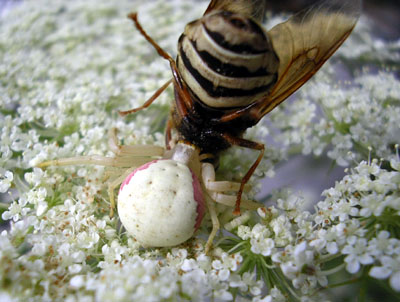
What's that wasp doing?

A big beautiful Queen Anne's Lace has volunteered itself in a garden bed just in front of the house. Very hot day yesterday (and probably again today), humid and smoggy, so I was pleased to find something interesting so close. Walked over to take a look.

That's no phymata.

A flower crab spider (probably the goldenrod, Misumena vatia) had a good hold of the much larger wasp. I wrote about these spiders in Rugosa Drama, a story about their activities on the big Rosa rugosa alba in front of the house. There are only a few blossoms on the rose now, but apparently no end to the opportunities in the garden for ambitious ambush predators.

Submitted to Friday Ark #97

Thursday, July 27, 2006

Urban Wildlife: Celebrity Edition

Michael, my friend and source of news about the wildlife of the big city, Toronto, sent me a picture today of a famous Black-crowned Night-Heron (Nycticorax nycticorax), known as Charlie or Oscar. According to the National Post (story here), this bird has been coming back to Toronto for several years, and consorting with, that is, taking handouts from, people recreating at Harbourfront. There was a gentleman sitting on the ledge next to the bird at the time the picture was taken, feeding it bits of meat or fish from a sandwich.

Photograph courtesy of Michael Solomon

When I lived in Toronto I saw Night-Herons regularly, but they're a rare sight for me now. I was very pleased to see a pair when I was staying down in Prince Edward County in May, both perched in trees and flying overhead. It never occurred to me to offer them hotdogs.

As John of A DC Birding Blog says, in his species account, Birds of the Mid-Atlantic #12: Black-crowned Night-heron, they are particular about habitat. While not a common bird in Ontario, the Ontario Breeding Bird Atlas (preliminary data) records this bird as a breeder in several locations in southern Ontario, most in proximity to one of the Great Lakes, as shown on this map.

Submitted to The Friday Ark. Head on over and see who else is on board this week.

Tuesday, July 25, 2006

Bumblebee (Or mimic?) on Scat

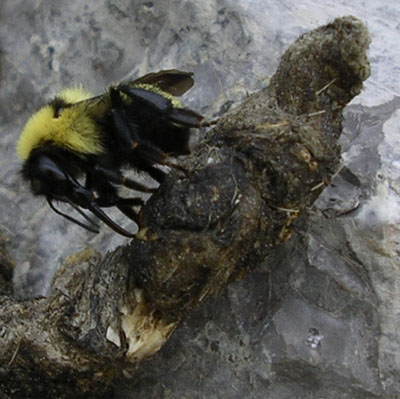
Whose scat? Not large, canid-like, deposited on top of a large rock. I noticed it from a distance (good eye for scat), and expected to see raccoon scat, because of the prominent placement. But lots of critters like to advertise. I think it is probably fox scat, but could be coyote. You can see small animal bone and hairs in it.


The bumblebee is medium size, not as big as the big fat ones that roll in the rugosa blossoms, or as small as the little ones that came to the honeysuckle when it was in bloom. Unfortunately the picture doesn't show the squared-off looking back end. The mouth parts, or whatever they are, are quite fearsome looking. A quick search didn't turn up any scat-eating bumblebees, and I didn't know how else to look, so I don't know what kind of Bombidae this might be.

Bev at Burning Silo has a post about bumblebees here, where she talks about the great variety in the family (and has marvellous pictures of a couple of examples). She doesn't mention this behaviour, but does direct the bee-curious to an identification page, here. So I went to take a look. There's a lot to learn about collecting the field marks of bumblebees.

The mouth parts, or proboscis, or whatever, kept bothering me. It's not unusual that I'm surprised by what I see in a macro photo, but really, do bees look like that? I Googled "bumblebee mimcs." Came up with a bunch of insects, nothing as bumblebee-like as this one. It's a bumblebee.....isn't it?

Added later: The more I look at this photo, the more I doubt that this is a bee (hence title change). More research but still no answer....watch for updates, or if you know what has a face like this critter, please leave a comment.

Sunday, July 23, 2006

Milbert's Tortoiseshell

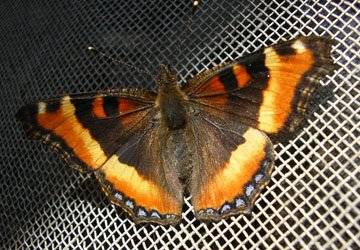
This morning a very pretty butterfly spent some time on the screen door, giving me a very good look. My only complaint was that it refused to pose in the full sun (got just the one shot of it partly in the light).

Note the white at the tips of the antennae

Turns out it is a not uncommon butterfly, known as Milbert's tortoiseshell (often written "Tortoise Shell"), Nymphalis milberti. It occurs all across Canada, south of the tundra, and feeding mostly on sap, rotting fruit and dung. Its larvae feed on stinging nettles--which doesn't sound too nice, but according to this page (scroll down, scroll way down, to "Vanessa species Caterpillar") at What's that Bug many caterpillars in the genus Vanessa go for nettles. It seems that nettle-eating is common among the larvae of the family, Nymphalidae, to which both Vanessa and Nymphalis belong. And, of course, some humans eat them too.

Wing detail