Showing posts with label Friday Ark. Show all posts

Friday, August 24, 2007

Friday Hornworm

I found this on a baseball cap that was lying on the floor on the porch. On disturbance it started motoring along the concrete floor towards the wall of the house. That didn't seem good, so I encouraged it to climb onto a maple leaf also lying there and moved it into the garden. Then I went into the house to try to find out what it was--it was gone when I returned.

Hemaris diffinis
Pretty caterpillar, on a leaf not of its own choosing

I knew on sight that it was a hornworm, but what kind? I consulted BugGuide.net, of course, and scanned through the hornworms there. Turns out, it is most likely a Snowberry Clearwing (Hemaris diffinis) larva, not entirely of the brown form, nor of the regular green (see this page showing different colour phases of this caterpillar). It has the yellow at the base of the horn, and around the "neck," and the black dots that seem to define this species. Interesting because I've never been sure whether I've seen diffinis, or whether all the clearwings I've seen have been the very similar Hemaris thysbe. And now I have good reason to believe that the Snowberry does come around here.


Join us on the Friday Ark!

Friday, August 17, 2007

Friday Spider

Now that the goldenrod is blooming I've been looking for a yellow goldenrod crab spider doing what its name suggests it should. This morning I found one, mature, yellow and working the goldenrod--just in time to board the Friday Ark.

Misumena vatia and prey
If it hadn't been for the fly in her jaws I probably wouldn't have seen her.

Friday, August 10, 2007

Friday Walkingstick

This pretty creature visited the porch the other day, and happily walked all over my hands. If only macro shots of my hands were more flattering I'd post one here. Instead, here it is walking on the edge of the arm of a Muskoka chair (called south of the 49th parallel an Adirondack chair).


Much more delicate than the brown Northern Walkingsticks (Diapheromera femorata) I posted about last year (Walking Stick Love), when I coaxed this one into some foliage in the front garden it disappeared into it, its colour and shape being such excellent camouflage. Not so much a walkingstick as a walking blade of new grass, or walking stem.

Based on this page at BugGuide, I think this is probably an immature Diapheromera femorata. Based on that and on the fact that there aren't very many species of walkingstick this far north, and this is the most common. Interesting the difference in colour between this and the adult form--suggests to me the possibility that diet changes as life progresses, taking the insect into different habitats.

I hope its cryptic colouration will keep it safe on the Friday Ark.

Friday, July 06, 2007

Friday Hairstreak


I'm pretty sure that this is the Acadian Hairstreak (Satyrium acadica). I would be absolutely sure except that the underside of the wings of this butterfly look more light brown than grey (a feature of the Acadian) to me. Pretty butterfly in any case--and to identify a hairstreak at all is new for this novice butterfly watcher.

Like so many other critters, this butterfly was found feeding on common milkweed (Asclepias syriaca), which is just now coming into bloom. In Ontario common milkweed is one of twenty-four species on the noxious weed list--a kind of hit list. The Ministry has this to say:
Milkweeds are an important component of the native and naturalized vegetation communities of Ontario as they are an important nectaring plant for many species of Lepidoptera, such as the Monarch butterfly. (From Milkweed Species in Ontario)

Then on their FAQ page they add this:
Why is Milkweed on the List of Noxious Weeds in Ontario?

Common milkweed can be a very difficult weed to control in many field crops thereby causing significant reductions in crop yield and quality. This can have a considerable negative impact to a grower's net economic return. In the last 10 years, new herbicide technologies have greatly improved the control of common milkweed in field crops. However control of common milkweed around field borders is essential as it minimizes seed spread into fields and therefore reduces the reliance on herbicides for "in field" control.

Common milkweed when consumed in large quantities is poisonous to livestock. Therefore minimizing populations in actively pastured land will greatly reduce the chance of any adverse health affects to livestock.

For more information on Milkweed and the Weed Control Act, refer to the article entitled: "Milkweed Species in Ontario".

Which is yet another example of us humans getting hold of the wrong end of the stick it seems to me. Especially in the current climate in which we are engaged in international efforts to protect the Monarch Butterfly, which depends on milkweed as the foodplant for its larvae.

Here's what they have to say about Monarch protection at the Royal Ontario Museum's Species at Risk site:
Protection: There is no formal protection for this species in Ontario. Three key management strategies have been identified to protect the Monarch Butterfly. Milkweeds, the larval foodplant, should be taken out of the noxious weed acts in Canada; native wildflower habitat should be protected and encouraged; and migration stopover sites should be protected from disturbance.

Meantime I'm sending this butterfly to board the Friday Ark

Friday, June 15, 2007

Friday Bee Blogging

The more I look at bumblebees the more apparently different species I find. Amazing! Below are three more I've managed to get photos of recently.

Bumblebee on raspberry flowers last week


Bumblebee on Rosa rugosa alba today--they love this rose!


Bumblebee on the wild bleeding heart (Dicentra eximia).

I think the last one is the same species as a couple that turned up in the house earlier in the season. Big, biggest of the three, all yellow back, noisy, scary. I've been trying to get a picture of one of these bees for days. Couldn't get a good shot of the back, but am publishing anyway!

And preparing to board the Friday Ark. Drop by to see who else made it on board.

Friday, May 25, 2007

Dolomedes triton--NOT!

Correction

I try to be careful--but sometimes I'm not--and then even if I'm corrected, a misidentification may persist forever in the Google cache.

I've adjusted the text below, and the title, in response to the comment Bev of Burning Silo kindly left on this post, pointing out that this is another spider altogether--probably a Pisaurina mira. The linked page includes a photo of what I think is a female of this species. Mine was probably a male, given the clubbed appearance of the palps.

Back in April, as described in this post, I found a spider on the kitchen floor that was identifed for me as a Dolomedes triton (six-spotted fishing spider). Well, that's crazy. What would a fishing spider be doing in my kitchen?

Pisaurina mira
Fishing (?) in the kitchen sink

Then the other morning I found the critter above--same similar markings (though the white strip around the body doesn't show as well in this photo, it was there in life), but bigger, and in a posture I associate with the watery spiders. One difference is in the shape of the marking outlining the body, not the crisp line of the Dolomedes triton, but a more scalloped affair. In the earlier post I mentioned that I thought that this is a familiar spider around the house.....I guess I was right. Familiar yes, in the sense that there are many species in and around the house, and some are vaguely alike. but this one is not Dolomedes triton.

Dolomedes triton is one of the spiders being recorded in Spider WebWatch, so I take this as a sign that I really must sign up and submit the record be more careful when I identify a spider, and not jump to hasty conclusions before 6:00 am (or even later in the day!).

Spider WebWatch

Burning Silo has an excellent post from earlier this year with photos and accounts of a number of quite beautiful spiders in the genus Dolomedes.


And since it's Friday: All aboard the Friday Ark!

Friday, May 18, 2007

Becoming

Courtesy of Bill Newman, a Scarlet Tanager (Piranga olivacea) transitioning into breeding plumage:


Singing:


All aboard the Friday Ark

Friday, March 23, 2007

Friday Turkey

Jake in the Yard (courtesy of Bill Newman)


All aboard the Friday Ark!

Friday, October 13, 2006

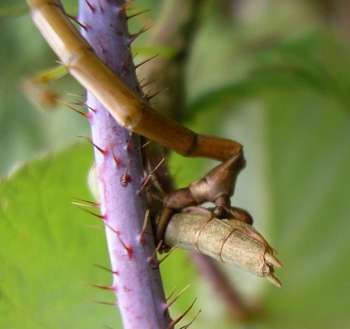
Walking Stick Love

Lost in a folder marked "Sept18-flora," these images of northern walking sticks (Diapheromera femorata) I came upon cavorting in a raspberry patch. I was following a butterfly at the time, when the sight of three walking sticks in the canes stopped me. As I approached, gingerly, one of them dropped away, leaving two, busily engaged. I couldn't see for sure what was going on, but I photographed it as best I could, avoiding thorns and not wanting to disturb them if I could avoid it. As it happened, they didn't pay any attention to me.


Mating sticks


Back in August there was a walking stick hanging around on the patio.

Posing on the handle of a butterfly net

I did a little research, and oddly enough a lot of pet sites popped up. Also the comforting information that there is only one walking stick, the northern, likely to be found in my neighbourhood (so unlike the case of the bees and wasps!). In French they are known as bâtonnet ordinaire.

All aboard the Friday Ark!